



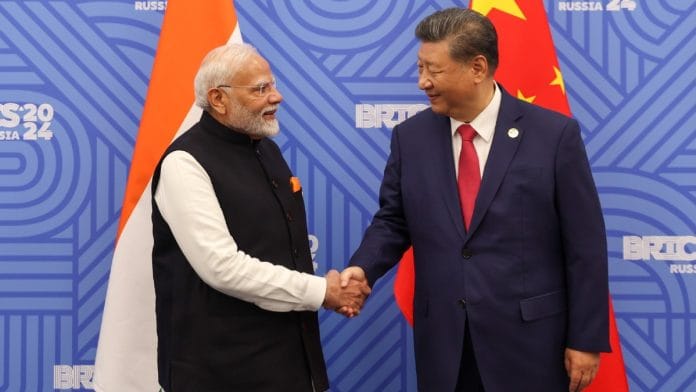

New Delhi: Prime Minister Narendra Modi made “suggestions” on “improving and developing” bilateral ties with China, which Chinese President Xi Jinping “agreed to in principle” during their meeting Wednesday in Russia, according to Beijing’s readout of the discussions.
“The two leaders commended the important progress the two sides had recently made through intensive communication on resolving the relevant issues in the border areas. Prime Minister Modi made suggestions on improving and developing the relationship, which President Xi agreed to in principle,” said the Chinese ministry of foreign affairs.
The meeting—the first full bilateral between the two in five years—saw the leaders spend close to an hour discussing the situation at the border, while also reviewing other aspects of ties from a “strategic” perspective.
The readout from the Chinese foreign ministry relegated the issue of the border to the fifth paragraph, while for India it was the first.
Differences in readouts are common, especially as every country has its own views on what was discussed, and the importance of any issue can be perceived differently by either side. It is quite common to see differences in readouts during high-level meetings between India and China.
For China, the readout highlighted issues raised by President Xi, focusing on strengthening communication and enhancing mutual trust between the two countries, each with a population of more than 1.4 billion people.
“The two sides should strengthen communication and cooperation, enhance strategic mutual trust, and facilitate each other’s pursuit of development aspirations. The two countries must also shoulder their international responsibility, set an example in boosting the strength and unity of developing countries, and contribute to promoting a multipolar world and greater democracy in international relations”—this is how the Chinese readout began.
The emphasis was on the fact that Xi had pushed for both countries to look at each other as a “development opportunity” rather than a threat to one another.
A look at the Indian readout indicated the focus for New Delhi: solving the border situation at the Line of Actual Control (LAC) and restarting the high-level dialogue.
Ties between India and China had particularly hit a rough patch after the military confrontation at Galwan in June 2020. The clashes, which occurred a few months after Xi visited Mamallapuram in Tamil Nadu for the second India-China informal summit, led to an immediate chill in ties at the height of the COVID-19 pandemic.
Barring a couple of brief exchanges on the sidelines of the G20 Leaders’ Summit in Bali in November 2022, and on the margins of the BRICS summit at Johannesburg in August 2023, the two leaders and their respective governments did not meet regularly in the past four-and-a-half years.
However, External Affairs Minister S. Jaishankar met with his counterpart Wang Yi twice this July—at the Shanghai Cooperation Organisation in Astana, and on the sidelines of ASEAN meetings in Vientiane, Laos.
Subsequently, National Security Adviser Ajit Doval held a meeting with Wang in September on the margins of a BRICS conclave.
As diplomacy gathered pace, other mechanisms to resolve the border standoff started operating as well, which led to the final arrangement on patrolling along the Line of Actual Control—announced by India Monday and confirmed by China Tuesday.
(Edited by Tikli Basu)
Also read: Modi and Xi meet in Russia, talks focus on thaw in ties, resolution of LAC standoff