





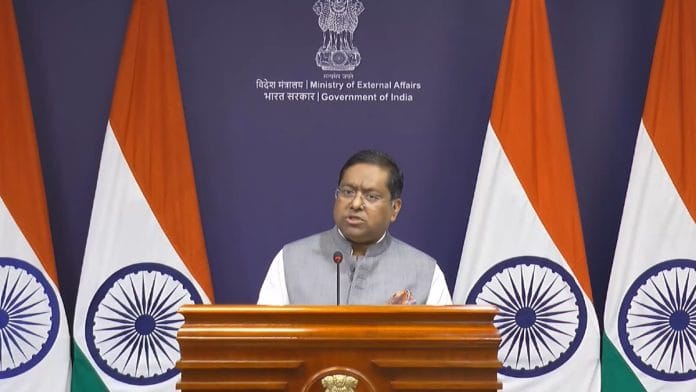


New Delhi: As voting got underway this week in Pakistan-occupied Kashmir (PoK), the Ministry of External Affairs (MEA) Tuesday dismissed the exercise altogether, calling it a “cosmetic electoral exercise”.
“The current cosmetic electoral exercise is nothing but an attempt by Pakistan to camouflage its illegal occupation and hide its grave human rights violations in the region…,” MEA spokesperson Randhir Jaiswal said at a regular press briefing.
“We have seen reports regarding the so-called legislative assembly elections being conducted in Pakistan-occupied Jammu and Kashmir (PoJK). India’s position on this matter is consistent, clear, and well-known. The entire Union Territories of Jammu and Kashmir and Ladakh, including the areas currently under Pakistan’s illegal and forcible occupation, are integral and inalienable parts of India,” he added.
The Indian government’s rebuke came as the first phase of the vote unfolded amid deadly street protests, mass arrests, a ban on a leading civil-society movement, and a boycott by the Imran Khan-led PTI that won the previous election. Voting is being held in three phases for the first time in the territory—a change PoK poll panel chief Ghulam Mustafa Mughal said was necessary to allow the Pakistan Army to be deployed for security at each stage.
While 13 Mirpur division constituencies voted on 27 July, polling in 9 Muzaffarabad division seats and all 12 refugee constituencies will follow on 2 August. The 11 constituencies of Poonch division, hit hardest by the latest unrest, will vote on 10 August.
Former Prime Minister Imran Khan’s Pakistan Tehreek-e-Insaf (PTI) chose to boycott the contest, saying it saw little prospect of a free and fair vote.
A political dispute over legislative representation has erupted into one of the deadliest episodes of unrest in the occupied territory in decades, with at least 15 people killed and 70 injured, according to reports in local media.
The Jammu Kashmir Joint Awami Action Committee (JAAC), an umbrella outfit of various interest groups, has also called for a boycott of the elections amid mass detentions.
Roughly 14,000 police personnel from Pakistan’s Punjab have been deployed across PoK to oversee the polls.
Tensions had been building for weeks ahead of JAAC’s planned march on Muzaffarabad on 9 July to demand withdrawal of 12 seats in the PoK Assembly reserved for refugees who settled in Pakistan after 1947. JAAC leaders argue that the seats allow Pakistan’s major political parties to exert disproportionate influence over the territory, Dawn reported.
Amid concerns, the PoK administration on 5 June designated JAAC a prohibited organisation under anti-terrorism laws, alleging that it was engaged in activities threatening public order and security.
Although Pakistan exercises effective control over the territory, it has structured it with the trappings of a separate, self-governing entity with its own legislature, its own prime minister, its own constitution—a framework meant to project autonomy even as key powers remain with Islamabad. Day-to-day matters such as healthcare and education fall to the elected territorial administration, but Pakistan’s federal authorities retain control over defence, foreign policy and core constitutional questions touching Kashmir.
The PoK Assembly currently has 53 seats, expanded from 49 in 2021, when 4 new seats were added—one each to Muzaffarabad, Neelum, Sudhnoti/Poonch and Kotli to reflect those district’s demographics, raising the majority mark from 25 to 27.
Of the 45 directly-contested seats, 33 represent constituencies inside the territory itself. The remaining 12 are reserved for people registered as refugees who resettled in Lahore, Rawalpindi, Gujranwala, Faisalabad and Sialkot; despite living far outside the territory, those voters elect representatives to the PoK Assembly.
A further eight seats—five for women, one each for a technocrat, a religious scholar and an overseas Kashmiri—are allocated after the general election based on each party’s strength in the new National Assembly.
This time, more than 3.8 million voters are registered in PoK, up from about 3.2 million in 2021, with roughly 439,000 of them in the 12 refugee constituencies.
Economic grievances have also compounded the political dispute. Rising electricity prices, unemployment and inflation have fed public anger, with many residents demanding a larger share of revenue from regional hydropower projects.
(Edited by Amrtansh Arora)
Also Read: Violence mars Pakistan-occupied Kashmir polls. What’s at stake & why it’s an Islamabad-backed farce