


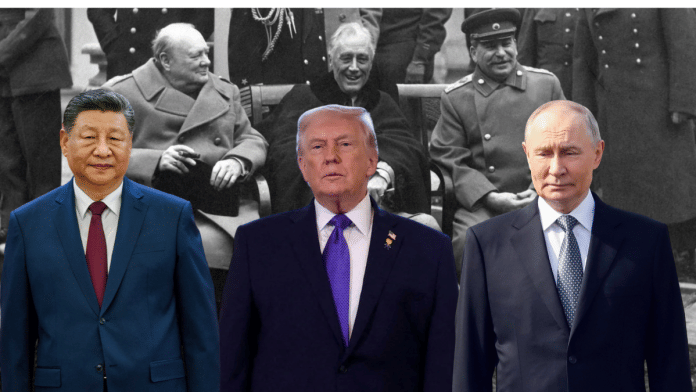
New Delhi: Donald Trump, Xi Jinping and Vladimir Putin will meet for the first time ever in a trilateral summit at Shenzhen Thursday. The meeting between the presidents of the US, China and Russia is being dubbed the modern version of the post-war 1945 Yalta conference.
The 1945 Yalta conference in the Soviet Union saw the big 3 Allied leaders—the US, Britain and the Soviet Union—discuss the postwar reorganisation of Europe. Germany was split, the United Nations (UN) was created and Poland and Eastern Europe went on to adopt the Declaration on Liberated Europe to pledge free elections, though subsequent Soviet control laid the bedrock for the Cold War.
For Thursday’s meeting, China’s Foreign Ministry said the leaders would exchange views on safeguarding world peace and promoting strategic stability in relations among major powers. The meeting will take place alongside the 33rd Asia-Pacific Economic Cooperation (APEC) Economic Leaders’ Meeting, which China is hosting in Shenzhen on 18 and 19 November. It is separate from APEC’s formal proceedings.
Trump has said the meeting would give the three leaders an opportunity to discuss his proposal for a trilateral agreement on their nuclear arsenals and the US-Iran war. All three countries are permanent members of the United Nations Security Council and possess nuclear weapons.
The last nuclear arms control agreement between Washington and Moscow, known as New START, expired in February, lifting limits on the world’s two largest nuclear arsenals for the first time in more than half a century. Trump had rejected Russia’s proposal to extend the treaty by another year, instead calling for a “new, improved and modernised” agreement that would also include China.
Moscow has expressed interest in discussing Ukraine, while Washington has suggested that the war is not the principal purpose of the meeting. A senior US official told The Associated Press that Trump would raise the Iran war with Xi and Putin but would avoid discussions on Ukraine.
Beijing, meanwhile, has been reluctant to be drawn into nuclear negotiations on terms it considers unequal.
The US and China are also working on an agreement on military crisis communication and accident prevention ahead of the summit in Shenzhen, South China Morning Post reported Sunday. The proposed agreement, first discussed after Xi’s September visit to Washington, aims to strengthen communication and prevent military miscalculations. However, disagreements between the Pentagon, White House and State Department over its scope have complicated negotiations.
Also Read: Beijing is bringing Trump and Putin together. The Chinese say it’s a major diplomatic milestone
Why Yalta is being invoked
Yalta was the second major wartime meeting of the so-called Big Three, following the Tehran Conference in November 1943. It would be followed by the Potsdam Conference in July 1945. But even before the leaders arrived in Crimea, the groundwork for disagreements had been laid. In October 1944, Britain’s then Prime Minister Winston Churchill and Soviet General Secretary Joseph Stalin had held talks in Moscow, without US President Franklin D. Roosevelt, and reached an informal understanding on Western and Soviet spheres of influence in Europe.
The idea of another summit had come from Roosevelt, who initially wanted the leaders to meet before the US presidential election in November 1944. He pushed for an early-1945 meeting at a neutral location in the Mediterranean. Malta, Cyprus, Sicily, Athens and Jerusalem were among the places considered.
Stalin was not impressed. Citing his doctors’ advice against long journeys, he rejected the proposed locations and suggested Yalta instead. His reluctance to fly also helped settle the question of where the three leaders would meet and the conference was finally held on 4-11 February 1945.
Once assembled, the Big Three found that they were not quite on the same page. Roosevelt wanted Soviet support in the Pacific war against Japan, including a commitment to join the fighting, as well as Moscow’s participation in the proposed United Nations. Churchill wanted free elections and democratic governments across Central and Eastern Europe, particularly in Poland.
Stalin had a different priority—securing a Soviet sphere of influence in Eastern and Central Europe. He viewed the region as essential to the Soviet Union’s security, given its history of invasions through the area. With Soviet forces already advancing deep into Europe, he also arrived from a position of considerable military strength.
The Soviet Union wanted to retain the eastern Polish territories it had lost during the Polish-Soviet War, with Poland compensated through territorial gains at Germany’s expense in the west. Stalin also made clear that the demands of the Polish government-in-exile were not open to negotiation.
Roosevelt, meanwhile, was looking east. He wanted the Soviet Union to enter the war against Japan after Germany’s defeat, hoping that its involvement would shorten the conflict and reduce American casualties.
Stalin agreed to join the Pacific war three months after Germany’s defeat, but not without securing concessions. Moscow sought US recognition of Mongolian independence from China, as well as recognition of Soviet interests in the Chinese Eastern Railway and Port Arthur. It also wanted South Sakhalin, lost to Japan in 1905, and the Kuril Islands.
Korea, however, received a rather different kind of attention. Although its future was not formally recorded among the conference’s main agreements, declassified documents later revealed that Roosevelt and Stalin discussed the peninsula privately on 8 February, while Churchill was absent.
Germany’s future was another major item on the agenda. The three leaders agreed on occupation zones for the defeated country, with each of the principal Allied powers receiving one. France would also get a zone carved out of the American and British sectors.
Churchill argued that France should have a full place on the proposed Allied Control Council for Germany. Stalin initially resisted but relented after Roosevelt backed the British prime minister. But the leader of the Soviet Union continued to oppose full French membership of the Allied Reparations Commission, a position he would soften only at Potsdam.
The leaders also agreed that governments displaced by the war should generally be restored in liberated countries. Poland, Romania and Bulgaria were exceptions to this understanding, with Stalin refusing to accept the claims of their governments-in-exile.
The United Nations fine print
Yalta also helped shape the institution that would become the United Nations. The Soviet Union agreed to join, following an understanding on the voting system that gave the permanent members of the Security Council veto powers. In practice, that meant each could block decisions it opposed.
West Asia also found a place in the discussions. Roosevelt supported the idea of establishing a Jewish state in Palestine, arguing that it could advance social justice and improve living standards. His position faced opposition from Saudi King Ibn Saud.
Before the conference, US Secretary of State Edward Stettinius Jr. had cautioned Roosevelt against making decisions on Palestine without considering British and Soviet positions, warning that Moscow could use the issue to expand its influence in the region. He urged an approach that took account of both Arab and Jewish interests.
At Yalta, Stalin did not object to Roosevelt’s position, while Churchill offered informal support in exchange for avoiding a discussion on Britain’s 1939 White Paper on Palestine.
By the time the conference ended, the three leaders had agreed on occupation zones for Germany, arrangements for the Soviet Union’s entry into the war against Japan, and the broad framework of a new international organisation. But they had also left unresolved the question that would come to define the next decades—how much freedom would countries in the Soviet sphere actually have to determine their own futures?
Within a few years, the wartime alliance would give way to the Cold War, and Yalta would become shorthand for the great-power bargaining that helped divide Europe.
Yalta was not, strictly speaking, a formal agreement to divide the entire world into spheres of influence. Its reputation comes from the decisions taken by three powerful countries about the political future of territories whose populations had little say in the negotiations. For countries in Eastern Europe, particularly Poland, Yalta became synonymous with the compromises made by Western powers at the expense of smaller nations.
Why the Yalta comparison may not hold
Not everyone is convinced that the Shenzhen summit represents the beginning of a new great-power settlement. The strongest argument against the analogy is that the international landscape today is considerably different from that of 1945. The countries that might be affected by any agreement are not necessarily powerless spectators.
An analysis in Foreign Affairs, an American journal, post the mid term Republican rout had suggested that Trump could attempt to create a great-power forum involving Washington, Moscow and Beijing, through which the three countries might coordinate their approaches to global order. Yet it also questioned whether such meetings would produce meaningful results, given Russia and China’s limited interest in the proposed trilateral nuclear framework.
The historical comparison also has its limitations. In 1945, the Soviet Army already occupied much of Eastern Europe, giving Stalin considerable leverage over the post-war settlement. Historians have also pointed to the informal Churchill-Stalin ‘percentages agreement’ of October 1944 as an important precursor to the division of influence in Europe.
Ukraine, despite the destruction caused by Russia’s invasion, has continued to resist Moscow militarily and diplomatically. European governments have also sought to assert their role in negotiations concerning the continent’s future.
An example of this was the assertion by Poland’s deputy prime minister and foreign minister Radosław Sikorski last month that the original Yalta conference had recognised Soviet domination over territories controlled by the Red Army, whereas Putin now wanted Ukrainian territories he had failed to conquer to be handed to him as a gift.
Ukraine foreign minister Andrii Sybiha reiterated the same in a post on X on Sunday and wrote, “Putin is floating ideas for redrawing Europe’s security order. In his dreams, he sees himself at Yalta in 1945. The problem is, to propose ideas on that scale, you first need to win a world war.”
Putin is floating ideas for redrawing Europe's security order. In his dreams, he sees himself at Yalta in 1945. The problem is, to propose ideas on that scale, you first need to win a world war.
Last time I checked, Russia had spent four years and eight months "nearly capturing"… pic.twitter.com/uatpa85qUs
— Andrii Sybiha 🇺🇦 (@andrii_sybiha) November 15, 2026
He added, “At this stage, the most Putin can negotiate is a fair ceasefire along the current line of contact, not spheres of influence in Europe. Frankly, Europe does not need a new security order. It already has one, which Russia keeps violating. The best plan for a safe and free Europe is to end Russia’s aggression against Ukraine.”
At an informal European Council meeting in Dublin on 13 November, European leaders discussed a coordinated role in the peace process. European Council President António Costa outlined a proposed negotiating group involving EU institutions and France, Germany, Italy, Poland and the UK, stressing that European and Ukrainian security were inseparable.
The Yalta analogy, however, has also been amplified by Kremlin-aligned commentators, who see the proposed gathering in Shenzhen as recognition of Russia’s status alongside the world’s other major powers.
Vladimir Medinsky, Russia’s chief negotiator in Ukraine peace talks, last week proposed a “new, modern Yalta” as the basis for European security.
Here is the unedited translation of what Russia’s chief negotiator Vladimir Medinsky told Russian state TV today.
Q: A significant part of the territory of Kharkiv Oblast and other regions is currently under Russian control. Were exchanges of these territories discussed during… https://t.co/inUA6UDdqC
— Liza Fokht (@lizafokht) November 11, 2026
China, however, has previously maintained that Europe should participate in discussions about Ukraine. Any attempt to negotiate a settlement behind Europe’s back would therefore not sit well with Beijing’s stated diplomatic position.
Further, the US continues to share intelligence with Ukraine, including those used for strikes against Russian targets inside Russia. It has also maintained its military commitment to NATO’s eastern flank, with plans for a permanent American military presence in Poland.
On Taiwan, Trump’s approach has been ambiguous and the administration has also approved substantial arms sales to the self-governing island. Iran offers another complication. America’s decision to wage war against Iran, rather than recognise it as belonging to another power’s sphere of influence, is difficult to reconcile with a straightforward spheres-of-influence framework.
It is what analyst Daniel DePetris argued, “The “Trump-Xi-Putin summit is a Yalta 1945 redux” is so massively overplayed that we should probably stop saying it. The Yalta framing only passes muster if Trump is actually interested in carving up the world into spheres-of-influence. There’s not much evidence this is true…It’s hegemony in action. Settle down.”
The "Trump-Xi-Putin summit is a Yalta 1945 redux" is so massively overplayed that we should probably stop saying it.
The Yalta framing only passes muster if Trump is actually interested in carving up the world into spheres-of-influence. There's not much evidence this is true.…
— Daniel DePetris (@DanDePetris) November 16, 2026
(Edited by Chingkheinganbi Mayengbam)
Also Read: Trump pushes AI, military cooperation at Quad summit; India pushes safety of seafarers