


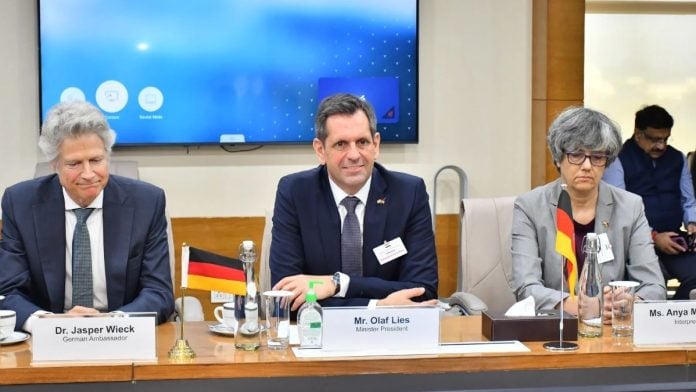
New Delhi: The signing of India’s Free Trade Agreement with the European Union (EU) next month will unlock investment opportunities for German automobile manufacturers, such as Volkswagen, in India, while allowing Indian businesses to collaborate with German firms, said Olaf Lies, the Minister-President of the German state of Lower Saxony Monday.
Speaking to ThePrint, Lies, who is on a three-city visit to New Delhi, Pune and Mumbai, highlighted that the opportunities for businesses—especially in the automotive sector, chemicals and pharmaceuticals, and artificial intelligence—once the free trade agreement is operationalised would be significant. The Minister-President (equivalent to Chief Minister of a state in the Indian system) also highlighted the possibility of an enabling environment for skilled labour and mobility of Indians within the state.
“I’m confident that (the FTA) will be signed at the end of the year. And I’m hopeful that the next steps will follow very quickly because we are really interested in this collaboration. Companies from Lower Saxony will invest here in India because it makes sense that we cooperate on production in Lower Saxony and production here in India,” said Lies.
He added: “Today, we talked about hydrogen production here in India, which makes sense, because we need a lot of hydrogen in Europe and in Germany. It makes sense to manufacture it here (India), and to transport it to Lower Saxony, and then to the gas port of Wilhelmshaven.”
Pointing to the already existing cooperation in the automotive industry for example, Lies highlighted the Volkswagen plant in Pune, and how it is important for businesses from Lower Saxony to be “located here in India for production of cars for the Indian market”, and potentially for exports to third country markets as well.
Volkswagen, the German automobile giant and the world’s second-largest car manufacturer, is headquartered in the city of Wolfsburg in Lower Saxony. It posted its worst quarterly results last month, in over a decade, with losses amounting to around $6.6 billion. The company expanded heavily into China at the turn of the century.
However, it has been grappling with a shrinking market in China over the last few years, and is currently undergoing one of the largest restructuring plans in its history. The company has been overtaken by Chinese electric vehicle manufacturers, such as BYD, in recent years.
In comparison, the group has barely any presence in India, with roughly a two percent market share across all its brands in the South Asian country’s market.
While challenges faced by the company are markers for larger issues facing German industry, Lies noted that the opportunities in India include downstream impact, such as “suppliers necessary” to build the cars, who could benefit from the deal.
“I’m very hopeful that the field of artificial intelligence becomes more and more important because if you see Germany with the machine industry, it’s really a precision industry and if you combine precision industry with artificial intelligence, it becomes important for industry all over the world,” he added, while commenting on other sectors that could benefit from the overall deal.
He also pointed to “chemical industry and pharmaceutical industry” as other sectors that could benefit from investing in Lower Saxony. The state is the fourth largest economically within Germany, with a gross domestic product of roughly $417 billion, as of 2024.
Also Read: Defence, semiconductors, Ukraine war dominate India-Netherlands talks as Dutch FM meets Jaishankar
‘Need skilled migration’
The Minister-President also talked about the other reason for his visit, which is to promote the migration of skilled workers to the state of Lower Saxony. With over 50,000 Indians studying in the country, Germany has become increasingly important for Indian students.
“One of the reasons I’m here is because we are really interested in attracting skilled young people and a skilled workforce from India. We need these skilled migrants in Germany. We need their perspectives, their experiences, we need young people in different sectors like the tourism sector, health sector, but also in the industrial sector, the AI sector,” said Lies.
“There’s no question of whether it is necessary, it’s more a question of whether it’s interesting for young people from India to go to Germany. And that’s why it is important to say they are welcome. We have a difficult situation with some parties saying we don’t need migration. That’s wrong,” he added.
Delving into the current situation in Germany, Lies underlined that the population within the country is becoming “older and older, and if you see the population in India, it’s a really young population,” which is important for the European country.
“I invite them. We are working on a system that makes it easier for young people to learn the language before coming. It’s much easier to be integrated if you know a little more about the language, to learn a little more about the culture,” said Lies.
The Minister-President further highlighted that Lower Saxony, for decades, has been open to migrant workers, adding that the German economy grew in the 1950s and 1960s, largely due to the labour that was coming into the country. The success of Lower Saxony economically through history has been aided by migration, he said.
(Edited by Mannat Chugh)
Also Read: At Purana Qila in Delhi, Pakistan minister invokes ‘Ghalib’, addresses SCO forum in Urdu