


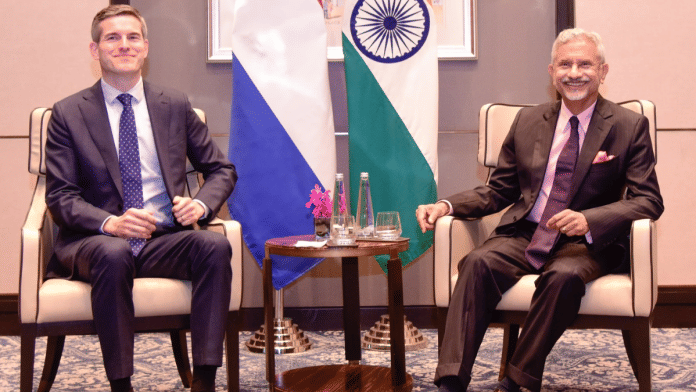
New Delhi: Decreasing dependencies with a focus on defence and economic security is key to the growing strategic partnership between India and the Netherlands, Dutch Foreign Minister Tom Berendsen said in an exclusive interaction with ThePrint on Sunday.
“It is indeed an important step to cooperate on this [defence] issue. Security is, of course, about both defence and industry as well as economic security and how to decrease dependencies. If you want to decrease dependencies, you need new partners. That is the basis of what the Netherlands and India are doing in these sectors,” Berendsen told ThePrint.
He pointed to semiconductors as another strategic sector in which the two countries are looking to deepen cooperation, with both governments working to establish new partnerships.
“Cooperation in the semiconductor ecosystem is not only one of the ambitions of both India and the Netherlands; we also see possibilities of teaming up there and cooperating in this area,” he said.
Berendsen cited the signing of a memorandum of understanding between ASML (Advanced Semiconductor Materials Lithography) and the Tata Group in May to support the establishment of a semiconductor fabrication plant in Gujarat. He described ASML as the “most strategic European company” based in the Netherlands.
Defence and semiconductors also featured in the India-Netherlands Joint Statement issued by Prime Minister Narendra Modi and his counterpart Rob Jetten during the former’s visit to the European country on 16 and 17 May this year.
Berendsen arrived in New Delhi on Sunday for a two-day visit and met External Affairs Minister S. Jaishankar later in the evening. Jaishankar noted that it was his sixth meeting with Berendsen this year, underscoring the deepening relationship between New Delhi and The Hague.
“Our ties have now been elevated to a Strategic Partnership, and the roadmap that we have forged allows us a pathway to proceed forward. What began as a partnership centred on water has expanded into several other domains,” Jaishankar said in his opening remarks. He added that the discussions would cover both traditional areas of cooperation, including agriculture, water and health, and newer sectors such as technology, semiconductors, defence and renewable energy.
Berendsen is scheduled to meet IT Minister Ashwini Vaishnaw on Monday morning before departing the national capital.
During Modi’s visit to the Netherlands earlier this year, the two countries elevated their relationship to a “Strategic Partnership” and signed a letter of intent (LoI) on defence cooperation. New Delhi and The Hague are also working towards a defence industrial roadmap under the broader framework for bilateral cooperation between 2026 and 2030.
The 2026-2030 Roadmap of the India-Netherlands Strategic Partnership outlines plans to “explore avenues on technology collaboration of platforms and equipment” between the two countries’ defence ministries. It also calls for a defence industrial roadmap to promote collaboration between defence industries and research institutions through their respective industry bodies—the Society of Indian Defence Manufacturers (SIDM) and the Netherlands Industry for Defence and Security (NIDV).
The roadmap further proposes examining the feasibility of institutionalising logistical support for military units and formations during training exercises through a Mutual Logistic Support Agreement.
Also Read: Netherland’s first openly gay PM Rob Jetten visits New York’s Stonewall Inn: Why it matters
India’s efforts on Russia-Ukraine war
Beyond bilateral ties, Jaishankar and Berendsen also discussed the global geopolitical situation, including the Russia-Ukraine war. India proposed a partial ceasefire between Moscow and Kyiv to allow the movement of food, fuel and fertilisers through the Black
Sea, where hostilities have intensified in recent months.
Ukrainian Foreign Minister Andrii Sybiha described the Indian proposal as the “broadest” such effort in October. Russian President Vladimir Putin acknowledged India’s initiative in an address to the Valdai Club a few days later.
However, prospects for peace remain uncertain following Ukraine’s successful attack on the Kerch Bridge, which connects Russia to the Crimean peninsula, last week. Putin, speaking to the media in the Chinese city of Shenzhen last Thursday, vowed to respond to the strike, which caused the collapse of a section of the multi-billion-dollar project.
Berendsen said he “highly appreciated” India’s efforts to bring an end to the war, particularly Modi’s calls on Russia to “end the war”. However, he said Moscow had “no real intention” of ending the nearly four-and-a-half-year-long conflict. He added that the European Union’s focus was on imposing sanctions on Russia to ensure that it came “to the negotiating table”.
(Edited by Chingkheinganbi Mayengbam)
Also Read: Adaptability, resilience of farming on agenda for Indo-Dutch talks—Netherlands agri minister