



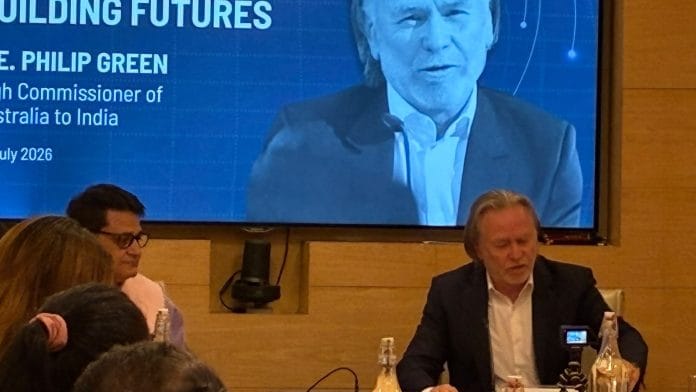
New Delhi: India has become a “top-tier” security partner for Australia, said Australian High Commissioner Philip Green Tuesday, underlining that the recent visit by Prime Minister Narendra Modi to Melbourne has expanded the security relationship between the two countries.
“The two leaders launched a new joint declaration on defence and security, a big upgrade from our previous agreement in 2009. We have identified new areas of partnership, including offshore areas for our aircraft to operate, for better maritime domain awareness,” Green said, speaking at the Observer Research Foundation (ORF) in New Delhi.
“This declaration demonstrates that India is now a top-tier defence security partner for Australia. The two countries have also unveiled a maritime collaboration roadmap. The maritime domain is perhaps the most important in the defence and security sphere. Australia and India can do a lot.”
Modi travelled to Melbourne between 8 July and 10 July and attended the third India-Australia Annual Leaders’ Summit. During the visit, at least 19 agreements were signed between the two countries, including the administrative arrangement for the civil nuclear partnership between New Delhi and Canberra.
Green highlighted that as part of the new defence partnership, the two countries use similar equipment, such as the Boeing P-8I (Neptune) maritime reconnaissance aircraft. The new agreement will allow the use of offshore areas, which would then allow for “greater range for maritime domain awareness and other activities”, the Australian envoy added.
“This is the first time we have identified the ambition to use those…For offshore areas, Australia is talking about the Cocos (Keeling) Islands…We are in the process of upgrading the airfield in the Cocos (Keeling) Islands to accommodate larger aircraft,” the Australian High Commissioner added.
Green underlined that the Indian Ocean is too large for either India or Australia to “map out” its ongoing activities and that collaboration between the two countries would provide greater security. He pointed out that the Quad, consisting of India, Japan, Australia and the US, is also in “good shape”.
The minilateral has been active for almost a decade with a focus on ensuring a “free and open” Indo-Pacific region. However, there has been a growing perception that the minilateral has lost the momentum it had gathered in the last half-decade, as US President Donald J. Trump has changed the strategy on managing China.
“We are living in a moment of turbulence in global affairs. What I see is that notwithstanding that turbulence, the Indo-Pacific concept is retaining traction and in Australia is growing. We can see that in the development of the Quad. The Quad is in extremely good shape,” said Green.
He added: “The sense of alignment amongst the foreign ministers is very strong. They just met in Manila a few days ago. Many say that the core of the Quad is the India – US ties, and that has faced some complex dealings in the last 18 months. I talked to the Ambassador [of the US Sergio] Gor, and he is a strong vector for the relationship and brings new levels of stability for it.”
The Australian envoy highlighted that there is an expectation for at least one more foreign ministers meeting of the minilateral before the end of the year, which would be the third such meeting at this level in 2026.
India remains the chair of the Quad. The last leaders’ level summit was held in September 2024. Since Trump assumed power in January 2025, the minilateral has not seen a leaders’ level meeting.
Quad is seen as an effort to balance China’s reach across the Indo-Pacific. However, Trump visited Beijing earlier this year and held a bilateral meeting with Chinese President Xi Jinping. Green highlighted that it is important for the two largest economies in the world to talk to one another and prevent the “competition from getting out of hand.”
Uranium & energy security
One of the key outcomes of Modi’s visit to Melbourne is the administrative arrangement for the civil nuclear partnership. India and Australia had signed a nuclear safeguards agreement in 2014, which would open the pathway for the sale of Australian uranium for the Indian nuclear programme.
However, the “underlying” administrative framework to allow for commercial sales had yet to be completed. The new agreement “operationalises” the safeguards agreement, allowing for commercial trade in uranium.
“Prime Minister Modi’s visit put a capstone on the nuclear safeguards agreement. I think it’s right to say that this is amongst the single biggest upgrade of the bilateral partnership we’ve had…Australia signed a nuclear safeguards agreement. Since then we had not settled the underlying framework for the deal,” said Green.
He added: “So what has occurred now that the administrative framework is signed and done. The actual sales of uranium will be a matter for our commercial sector. The government framework is now done.”
Another key area where the two countries are looking to deepen the partnership is energy security. The two leaders unveiled a joint statement on energy security, reaffirming the need to ensure a stable supply of energy between the two countries.
The agreement comes as the continued disruption of transit through the Strait of Hormuz in West Asia has roiled global energy markets. Australia supplies India coal, and has identified liquefied natural gas (LNG) as another potential export to the South Asian nation.
(Edited by Pakhi Khare)