



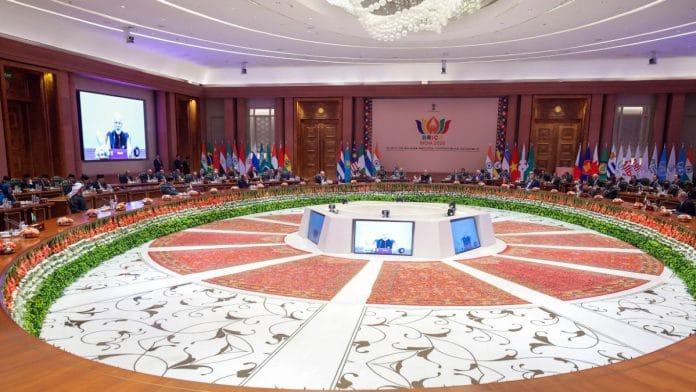
New Delhi: In the joint declaration adopted Saturday, BRICS leaders expressed “deep concern” over the continuing escalation in West Asia, calling for “maximum restraint” and avoiding actions that “could further aggravate the situation”.
“We express deep concern over the continued escalation of tensions in Middle East/West Asia and, recalling our respective national positions, call for exercising maximum restraint, as well as avoiding actions that could further aggravate the situation,” read the declaration adopted on Day-1 of the 2026 BRICS Leaders’ Summit.
The declaration added: “Furthermore, we urge to ensure the protection of civilians and civilian infrastructure in accordance with the purposes and principles of the Charter of the United Nations in their entirety and interconnectedness, including respect for the sovereignty and territorial integrity of the States.”
The language over the situation in West Asia was negotiated until late Friday evening, before all members of BRICS agreed to the final language. This is the first time the BRICS has found consensus on language over the ongoing situation in West Asia, since the joint US-Israel strike on Iran on the last day of February.
The grouping called for “dialogue and diplomacy” to find a “long-term understanding” that will contribute to “lasting peace, security and stability in the region”.
It also emphasised the need to work together to maintain “flow of global trade, supply chains and energy,” in accordance with “applicable international law”.
Iran has effectively closed the Strait of Hormuz—the global waterway connecting the Persian Gulf with the Gulf of Oman, and accounting for roughly a fifth of global energy supply before the war in West Asia began.
Iran has been working with Oman to establish a mechanism of collecting tolls going forward for ships transiting the Strait of Hormuz.
In the joint statement, BRICS leaders also expressed concern over “deliberate attacks on civilian infrastructure and peaceful nuclear facilities under full safeguards of the International Atomic Energy Agency (IAEA)”. Iran allowed the IAEA access to its nuclear sites until the strikes by the US and Israel in 2025.
The joint declaration makes no mention of the conflict in Ukraine. The earlier BRICS leaders’ declaration in 2025 had a mention of the conflict, which highlighted that members maintain their “respective national positions” on the Russia-Ukraine war.
The BRICS leaders also highlighted their concern on the ongoing blockade against Cuba, a partner country of the grouping. The US has enforced an energy blockade on the Caribbean country, which has led to negative impacts on the availability of fuel in Cuba. “In this regard, we reiterate the necessity of ending the economic, commercial and financial measures against Cuba in accordance with UNGA Resolution A/RES/80/4,” said the joint declaration.
Further, the BRICS leaders condemned the April 2025 terrorist attack in Jammu and Kashmir’s Pahalgam. The statement issued last year following the summit in Brazil’s Rio de Janeiro made no mention of the terror attack.
“We condemn in the strongest terms the terrorist attack in Jammu and Kashmir on 22 April 2025, during which 26 people were killed and many more injured. We reaffirm our commitment to combating terrorism in all its forms and manifestations, including the cross-border movement of terrorists, terrorism financing and safe havens. We reiterate that terrorism should not be associated with any religion, nationality, civilization or ethnic group and that all those involved in terrorist activities and their support must be held accountable and brought to justice in accordance with relevant national and international law,” said the joint declaration.
(Edited by Amrtansh Arora)
Also Read: At bilateral with Iran’s Pezeshkian, Modi calls for ‘freedom of navigation’ in West Asia