





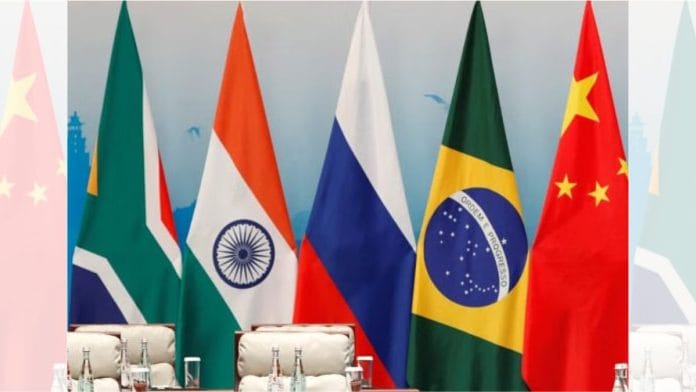


New Delhi: Culture ministers from BRICS, a grouping of 11 major emerging economies, will meet in Bhopal this August to deliberate the impact of Artificial Intelligence (AI) on creative industries, the repatriation of cultural articles taken during the colonial period, and the role of culture in climate action, Culture Secretary Vivek Aggarwal said Monday at a press conference.
The ministerial summit, scheduled for 6-7 August, is expected to adopt a joint communique on three priority areas identified under India’s 2026 BRICS Chairship. A working group meeting will precede the Bhopal ministerial summit in Varanasi on 4-5 June, followed by an officers-level technical meeting in Bhopal on 5-6 August.
A cultural festival and a theatre festival—the latter in New Delhi in October—are also planned alongside the formal meetings.
BRICS comprises Brazil, China, Egypt, Ethiopia, India, Indonesia, Iran, Russia, Saudi Arabia, South Africa, and the United Arab Emirates.
“We will strive that we come on a common agenda and a common ground to bring out a joint communique. But it will depend upon how we proceed in the discussions and how much consensus we can build amongst all the members,” Aggarwal told mediapersons .
On AI, Aggarwal said both its opportunities and risks for creative industries would be examined through case studies shared by member countries. Written suggestions received after a virtual meeting in April—including a focus on intellectual property protection and preventing AI from infringing on creative work—have been incorporated into the Varanasi agenda.
On cultural heritage, discussions will cover both protection within member countries and the return of objects taken during the colonial era. Aggarwal acknowledged the contested legal ground: objects removed under the laws in force at the time do not automatically qualify as stolen under existing international definition, making repatriation a matter of building bilateral and multilateral consensus. “India would be the most successful country by far to have got such a high number of repatriations done in the last 12 years,” Aggarwal said, citing successes with the United States, Europe, Australia, and New Zealand. India will share these case studies in Varanasi to encourage similar efforts by other BRICS members.
On sustainable development, sessions will examine cultural practices—Aggarwal cited Chhath as an example—that promote ecological values, and their potential contribution to climate action and the post-2030 development agenda.
Aggarwal noted that the BRICS membership includes nations on opposing sides of active conflicts , Iran but not the United States or Israel, Russia but not Ukraine but said this was not expected to derail consensus. “The membership of BRICS is of like-minded countries which are interdependent and which have thought of working together to make progress,” he said.
The Varanasi meeting will be led by Additional Secretary Amita and Joint Secretary Arvind Kumar, with the Indira Gandhi National Centre for Arts as knowledge partner. Invitations have gone to all ministers for the August meeting, with confirmations expected closer to the date. The theatre festival in October will invite artists from BRICS and partner countries, and will be held in association with the National School of Drama.
Separately, India’s Ambassador to the United Nations Educational, Scientific and Cultural Organization, Vishal V. Sharma, has been advancing a related argument at the international level. Speaking after India’s successful effort to secure the return of Chola-era copper plates from the Netherlands, Sharma told ThePrint that the existing international framework—the 1970 UNESCO Convention—is prospective in nature and does not cover cultural property removed during colonial or foreign occupation.
He said India has been pushing for an additional protocol to extend its scope retroactively, drawing an analogy with the post-World War II consensus among European nations to return property looted during the Nazi occupation between 1933 and 1945. India has also introduced a human rights angle to the debate, arguing that the continued retention of cultural property is a violation of Article 27 of the Universal Declaration of Human Rights.
“Continued dispossession of cultural property is a human rights violation,” Sharma said.
(Edited by Nardeep Singh Dahiya)
Also Read: The evolution of BRICS, an odd grouping born out of a 2001 Goldman Sachs paper