





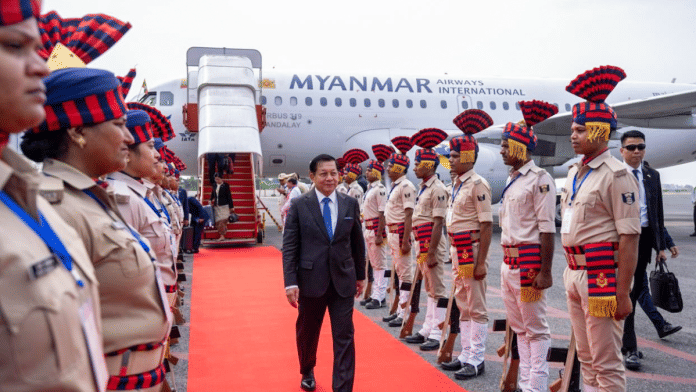


New Delhi: As Myanmar’s junta chief-turned-President Min Aung Hlaing arrived in India Saturday for his first official foreign visit since assuming the presidency last month, the trip highlights a reality that has shaped New Delhi’s Myanmar policy for decades: strategic geography matters more than political systems.
For many Western governments, Min Aung Hlaing remains a controversial figure. The former military chief seized power in a 2021 coup, presided over a brutal civil conflict, and now leads a government whose April elections have been widely questioned by opposition groups and international critics.
Yet India, the world’s largest democracy, has chosen to become the first country to host him in his new role.
According to analysts and experts, the five-day visit, which includes the pilgrimage to Bodh Gaya and talks scheduled with Prime Minister Narendra Modi, reflects New Delhi’s long-standing approach toward Myanmar: engagement with whoever governs in Naypyidaw, regardless of international opinion.
“This is a big diplomatic gain for Myanmar—the visit to India, the first bilateral visit by the newly elected president under obviously controversial circumstances. Being received by the largest democracy in the world and by a popular, charismatic leader such as our prime minister will be received well within Myanmar and the region. And it will hopefully impact other countries’ decisions on how to deal with Myanmar in the future,” Rajiv Bhatia, former Indian ambassador to Myanmar and Distinguished Fellow at Gateway House, told ThePrint.
India is important for Myanmar, and Myanmar is important for India, he added. “It is not a one-sided relationship, but a relationship based on mutual benefit.”
India’s cautious engagement with the junta has led to at least two bilateral meetings between Prime Minister Narendra Modi and Senior General Min Aung Hlaing in 2025: at the margins of the BIMSTEC(Bay of Bengal Initiative for Multi-Sectoral Technical and Economic Cooperation) and SCO (Shanghai Cooperation Organisation) summits.
Others noted that diplomatic interactions had always been taking place between India and Myanmar.
Jaideep Mazumdar, a former Secretary (East) in India’s Ministry of External Affairs, called the visit “a bold diplomatic step”.
“Even before the recent elections in Myanmar, there have been interactions at the NSA and EAM level. The Presidential visit is certainly a bold diplomatic step that will capture international attention. It will, in my view, make it easier for others to resume relations with the Myanmar Government”, he said.
Being received by largest democracy & by a popular, charismatic leader such as our prime minister will be received well within Myanmar & region—Rajiv Bhatia, ex-Indian ambassador to Myanmar.
“It’s not as if we haven’t dealt with military leaders who have gone on to become Presidents in our neighbourhood. In the case of Myanmar, and at the very least, they have not been malevolent actors towards us,” he added.
Also Read: Min Aung Hlaing’s rise in Myanmar matters to India—he is closer to New Delhi than Beijing
India-Myanmar equations
According to Bhatia, for India, the calculations are rooted in three enduring concerns: stability along the northeast, the future of its connectivity ambitions in Southeast Asia, and China’s growing influence in Myanmar.
“For India, three motivations are very obvious. One, instability in Myanmar is adversely impacting the situation in our northeast. So clearly, we want Myanmar to move towards stability in order to improve stability in our own northeast,” Bhatia said.
The second factor, he said, is India’s Act East policy. “If Myanmar remains disturbed and is not brought back to normalcy, there is a hole in our Act East policy. So we want to try to correct that.”
“The third, obviously, is the China factor. All those who claim that China is irrelevant in the India-Myanmar context have got it wrong because China is ascendant in Myanmar, and India has to compete and do better than in the past for our own interest,” he added.
Those concerns are not new. India and Myanmar have maintained close ties since independence, and New Delhi has repeatedly chosen strategic engagement over ideological alignment.
Following General Ne Win’s 1962 coup, India became the first country to recognise Myanmar’s military government, motivated largely by concerns about Chinese influence and insurgencies operating along its northeastern border.
The visit is certainly bold diplomatic step that will capture international attention. It will, in my view, make it easier for others to resume relations with Myanmar government, Jaideep Mazumdar—former Secretary (East), MEA.
Though New Delhi briefly supported Myanmar’s pro-democracy movement after the military crackdown of 1988, it reversed course in the early 1990s, rebuilding relations with the junta as part of its Look East policy. While China has played a noticeable role in the situation in Naypyidaw post-2021, India too maintained strong support for a
“Myanmar-led” solution to the current crisis.
Today, Myanmar occupies an even more important place in India’s strategic thinking.
As the only ASEAN country sharing a land border with India, Myanmar sits at the intersection of New Delhi’s Neighborhood First, Act East, and the MAHASAGAR (Mutual and Holistic Advancement for Security and Growth Across Regions) policies.
“The Kaladan multi-modal transport network, the tri-lateral India-Myanmar-Thailand highway, and the Sittwe port are of vital importance to us. We need to have a good working relationship with both the government in Naypyidaw as well as with ethnic armed organisations that control access to these areas. Going forward, I foresee greater engagement with all the relevant actors in Myanmar,” Mazumdar added.
Strengthening civilisational links with our neighbour!
A warm welcome to President U Min Aung Hlaing of Myanmar on his arrival in Bodh Gaya. He was received by Hon’ble Governor Lt Gen Syed Ata Hasnain (Retd.) @GovernorBihar at the airport.
The visit reflects the strong… pic.twitter.com/jXFPfiF1mz
— Randhir Jaiswal (@MEAIndia) May 30, 2026
Myanmar’s strategic value also extends beyond connectivity. It has become increasingly important to India’s broader maritime ambitions in the Bay of Bengal and the Indo-Pacific.
Shrabana Barua, Associate Professor at O.P. Jindal Global University, said Myanmar’s significance now extends beyond the traditional frameworks of the Neighborhood First and Act East policies.
India’s growing strategic interest in Myanmar was also seen in early May when Chief of Naval Staff Admiral Dinesh K. Tripathi travelled to Naypyidaw and Yangon and met Senior General Ye Win Oo, the Commander-in-Chief of Myanmar’s Defence Services, and Myanmar Navy chief Admiral Htein Win to discuss maritime security in the Bay of Bengal, military training exchanges, capacity building and deeper defence collaboration.
“This brings out India’s strategic priorities with Myanmar,” Barua said.
We have contiguous boundary of 1,643 km and simple answer is we cannot ignore it, no matter what government is in power in the capital—Shrabana Barua, Associate Professor, O.P. Jindal Global University.
The China factor
While China remains an unavoidable part of the equation, analysts caution against viewing India’s Myanmar policy solely as an effort to counter Beijing. “To look at our relations with Myanmar as a counterweight to China or as an attempt to balance China’s role is unfair,” Mazumdar said.
India’s relations with Myanmar far predate the Chinese presence there, he said.
“We are merely seeking to reclaim a civilisational and symbiotic relationship that at different points in our post-independence history has been subjected to jolts but never severed,” he added.
At the same time, he acknowledged Beijing’s entrenched position inside Myanmar.
“China has, by virtue of her influence over some ethnic groups, a strong influence and presence in Myanmar. It has also built strong economic interests in extracting natural resources from the country. These are undeniable realities. And to do this, China has worked with the situation on the ground as it is. India does not and cannot compete with China in how China conducts such relations.”
Bhatia similarly argued that successive governments in Myanmar have historically maintained close ties with Beijing.
“Our knowledge of history indicates that every government in the capital of Myanmar — earlier Rangoon, now Naypyidaw — likes to have good, cordial, and cooperative relations with China,” he said. “That is a fact which is unaltered and unquestioned.”
But he noted that Myanmar has traditionally sought to avoid dependence on any single power.
“There is a Burmese thinking that they should run an independent foreign policy, that they should not be dependent only on one power,” Bhatia said. “Therefore, the present leadership also wants to keep exercising other options. Clearly, a more independent Myanmar is what India is looking for, and this visit is bound to further strengthen that outcome.”
Strategic interests and border realities
The challenge for India is that Myanmar itself has changed dramatically since the 2021 coup. The military no longer controls large stretches of territory bordering India. Ethnic armed organisations and resistance groups now dominate significant parts of the border, forcing New Delhi to adapt to new realities.
“It is a reality that the Myanmar Army has no control over the length of their border with India. The existence of Ethnic Armed Organisations (EAOs) is also a reality,” Mazumdar said.
“The arrest recently in Mizoram of foreigners peddling drone warfare technology across the border indicates a high level of security risk in our bordering areas. Control of drug trafficking, gun running, cyber crime etc are all critical for our security,” he added.
As a result, India has increasingly pursued what analysts describe as a dual-track approach: maintaining formal relations with the government in Naypyidaw while expanding contacts with ethnic armed organisations that control territory along the border.
“We continue to engage with whoever is in power in the capital, in Naypyidaw,” Barua said. “Simultaneously, we hope to engage with EAOs, particularly because in the bordering areas of India and Myanmar, most places are under the control of EAOs.”
Security concerns have also shaped India’s decision to tighten border regulations and pursue fencing along parts of the frontier.
“There is now, not just with Myanmar but across all borders with our neighbours, a tendency on the part of India to monitor and regulate the flow of goods, the flow of people, and the flow of other things properly. So, India is protecting its own borders. India is protecting its own interests. How can anybody take exception to that?,” Bhatia pointed out.
Concerns around visit
However, there are concerns that India’s engagement risks legitimising a military leadership accused of widespread human rights abuses. Myanmar exile groups and democracy activists have already announced plans to protest Min Aung Hlaing’s visit.
According to local reports, Myanmar’s parallel National Unity Government (NUG), exile communities in Delhi, and refugee groups announced plans for protests. The India for Myanmar group said it had petitioned Indian authorities to hold demonstrations. At the same time, refugees urged fellow citizens to participate, saying they had been driven from their homes by Min Aung Hlaing’s “unjust oppression and brutal actions”.
Bhatia dismissed concerns that the demonstrations would significantly affect India’s diplomatic outreach.
“On the protests, I think there need not be any serious worry,” he said. “I think those who are protesting do not fully understand and appreciate the stakes involved and the interests of India. I think that, through a proper communication strategy, that can be taken care of.”
The key point here, analysts say, is that the visit reflects a calculation that has guided India’s Myanmar policy for more than half a century. Governments in Naypyidaw may change, but geography does not.
“India has always had a relationship with Myanmar,” Barua said. “We have a contiguous boundary of 1,643 kilometres and the simple answer is we cannot ignore it, no matter what government is in power in the capital.”
(Edited by Ajeet Tiwari)
Also Read: Myanmar wants to distance from China. India offers a relationship without domination
What has changed between Ne Win’s unnilateral military takeover in 1962 (I had many classmates, in India, from Burma… at that time… who NEVER returned to Burma aka Mynammer…. What has changed with this “new military avatar”…. NOTHING… same Military… same overthrow of Democracy and Democratic Leaders…. just like China since the 1940’s…
INDIA MUST BEWARE BEFORE IT “GETS INTO BED” WITH MILITARY DICTATORS… that have a habit of Stabbing Democracies “in the back”… without even a moments notice …. NOTHING MORE…. NOTHING LESS…!!!