





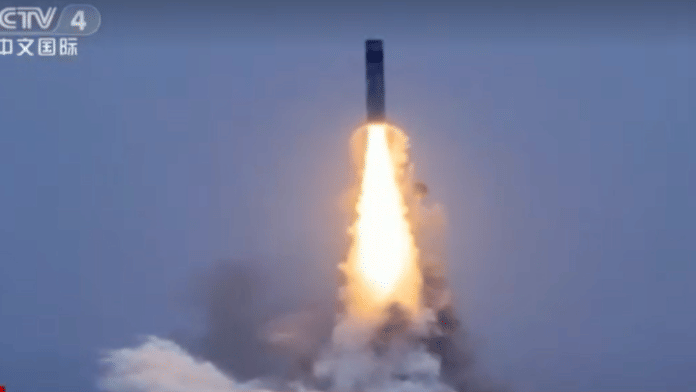


New Delhi: China’s test-firing of a long-range ballistic missile from a nuclear-powered submarine Monday has triggered alarm at a time when Australia is racing to deepen security ties with Pacific island nations and India expanding its strategic partnership with Indonesia.
The Chinese People’s Liberation Army (PLA) Navy launched the missile, which carried a dummy warhead, toward international waters at 9:31am IST, in what Chinese state media Xinhua described as its first publicly acknowledged test of this kind. The launch was a “routine part of China’s annual military programme,” it reported.
A separate Xinhua report stated that Beijing had notified “countries concerned” in advance, though the article did not disclose the missile’s flight path or specify where it landed in the “high seas of the Pacific Ocean.”
“The related launch activity was conducted in a safe, regulated, and professional manner,” Chinese Foreign Ministry spokesperson Mao Ning said at a briefing in Beijing after the launch. “We hope relevant countries will not over-interpret the matter.”
The Chinese PLA Navy's test launch of a strategic missile by a submarine was a routine arrangement of China’s annual military training.
It was not targeted at any specific country or target.
China notified relevant countries in advance, which is in line with international… pic.twitter.com/xLZeucqOTm
— China Military Bugle (@ChinaMilBugle) July 6, 2026
The missile was not officially identified, though Chinese state-linked commentary indicated it was likely the JL-3, which is Beijing’s most advanced submarine-launched ballistic missile.
Indo-Pacific backlash
The launch drew criticism from the US, Japan, Australia, New Zealand, and Taiwan. India has not issued a public response to the launch as of Tuesday.
In a press briefing Tuesday, Australian Prime Minister Anthony Albanese called the launch a “provocative act” and said China had not followed the standard 48-hour advance notification procedure. The “real concern”, Albanese stated, was that the missile had been fired from a nuclear-powered submarine.
The government of New Zealand stated that it was informed of the launch hours before and cited that the missile was launched into the South Pacific Nuclear Free Zone.
Foreign Minister Winston Peters called the test an “unwelcome and concerning” development, noting that Wellington had no interest in China using the South Pacific as a missile testing site.
Japan, which is presently involved in its own maritime tensions with China in the East China Sea, condemned the PLA’s action.
“China’s military activities, combined with its lack of transparency, have become a grave concern for Japan and the international society,” Japan’s Chief Cabinet Secretary Minoru Kihara said.
US State Department spokesperson Thomas Pigott said Beijing’s “rapid and opaque” build up of nuclear weaponry is deeply concerning not just for the Indo-Pacific region, but for the world as a whole.
The US will progress efforts urging China to enter “meaningful arms control discussions” and to regularise launch notifications for intercontinental ballistic missile (ICBM) and space launches, Piggot asserted in a State Department statement released Monday.
China last fired a long-range ballistic missile into the Pacific in September 2024, when it launched an ICBM from its southernmost province of Hainan toward waters near French Polynesia.
Also Read: China’s mobile electromagnetic catapult could transform drone warfare. All about the system
India-Indonesia deepen bilateral ties
The launch coincided with Prime Minister Narendra Modi’s ongoing visit to Jakarta, where he met President Prabowo Subianto to expand their defence and strategic partnership.
India and Indonesia Tuesday announced a series of key agreements to deepen cooperation on BrahMos supersonic cruise missiles, Astra Mk-1 beyond-visual-range air-to-air missiles, critical minerals, and joint development of the Sabang Port.
The agreements fit a wider Indo-Pacific response to China’s military activity, with India and its partners emphasising maritime access, deterrence, and resilient supply chains.
Sabang Port gives India a strategic foothold near the entrance to the Strait of Malacca, one of the world’s busiest maritime chokepoints. The port, at the northern tip of Sumatra, is about 160 km from India’s upcoming Great Nicobar trans-shipment project and can host all classes of naval vessels, including submarines.
India will also invest in steel, nickel and rare-earth permanent magnet manufacturing in Indonesia, part of a critical minerals supply-chain push in a sector where China has a dominant presence.
Australia’s Pacific security efforts
Hours earlier before the missile launch, Australia and Fiji signed the Ocean of Peace Alliance in Suva, committing to help each other when attacked. With this agreement, Fiji is Australia’s fourth formal ally after the US, New Zealand, and Papua New Guinea, and it leaves the door open for other Pacific countries to join.
Australia had signed the Nakamal Agreement with Vanuatu on 29 June, under which Canberra will remain Vanuatu’s preferred security and policing partner and be consulted on third-party investment in critical infrastructure. Canberra has previously announced $500 million Australian dollars over 10 years for the pact.
The key China-related provision is that Vanuatu has agreed not to allow foreign military bases or militarised foreign infrastructure on its territory, which is widely interpreted as a clause aimed at preventing Beijing from gaining a military base on a Pacific island nation.
Albanese also met Solomon Islands Prime Minister Matthew Wale in Honiara Tuesday, where they agreed to deepen ties and speed up talks on a new comprehensive treaty.
Solomon Islands remains closely watched because its 2022 security pact with China raised fears that Beijing could deploy police or armed personnel near vital shipping lanes and, eventually, seek a military foothold in the South Pacific.
Wale said China remained a “good friend”, but that missile testing in the Pacific was “not something a friend does”.
Maritime flashpoints
China’s missile launch adds to tensions with two other Indo-Pacific actors: the Philippines and Japan.
In the South China Sea, Beijing asserts expansive maritime claims rooted in its nine-dash line, putting it in direct conflict with several claimant nations, most notably the Philippines. Despite a 2016 Hague tribunal ruling that rejected Beijing’s legal basis for claiming much of the area, tensions continue as China furthers its military build-up in disputed waters.
Around Scarborough Shoal, a triangular coral atoll located in the disputed waters, China’s PLA said on 29 June that it had deployed vessels and aircraft after a joint US-Philippines maritime drill near the shoal. Manila said Chinese vessels monitored the exercise.
The Philippines has also protested what it called an illegal Chinese floating structure in the area, following April reports of a 352-metre floating barrier.
With Japan, China has been locked in a separate dispute over the Senkaku Islands, which Beijing calls Diaoyu. Tokyo said Tuesday that its coast guard ‘expelled’ Chinese vessels near the islands, while Beijing gave its own counterclaim.
Days earlier, on 29 June, Beijing imposed export controls on 40 Japanese entities over dual-use goods, citing Japan’s “remilitarisation”.
At the Shangri-La Dialogue in Singapore in late May, Japanese Defence Minister Shinjiro Koizumi said China was expanding its military capabilities “without sufficient transparency”, adding that Beijing’s “external approach and military activities” were a serious concern for Japan and for the international community.
As India builds its strategic depth with the Indonesia and Australia rushes to secure Pacific island security agreements, China’s missile test has heightened the urgency for Quad partners and like-minded Indo-Pacific states to act fast in countering Beijing’s expanding military reach.
Kyra Menon is an intern with ThePrint.
(Edited by Tony Rai)
Also Read: US Pacific Command seeks $122 bn, warns of rising threat of war with China—Washington Times report