


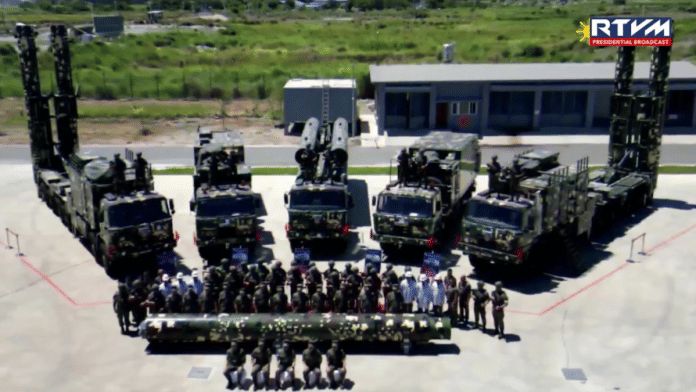
New Delhi: The Philippines has fielded its BrahMos shore-based anti-ship missile battery in coordination with naval vessels during its annual joint defence exercise under the looming shadow of a potential China-Taiwan conflict.
The 10th iteration of AFP Joint Exercise (AJEX) DAGITPA 10-2026, held from 17 to 27 November, includes operations in Northern Luzon, Palawan, the National Capital Region, and the Western Command area, focusing on defending the country’s northern maritime approaches in the backdrop of China’s growing naval presence.
The Philippine Marine Corps’ Coastal Defence Regiment (CDR), according to the US Naval Institute (USNI), deployed the missile battery for a joint maritime strike exercise during DAGIT-PA.
The exercise marks the first confirmed field deployment of the BrahMos system during this series of drills, following earlier rehearsals during Balikatan 2026. It also involved movement of air-defence systems to Northern Luzon, naval escorts protecting military transport and special forces operations on Fuga Island.
WATCH | AFP WRAPS UP AJEX DAGITPA 2026
The Armed Forces of the Philippines (AFP) successfully concludes AJEX DAGITPA 10-2026, a ten-day joint and combined exercise held from November 17 to 27 across Northern Luzon and Palawan.
Bringing together the Philippine Army, Philippine… pic.twitter.com/aSNQ7scpiO
— Armed Forces of the Philippines (@TeamAFP) November 26, 2026
The Philippine military said the drills were aimed at strengthening its ability to secure vital maritime approaches, particularly the Luzon Strait.
Luzon Strait & its importance
Separating the northern Philippines from Taiwan and connecting the South China Sea with the Western Pacific, the Luzon Strait is an important passage for commercial shipping and naval movements.
The strait’s location makes it significant in the event of a conflict over Taiwan. Any escalation could affect the Philippines’ northern islands, including Batanes, and bring the country closer to the military consequences of a cross-strait confrontation. Manila has increased its military presence and conducted area-denial exercises with the US in the region.
Given the presence of commercial shipping routes and undersea communications cables, any military escalation around Taiwan can disrupt maritime traffic and affect regional trade. For the Philippines, the northern islands are particularly exposed to conflict spilling over from Taiwan.
This explains Manila’s increased military activity in northern Luzon and the Batanes region. Deploying BrahMos missiles during DAGIT-PA forms part of its effort to bolster coastal defences and deter hostile naval activity near these strategic approaches.
The Chinese reaction
While the BrahMos deployment has not received comparable attention from Chinese state media outlets, several commentators have examined the implications of India’s missile exports to Manila and the potential threat to Chinese naval vessels operating in the South China Sea.
In January 2022, India and the Philippines signed a $375-million contract for three BrahMos anti-ship missile batteries. The agreement made Manila the first foreign customer of the system, jointly developed by India’s Defence Research and Development Organisation and Russia’s NPO Mashinostroyeniya. The first delivery took place in April 2024.
Some of the commentators have questioned whether the Philippines has the monitoring, target tracking, communications and operational capabilities required to use the missiles effectively against higher technological opponents.
Their discussions point out that the missile’s performance would depend not only on its speed and range, but also on supporting capabilities such as electronic warfare, reliable communications and a clear operational picture.
India, according to a Reuters report in the first week of November, is in final-stage talks with the Philippines for a potential follow-on deal worth $700 million to $800 million. Manila is considering around five additional systems, involving nearly 60 missiles, and exploring ways to adapt the system to its local environment and logistical framework.
The recent deployment places the BrahMos missile at the centre of Manila’s efforts to strengthen coastal security, while highlighting India’s expanding footprint as an arms supplier in the Indo-Pacific region.
(Edited by Tony Rai)