


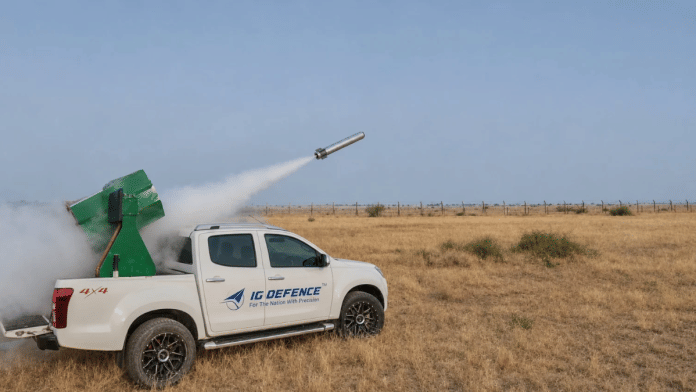
New Delhi: Noida-based IG Defence successfully test-fired JWALA MK-1 which it describes as India’s first self-operating Counter-Unmanned Aircraft System (CUAS) Micro-Missile System.
The test firing of JWALA MK-1—having a 5-km operational range and designed as a domestically built, autonomous and affordable counter-drone solution—was carried out Monday at Pokhran, Rajasthan.
The test at Pokhran highlights the role of private manufacturers in India’s defence sector. As the country pursues defence indigenisation, indigenous missiles, autonomous systems and AI-powered battle management platforms are expected to contribute to national security.
The development comes after the expanding use of inexpensive attack drones in conflicts and the challenge of intercepting them with costly conventional air-defence systems.
The imbalance cost can pressure interceptor inventories, ammunition supplies and the economics of air defence. Given India’s current security environment, developing cost-friendly and scalable counter-drone technology is a strategic priority, the defence firm said.
JWALA MK- 1 in Action 🚀
A powerful moment at the Pokhran Test Range!
India’s first indigenously developed Counter-UAS Micro Missile System, JWALA MK-I, successfully test-fired by @IGDefence .
This is more than a successful test firing. It is a step forward in strengthening… pic.twitter.com/wilAPVxYKU
— Bodhisattwa Sanghapriya (@bodhi_ig) November 23, 2026
JWALA MK-1, according to IG Defence, can identify hostile drone targets, classify them and facilitate their neutralisation through a mission autonomy architecture.
The system runs on GRID, the company’s AI-powered Mission Autonomy and Battle Management System. GRID handles sensor integration, target detection, identification, classification, mission decision-making and engagement management. IG Defence describes it as the “brain powering” of the JWALA MK-1’s operational kill sequence.
IG Defence founder and CEO Bodhisattwa Sanghapriya said that the GRID brings every stage of the system’s operations together through AI-driven coordination. “GRID brings the entire operational chain together through AI-driven coordination, from target detection to engagement management,” he said.
Sanghapriya added that the company’s aim is to develop homegrown defence systems in which hardware and software are built together, with autonomy and intelligence placing them together at their core.
IG Defence associate vice-president wing commander Anoop Sharma (retired) asserted that the proliferation of unmanned aerial threats required a new strategy to air defence. Using costly weapons to stop cheap drones is unsustainable for armed forces, he said, highlighting the demand for dependable, cost-friendly defences that can be produced in large numbers.
“India needs indigenous, reliable and cost-effective solutions to counter emerging aerial threats at scale,” he said.
Sharma presented JWALA MK-1 as a step towards an integrated counter-drone capability combining technology, mission autonomy and operational effectiveness. He said indigenous systems were important for strengthening India’s preparedness for battlefield challenges and advancing defence self-reliance.
IG Defence said the system shows its effort to manufacture homegrown capabilities and contribute to the country’s next generation of counter-drone solutions, while supporting the idea of lowering the dependence on foreign defence technology.
(Edited by Tony Rai)