


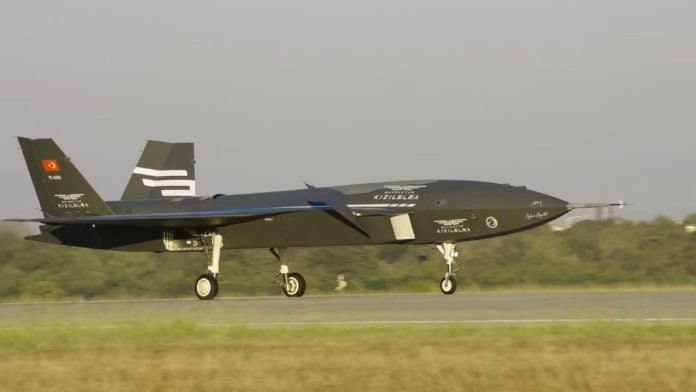
New Delhi: Turkey has commissioned the first three Bayraktar Kizilelma unmanned fighter aircraft into its defence forces, which its maker described as the first instance of any country’s armed forces commissioning an autonomous fighter jet.
Turkish manufacturer Baykar said the aircraft passed its qualification trials and has been commissioned into active service. Kizilelma is not a traditional armed drone. It has been designed to carry out fighter-type missions, including sky-to-sky combat.
According to a report by the defence news portal TWZ (previously The War Zone), the aircraft showcased this performance in November 2025, firing a domestically developed Gökdoğan beyond-visual-range air-to-air missile (BVRAAM) to strike a jet-powered target drone. The target was detected using Turkish defence electronics firm ASELSAN’s MURAD active electronically scanned array (AESA) radar, showing the integration of onboard radar and beyond-visual-range missile capabilities on an unmanned aircraft.
The aircraft has also showcased self-piloted formation flying. Yet, the extent to which it can independently spot, follow and engage hostile aircraft in a real-world combat environment remains unclear.
However, this marks a major step in a worldwide push to build unmanned aircraft that can fly alongside, and eventually take on some missions performed by, traditional fighter jets. While China’s GJ-11 stealth unmanned combat aerial vehicle (UCAV) is believed to have entered active service, there has been no public demonstration of its combat capabilities.
The US is also pushing ahead with its Collaborative Combat Aircraft (CCA) programme.
In July, American defence manufacturer Anduril said that its YFQ-44A drone had completed a full beyond-line-of-sight strike on a simulated target, terming the trial test a major step towards making CCAs active.
Boeing Australia, meanwhile, is building its MQ-28 Ghost Bat—uncrewed CCA—for the Royal Australian Air Force (RAAF), which has likewise showcased air-to-air combat capabilities.
The developments are particularly significant for India as New Delhi is looking to expedite its indigenous ‘loyal wingman’ programme before 2030.
In May, when he was Chief of Integrated Defence Staff, Air Chief Marshal Ashutosh Dixit urged for the homegrown Ghatak UCAV programme to progress fast. He said India should aim to achieve initial operational clearance for a ‘loyal wingman’ capability by 2030, pointing to similar initiatives in the US and Australia as examples. Ghatak is not a direct rival to the Turkish drone since its primary function is striking ground targets.
Dixit noted that the Indian Air Force (IAF) could eventually one day pair Tejas fighters alongside Ghatak aircraft carrying specialised mission payloads, including electronic warfare equipment, targeting sensors and precision-guided weapons. Pilots would be able to direct these pilotless aircraft while remaining outside hostile airspace, he had said.
He also stressed for a clear operational requirement from the IAF and a committed joint programme bringing together the Defence Research and Development Organisation (DRDO), Hindustan Aeronautics Limited (HAL) and private-sector partners. In March, The Defence Acquisition Council (DAC) had cleared Acceptance of Necessity to acquire 60 RPSAs—four squadrons—at an estimated cost of close to Rs 40,000 crore.
Ghatak, A Remotely Piloted Strike Aircraft (RPSA) is intended as a stealthy, jet-powered, tailless flying-wing unmanned combat aircraft for surveillance, identification, precision strike and offensive air operations. Its internal weapons bay is designed to carry roughly 1.5 tonnes of precision-guided munitions while preserving a low radar signature.
It is expected to fly at about Mach 0.8, with a service ceiling near 13,000 metres, powered by a Kaveri-derived engine producing about 49–51 kN.
Ghatak is being developed by DRDO specifically its Aeronautical Development Establishment (ADE) under the Remotely Piloted Strike Aircraft (RPSA) programme. The programme goes back to the Autonomous Unmanned Research Aircraft (AURA) feasibility study, which begun in May 2016.
(Edited by Amrtansh Arora)
Also Read: Are drones from Turkey fighting each other in Sudan’s proxy civil war?