





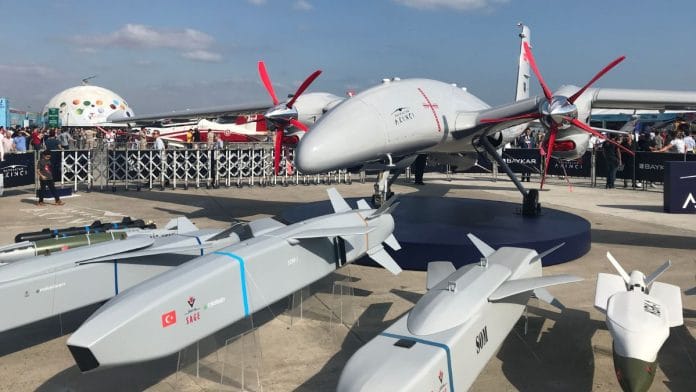


New Delhi: Sudan’s air force last Friday is believed to have shot down a Turkey-made combat drone using an identical Turkey-made drone from its own fleet—what is already being described as a drone-on-drone aerial kill.
According to reports, the Sudanese Armed Forces (SAF) intercepted a Bayraktar Akinci unmanned aerial vehicle near Ad-Damazin on 23 May, approximately 75 kilometres from the Ethiopian border. The drone is believed to have entered Sudanese airspace from Ethiopian territory.
Khartoum alleges the drone belonged to the Ethiopian Air Force and was being operated as part of a UAE-backed proxy campaign in support of the Rapid Support Forces (RSF), the paramilitary rebel faction at war with Sudan’s government.
The SAF has earlier accused both the UAE and Ethiopia of aggression against Sudan. “What Ethiopia and the UAE have done is direct aggression against Sudan and won’t be met with silence,” it was quoted as saying in a 5 May report by Al Jazeera.
It was the second such intercept this month. Earlier in May, Sudan’s air defences downed another drone from the same fleet north of El-Obeid.
Sudan’s technical teams said they analysed the UAV’s data and confirmed that the drone—serial number S88—belongs to the UAE.
The UAE has not made any statement publicly about the latest accusation, but it has repeatedly denied any involvement in backing RSF.
Also Read: Dragon’s armour: How Xi reshaped China’s military with theatre commands a decade before India’s push
The Sudan war
Sudan’s civil war erupted in April 2023, pitting the SAF, led by General Abdel Fattah al-Burhan, against the RSF, commanded by Mohamed Hamdan Dagalo. What began as a military power struggle has since hardened into a regional proxy conflict, with foreign actors channelling advanced weaponry into a theatre already defined by mass displacement and humanitarian collapse.
The UAE is widely regarded as the RSF’s most influential external backer. Abu Dhabi’s interests in Sudan are layered: through the RSF, it seeks access to Sudan’s fertile agricultural land for food security purposes, and control over the country’s strategically positioned ports, according to international non-profit organisations.
Sudan is also among Africa’s largest gold producers, with the RSF controlling several major mines. For years, billions of dollars’ worth of Sudanese gold has allegedly been channelled illicitly to Dubai, effectively bankrolling the rebel campaign, watchdogs tracking money laundering operations worldwide have said.
Sudan’s geography makes it worth fighting over. It sits at the intersection of the Red Sea, the Sahel, and the Horn of Africa—a position that confers both strategic depth and economic leverage.
Turkey’s exposure
The irony sharpening this episode is Ankara’s own exposure.
The Washington Post reported last year that Turkish company Baykar had negotiated an arms deal with the Sudanese army, while another arms firm in the country, Arca Defense, was in extensive contact with a senior RSF figure.
“In phone calls and other correspondence, an Arca executive discusses weapons sales with Algoney Hamdan Daglo Musa, in charge of arms procurement for the paramilitary and the brother of its leader,” the report said.
The Post could not determine if Arca, also a Pentagon contractor, had provided arms to the RSF. The executive quoted in the report said the company had never sold weapons to RSF.
The Akinci drone
The Bayraktar Akinci is a heavy, multi-purpose strike and reconnaissance UAV developed by Turkish firm Baykar. Development began in the mid-2010s as part of Turkey’s drive for autonomy in precision-guided weapons and aviation. The drone made its first flight in December 2019 and was officially inducted into the Turkish Armed Forces in 2021.
Built as a heavier, more capable successor to the Bayraktar TB2, the Akinci can carry out both reconnaissance and strike missions and is equipped to deploy long-range cruise and air-to-ground missiles. Based on its distinctive features, open-source observers on social media identified the downed aircraft as an Akinci version B.
Also Read: IAF willing to compromise further on Tejas Mk1A but red lines remain. Delivery still delayed