







New Delhi: Last week, External Affairs Minister S.Jaishankar said European countries ignore their own track record of supplying weapons that have been used against India. While he did not take names, the remarks were seen as an apparent reference to Pakistan.
At an event in Finland, the EAM while defending Russian oil imports reminded Europe that it sells weapons that are used against India, while New Delhi has never done anything to endanger the continent.
European countries have historically been weapons suppliers to Pakistan even as China alone accounts for more than 80 percent of Islamabad’s arms imports.
In recent decades, Italy, the Netherlands, and Sweden have emerged as major arms suppliers to Pakistan along with traditional exporters such as France, Ukraine, and the UK.
Also Read: Pakistan defence exports at all-time high, ‘contracts’ worth $10 bn inked across globe in 2025
The Netherlands
Pakistani Naval technology uses radar systems and other components mainly imported from the Netherlands.
According to the ‘Trends in International Arms Transfer, 2024’ report by the Stockholm International Peace Research Institute (SIPRI), the Netherlands became the second-largest arms supplier to Pakistan after China in the 2020-2024 period, accounting for 5.5 percent of its total arms imports.
Similarly, Islamabad became the second biggest export destination for the Dutch after the US, accounting for 20 percent of total Dutch weapons exports.
Major Dutch systems exported include electronic components of naval aircraft, including Sea King helicopters, minesweepers, and patrol vessels.
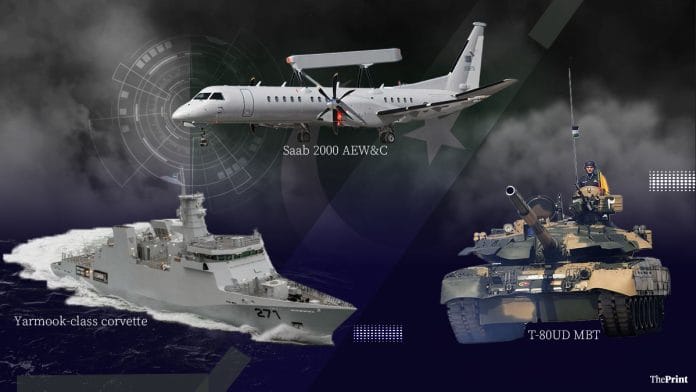
In 2020, Pakistan received Yarmook-class corvettes built in Galati, Romania, by the Dutch company Damen Group. In 2022, the Netherlands also supplied MCM (mine countermeasure) Tripartite ships to Pakistan.
The bilateral defence cooperation has a controversial history, too. In the 1970s, Pakistani physicist Abdul Qadeer Khan managed to get information on centrifuges from the Urenco group in Almelo, which was in turn used by Islamabad to develop nuclear weapons.
Last March, when Dutch Defence Minister Ruben Berkelmans visited New Delhi, his Indian counterpart Rajnath Singh urged him not to arm Pakistan, as that leads to instability in the region.
Italy
In 2018, Pakistan also became the second-largest importer of arms from Italy, after Qatar, with purchases reaching $762 million.
While its subsidiary AgustaWestland was banned by India in 2014, the parent firm Leonardo has cooperated extensively with the Pakistan Air Force in the previous decade.
Leonardo S.p.A. (formerly Finmeccanica) has supplied an undisclosed number of AW139 helicopters to Pakistan since 2016. These are mainly used in utility and transport as well as search and rescue operations. Another subsidiary OTO Melara exported 4 Super Rapid 76mm gun currently in use by the Pakistan Navy.
Italian firm Cos.Mo.S signed a deal with Pakistan in 1988 to provide three MG-110 midget submarines. Other Italian arms exports include the 10 Spada-2000 surface-to-air missile systems delivered between 2010 and 2013, and 79 Puma 6X6 armoured vehicles in 2015.
Meanwhile, India lifted the ban on AugustaWestland and Leonardo in 2021. In April this year, Defence Minister Rajnath Singh met with his Italian counterpart Guido Crosetto in Delhi where he urged Italy to stop sharing sensitive defence technology with Pakistan.
Sweden
Pakistan became the second-largest importer of Swedish weapons, after Brazil, accounting for 18 percent of total Swedish arms exports during the 2020–2024 period, according to SIPRI. Islamabad became an early buyer of Swedish designed SAAB-2000 Erieye Airborne Early Warning and Control aircraft, when the Pakistan Air Force (PAF) started inducting the system between 2009 and 2010.
Currently, the PAF operates eight to nine Erieye aircraft through No. 3 AEW&C Squadron ‘Angels’ stationed at Minhas in Punjab’s Attock district. Pakistani defence observers highly credited the Erieye aircraft for orchestrating real-time battlespace awareness last year during Operation Bunyan-Un-Marsoos, launched in response to India’s Operation Sindoor.
Although frontline fighters such as J-10C and J-17 engaged in visible kinetic action, the Erieye essentially functioned as the PAF’s “eyes and brain” for coordinating beyond-visual-range operation and integrated air defence management.
Later, Pakistan confirmed that one Erieye aircraft was damaged during Indian strikes on PAF Base Bholari, but claimed it was swiftly repaired and returned to operational service.
Islamabad reportedly deployed the Erieye early warning airborne system during Operation Swift Retort in 2019.
Saab also delivered four transport aircraft to Pakistan in 2018. Sweden throughout the 1980s and 1990s exported more than 1,500 RBS-70 portable surface-to-air missiles as well as 40 Type-43 anti-submarine torpedoes.
Interestingly, Sweden shares substantial defence ties with India too. In 2024, Saab opened the manufacturing facility for its Carl-Gustaf M4 shoulder fired weapon at Jhajjar in Haryana after getting 100 percent FDI approval.
France
In Pakistan’s early decades, France emerged as a major supplier of aircraft and various air-to-air and anti-ship missiles. From Dassault’s Mirage III and Mirage V aircraft, Daphne-class submarines, and helicopters to Atlantique naval aircraft and SMART bombs, etc. raised a lot of concerns in Indian strategic circles.
While the Mirages were kept on high alert during the 1999 Kargil conflict, they were actively deployed to launch H-4 standoff glide-bomb during the aerial skirmish with India in 2019.
Pakistan also benefits from French arms exports to Gulf countries, having established itself as a major hub of maintenance and support of French military equipment.
Germany
Germany has been a major supplier of Naval technology, especially propulsion systems for Pakistani submarines. In 2020, it turned down Pakistan’s request to provide air-independent propulsion systems for its submarines due to Islamabad’s failure to cooperate on the 2017 truck bomb attack on the German embassy in Kabul.
Between 1961 and 1981, Pakistan was among the 15 countries that got licences from the German firm Heckler & Koch to manufacture G3 assault rifles. According to estimates, the G3 rifles, through deals by H&K, have become one of the most ubiquitous rifles around the world.
In 2019, after an encounter with Naxalites in Chhattisgarh’s Kanker district, security forces recovered one G3 rifle from the neutralised cadres.
Ukraine
Kyiv has been exporting the T-80UD Main Battle Tanks, an improved version of Soviet-made T-64 MBT, to Pakistan since the 1990s. From 1997 to 2002, Pakistan received 320 such tanks. Both the countries concluded an agreement in 2017 to upgrade these tanks.
Ukraine also agreed to sell 200 6TD-2 engines for Pakistan army’s al-Khalid MBT, jointly developed by Pakistan and China in 1990s.
According to a BBC Urdu report in November 2023, Pakistan signed two contracts with American companies, Global Military and Northrop Grumman, to sell 155mm shells manufactured in Pakistan Ordnance Factories (POF) to Ukraine. The Pakistan foreign office, however, denied any sales of arms or ammunition to Kyiv, pledging neutrality in the Russia-Ukraine conflict.
UK, Belgium & Switzerland
According to SIPRI’s arms transfer database, the UK has been transferring weapons to Pakistan since the 1950s ranging from Lynx anti-submarine helicopter, Seacat surface-to-air missile to Amazon frigate and 102mm MK-19 Naval gun.
The most recent exports include Sea King-3 transport helicopter in 2018 and 3 Seaspray maritime patrol aircraft radar.
Belgium sold 7 C-130H Hercules transport aircraft to Pakistan in 2021. Over the years, Switzerland has transferred 140 Skyguard GR air search/fire control radars and more than 250 GDF 35mm anti-aircraft guns to Pakistan.
Jaydeep Gadhavi is an alum of ThePrint School of Journalism, currently interning with ThePrint.
(Edited by Tony Rai)
We have to get real and understand that small nations of Europe survive by selling advanced weapons all over the world. They can’t afford to pick and choose and limit their market spread. For example, we all know that BRitain always voted against India in the UN , on Kashmir. However, our GOvt did not go to town painting Britain as an enemy. Very soon, we finalised deals with UK for supply and manufacture of the top fighters and bombers of the day, Canberras, Hunters and Gnats. These were vital to dealing with Pakistan in 1965 and 1971. We need to take an unsentimental view of things as out earlier Governments did in the 50s and 60s.