



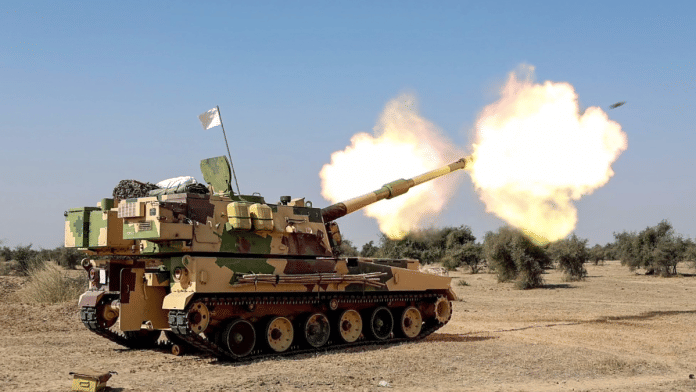
New Delhi: The Defence Ministry Monday cleared proposals worth Rs 2.12 lakh-crore for military procurements, including a major push for artillery guns with plans to procure 335 more 155 mm/52 calibre K9 VAJRA-T self-propelled tracked guns.
The Defence Acquisition Council (DAC), chaired by Defence Minister Rajnath Singh, accorded Acceptance of Necessity (AoN)—in-principle administrative approval—to various capital acquisition proposals of the defence forces.
For the Indian Army, approval was accorded for the procurement of High Mobility Vehicles (HMV), Self-Propelled Tracked Gun System, Gun Shot Response System (GSRS), Light Multi Role Helicopters (LMRH), Very Short-Range Air Defence System (VSHORADS), Platform-Based Counter Unmanned Aerial System (C-UAS), Unmanned Aerial System Brick Long Range, Surveillance UAV, Integrated Surveillance and Strike System and Long Range Kamikaze Drone System, a statement by the Defence Ministry said.
Sources in the defence establishment said the Self-Propelled Tracked Gun System was the Vajra, 100 of which have been delivered and another 100 of which has been ordered for.
With the additional 335 now cleared for contract negotiations, Vajra will emerge as the mainstay of the Artillery regiments in times to come.
The number of 500 Vajras is well beyond the original Field Artillery Rationalisation Plan targets which was just 100.
In 2017, L&T won the Rs 4,500-crore contract to supply 100 K9 Vajras under ‘Make in India’ initiative for which it signed a transfer of technology contract with Hanwha Corporation.
According to L&T, the K9 Vajras were delivered with more than 80 percent indigenous work packages and above 50 percent indigenisation (by value) at the programme level.
When the Army did the trials for Vajras before selection, the trials were conducted in deserts and not in high-altitude areas where the howitzer’s systems work differently in rarefied atmosphere and extreme cold.
But with the tensions breaking out with China at the Line of Actual Control (LAC), the Army decided to deploy three of these tracked howitzers in Eastern Ladakh as a trial measure in 2020.
The three guns were fitted with winterisation kits that enabled them to work in sub-zero temperatures even though they were designed to operate in deserts. As reported by ThePrint, the gun system proved its mettle following which the Army deployed a full regiment (20 guns make one regiment) of these howitzers in Eastern Ladakh to add to its firepower.
The Self-Propelled Tracked Gun System will provide matching mobility and firepower to mechanised formations, the defence ministry statement added.
“The HMVs will enhance operational capabilities, logistic support and mobility in challenging terrains…The GSRS will serve as a force multiplier providing real-time situational awareness of the forces. The LMRH will be used by both the Indian Army and the Indian Air Force for Reconnaissance and Surveillance, Combat, Search and Rescue of troops, Humanitarian Assistance and Disaster Relief etc.
“The VSHORADS will engage new generation small size aerial threats, while C-UAS will enhance survivability of Tanks in the modern battlefield. The Surveillance and Drone Systems will enhance the surveillance and targeting capabilities of the Indian Army,” the statement read.
For the Indian Navy, approval was given for the procurement of Active Offboard Decoy System (AODS) and other major Naval platforms.
The AODS will enhance the credibility of anti-missiles defence, especially against modern anti-ship missiles of adversaries. The indigenously designed and constructed major Naval platforms will possess modern-day warfare capabilities and enhance the combat capability of the Navy, the Defence ministry said.
VVIP choppers
For the Indian Air Force, approval was accorded for the procurement of helicopters, air defence systems, weapons and Mobile X-Band Doppler Weather Radar System to enhance air defence and war fighting capabilities.
The procurement of Special Utility Helicopters will help the IAF meet important air transport requirements, the defence ministry said.
Sources explained that this involves procurement of 24 choppers at an estimated cost of Rs 10,000 crore for transport of VVIPs, including the President, Vice-President and Prime Minister.
They will replace the current Russian Mi17- V5 helicopters in use.
The main competition will be between European Airbus and American Lockheed Martin.
(Edited by Ajeet Tiwari)
Also read: Modi or Manmohan, India’s military needs haven’t been met under either for 10 yrs, data shows