



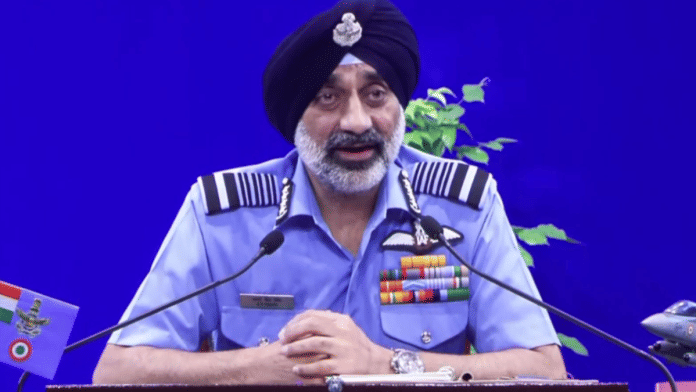
New Delhi: Indian Air Force (IAF) chief Air Chief Marshal A.P. Singh has flagged the lack of concrete progress in some indigenous defence programmes, saying “delays hurt” the capabilities of the force.
Addressing the annual press conference ahead of the Air Force Day on 8 October, he said modernisation projects need to be prioritised, and wondered if the country should have another Aeronautical Development Agency (ADA), which is currently handling multiple projects at once (Tejas MK1A, Tejas Mk2, Advanced Medium Combat Aircraft, Twin Engine Deck Based Fighter, among others).
The IAF chief, who will superannuate at the end of this month, said the force supports indigenous programmes, but added that several projects are progressing at different speeds. The ecosystem, he said, could not afford to spread its limited resources too thin.
“There is a requirement to reduce the number of programmes which are going on at any time, no doubt,” Singh said, responding to a question. When one organisation handles multiple programmes, he added, it could limit the resources dedicated to each. “If the same group is involved in two programmes, obviously, there is time sharing going on,” he said.
Singh said the focus should instead be on giving clear priority to certain programmes and ensuring that tangible progress is delivered.
The comments come at a time when the IAF is pursuing several major indigenous programmes, including the Tejas Mk-1A, Tejas Mk-2, and the fifth-generation Advanced Medium Combat Aircraft (AMCA), while simultaneously seeking additional aircraft to arrest the decline in its fighter squadron strength.
Singh said the different programmes under development at present will eventually help address the capability gaps faced by the IAF, but acknowledged that some of these platforms will take time to become operational.
“…the MRFA (Multi-Role Fighter Aircraft), we also are looking hopefully towards Mk2. And all these will be able to fill in the gaps that exist and are likely in the near future,” he said.
He said there is some time before the AMCA reaches the sky and becomes operational. “So we’ll have to see how it progresses.”
‘We have to fill the gap’
The air chief’s comments are significant because the IAF is already dealing with a gap between its present requirements and the time required for new indigenous fighter programmes to mature.
He said that if there were delays in AMCA, the IAF will have to examine other platforms to bridge the gap. “As far as other platforms are concerned, we have to look at some platform in case there are delays in the AMCA. If we have to fill in the gap… we need to look at something,” Singh said.
However, he made it clear that no decision has been taken on any particular alternative platform.
The comments come amid Russia;s push for its Su-57 fifth-generation fighter as a possible option for India, but Singh did not commit the IAF to the Russian aircraft or any other foreign platform.
The IAF chief also stressed that India’s fighter requirement cannot be met by relying on a single aircraft type. “One aircraft cannot do all that we want,” he said, arguing that the force needs a mix of different fighter platforms.
In the near term, he said, the IAF’s fighter fleet will comprise a mix involving Tejas Mk-1A and Tejas Mk-2, the MRFA and the AMCA.
Singh also talked about the scale of aircraft production required to stop the decline in the IAF’s fighter fleet. The service, he said, requires the induction of around 36-40 fighter aircraft every year merely to prevent its squadron strength from continuing to fall.
He suggested that if production targets for Tejas (24 aircraft a year) and the MRFA (12 per year), as well as 12 additional Sukhois, move ahead, annual inductions could eventually reach the 32-40 aircraft range.
The IAF currently has several fighter programmes at different stages, with the service counting on faster deliveries of Tejas Mk-1A while simultaneously waiting for the more advanced Mk-2 and AMCA programmes to mature.
Reiterating the force’s support for indigenous programmes, he said the decisions being taken today will have consequences several years down the line. “These are the things which actually make us (capable) up near,” he said, stressing the need for decisions to be taken with a long-term view.
The Air Chief said the objective was not to abandon indigenous programmes but to prioritise them better, with organisations and teams given clearer ownership so that projects do not compete for the same resources.
The IAF has in recent years increasingly pushed for greater domestic production even as it seeks urgent solutions for its fighter shortage.
Also Read: C-130J-30 vs C-390: Lockheed lays out its case for India’s medium transport aircraft deal