



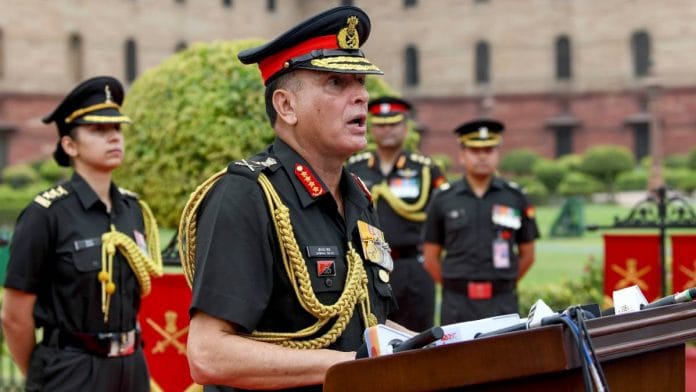

New Delhi: Army chief Gen Dhiraj Seth will be in Russia Wednesday on an official visit during which he is expected to discuss a range of issues with the Russians, including upgradation of existing Russian-origin weapons systems, spare parts and supplies, and some of the new military platforms being offered by Moscow.
Sources in the defence and security establishment told ThePrint that the Army chief will meet his Russian counterpart Colonel General Andrei Mordvichev and other senior military officials during the visit.
The visit is significant as it is the first by an Indian Army chief to Russia in nearly six years. The last serving Army chief to visit the country was Gen Bipin Rawat, who undertook a six-day visit in October 2018.
Sources said the primary objective of Gen Seth’s visit is to carry forward ongoing discussions between the two sides and explore ways to deepen India-Russia defence cooperation from a land-force perspective.
One of the key issues likely to be raised by Gen Seth is the availability of spare parts and supplies for Russian-origin equipment currently in service with the Indian Army, it is learnt.
From assault rifles and armoured personnel carriers to tanks, air-defence systems and rocket launchers, Russian-origin equipment remains deeply embedded in the Indian Army, even as the force increasingly seeks to diversify its sources and indigenise its weapons platforms.
Almost the entire Armoured Corps and the Mechanised Infantry are built around Russian-origin systems.
Sources said Russia has also offered a number of new systems to the Indian Army, with proposals at various stages of discussion.
One of the key systems being discussed is the possible acquisition of the Pantsir-S1M, Russia’s upgraded short-range mobile air-defence system. As ThePrint reported in 2024, the Indian Army is looking to procure at least 90 Carrier Air Defence Tracked (CADET) systems, with at least 50 percent indigenous content, to protect mechanised columns.
The Army plans to deploy the CADET system across plains, deserts, semi-deserts and high-altitude and mountainous areas up to 5,000 metres.
The Pantsir is designed to provide point defence to critical military assets, including air bases, command posts and other high-value installations. It combines surface-to-air missiles with twin 30-mm cannons and is designed to engage aircraft, cruise missiles, drones and precision-guided weapons.
This is not the first time the Pantsir has been in contention for an Indian Army air-defence requirement. In 2013, it was among the systems competing for the Army’s requirement for a similar mobile air-defence platform. Three systems had been shortlisted: South Korea’s Hanwha Defense Systems with its Hybrid Biho, Almaz-Antey with an upgraded Tunguska, and KBP Tula with the Pantsir.
The South Korean system eventually emerged as the preferred bidder, but the deal did not materialise, with officials attributing the setback to issues over indigenous content. Moscow had also objected to the Russian system being pushed out during the India-Russia Inter-Governmental Commission on Military Technical Cooperation meeting in New Delhi in 2018.
Another major project that Russia has been pushing is a new generation of infantry fighting vehicles, particularly significant because thousands of BMPs have been built in India under licence and form the backbone of the Army’s Mechanised Infantry.
The Army is pursuing an indigenous programme to modernise its existing BMP-2 fleet. But Russia is also offering the latest variant of BMP-3, a new-generation Russian-origin infantry fighting vehicle, as a potential option. The BMP-3 proposal by Russia comes at an interesting time for the Army, which is pursuing a project called Future Infantry Combat Vehicle (FICV).
Russia had offered the first version of BMP-3 several years back but the Indian Army rejected it citing design and capability constraints.
Another major proposal from Moscow relates to the Army’s requirement for a new-generation main battle tank. It is not yet clear whether Russia is offering an existing advanced tank platform or proposing to jointly design and manufacture a future tank for India.
The Army’s Future Ready Combat Vehicle (FRCV) programme envisages a new-generation main battle tank that will eventually replace the ageing T-72 and T-90 fleets. Russia could potentially offer its latest tank technologies, including the T-14 Armata, or propose a joint-development and manufacturing model tailored to India’s FRCV requirement.
Meanwhile, India has continued to place orders for upgrades and sustainment of Russian-origin systems. In March, it signed a Rs 445 crore contract for Russian Tunguska air-defence missile systems for the Army.
(Edited by Amrtansh Arora)
Also Read: Modi, Putin discuss Ukraine war, safety of Indian seafarers during bilateral meeting in Delhi