





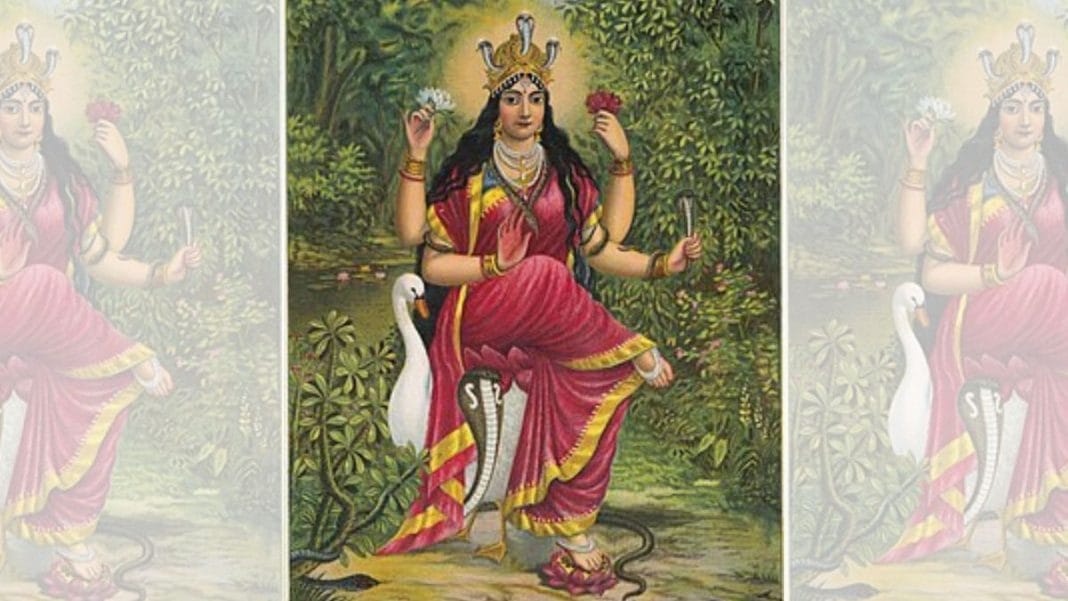


In the vast mythological tapestry of India, gods and goddesses are accorded immense reverence. Yet, Manasa stands out as a uniquely powerful and deeply misunderstood and marginalised figure. She is the goddess of snakes, associated with fertility, prosperity and protection from venomous bites. However, many of us remain unaware of a goddess of snakes.
We grew up hearing of the ‘Nag Devta’ or ‘Nag Raj’. Fertility is often associated with Goddess Parvati and her various forms, while prosperity is most commonly associated with Goddess Lakshmi.
Manasa is primarily worshipped in parts of Bengal, Bihar and Assam. In some traditions, she is worshiped as a plant locally called as Hildaona, the Indian spurge. She is believed to possess the power to heal but also to destroy; she can bless people with children, but can also bring plague, infertility and death.
Yet despite her formidable power, Manasa has been systematically sideline from the mainstream Hindu pantheon. A casualty of what scholars describe as Brahmanical patriarchy a social order in which caste and gender hierarchies reinforce each other.
As one researcher has put it, “It is an enduring contradiction that Hindus revere their goddesses, but their society is dominated by Brahmanical Patriarchy.”
We readily assume that goddess worship celebrates female power. Yet we often fail to examine how these traditions developed within deeply patriarchal societies that restricted women’s autonomy and continue to shape gender relations today. Manasa’s story, therefore, is not simply about a goddess. It can also be read as the story of countless women who are powerful and revered, yet remain marginalised by the very social structures around them.
The reality of Goddess Manasa unfolds with the truth hidden beneath the long-forgotten erased texts of Aryan Invasion. Her worship is generally understood to have roots in older, regional and folk traditions of eastern India, predating or developing alongside the spread of Brahmanical religious practices in the region.
Her devotees included rural communities, particularly women and marginalised caste groups, who worshipped her through songs, chants, vows and other non-Vedic rituals. This vibrant laukika, or folk, tradition was deeply embedded in everyday life and often existed outside the textual and ritual frameworks of orthodox Brahmanical Hinduism.
This was a goddess of the people and for the people — a deity who protected communities living in the riverine and forested landscapes of eastern India from the everyday threat of snakebite.
As Brahmanical traditions expanded and interacted with local religious cultures, independent folk traditions such as Manasa worship were increasingly incorporated into broader Hindu frameworks. In some cases, local deities were not erased but absorbed, reinterpreted and repositioned within larger Brahmanical pantheons. Such processes preserved aspects of local traditions while also transforming their meanings and status.
The Mangal Kavyas, a genre of Bengali devotional narratives composed and circulated particularly between the fifteenth and eighteenth centuries, played an important role in this process. These narratives became “instruments through which Hindu identity was reconstructed”, absorbing local religious worlds into a wider Hindu framework. This process was both a boon and a constraint. It helped preserve local traditions in literary and religious memory, but it also transformed the position and character of deities such as Manasa.
In the Manasa Mangal, one of the best-known narratives surrounding the goddess, Manasa is presented as a daughter of Shiva and is placed within an established divine hierarchy. Her independent status as a folk deity is thereby reframed within a broader Brahmanical cosmology. Her worship, once rooted in local communities and traditions, becomes entangled with a patriarchal and caste-based social order.
This tension is most visible in the Manasa Mangal itself. The central conflict revolves around Manasa’s desperate attempts to secure recognition from Chand Saudagar, a wealthy and powerful merchant. Chand refuses to worship her, even as the goddess subjects him and his family to a series of trials and tragedies.
Chand Saudagar can be read as a representation of elite patriarchal authority—a mortal man who refuses to recognise the power of a goddess. The irony is striking: a powerful female deity must seek acknowledgement from a man who represents the social order that denies her legitimacy. Her divine sovereignty is thus repeatedly placed in negotiation with male authority.
The conflict is also deeply intertwined with caste. Manasa is repeatedly insulted and treated as inferior by Chand and the social world he represents. His refusal to worship her is therefore not simply an act of personal disbelief; it can also be read as an assertion of caste and social hierarchy. Even after Manasa retaliates and ultimately prevails, the restoration of Chand’s prosperity depends upon his eventual acknowledgement of the goddess.
This creates a striking contradiction. Manasa possesses immense supernatural power, yet the narrative ultimately requires her to secure recognition from a powerful man. Her victory becomes a form of resistance, but that resistance is still framed within a patriarchal social order in which male acknowledgement remains crucial.
The story of Manasa, therefore, is not merely a forgotten or marginal myth. It can be read as an echo of the experiences of countless women who have been powerful, revered and indispensable, yet simultaneously pushed to the margins of social and political life.
A goddess who once stood at the centre of local communities was incorporated into a larger religious framework and, in the process, her identity and position were transformed. Her marginalisation reveals an enduring contradiction within Indian society: goddesses may be worshipped as embodiments of power, while the societies that worship them can remain deeply patriarchal.
To rediscover Manasa is therefore not simply to restore a forgotten goddess to memory. It is also to revisit the histories of local traditions, caste, gender and religious assimilation — and to listen to the long-muffled voices of feminine power that continue to survive within the shadows of tradition, waiting to be heard, honoured and remembered.
Meghaangee Chakrabarti is a student of Christ University, Bengaluru. Views are personal.
Also Read: How Hindi can learn from China’s Mandarin diplomacy and global soft power