



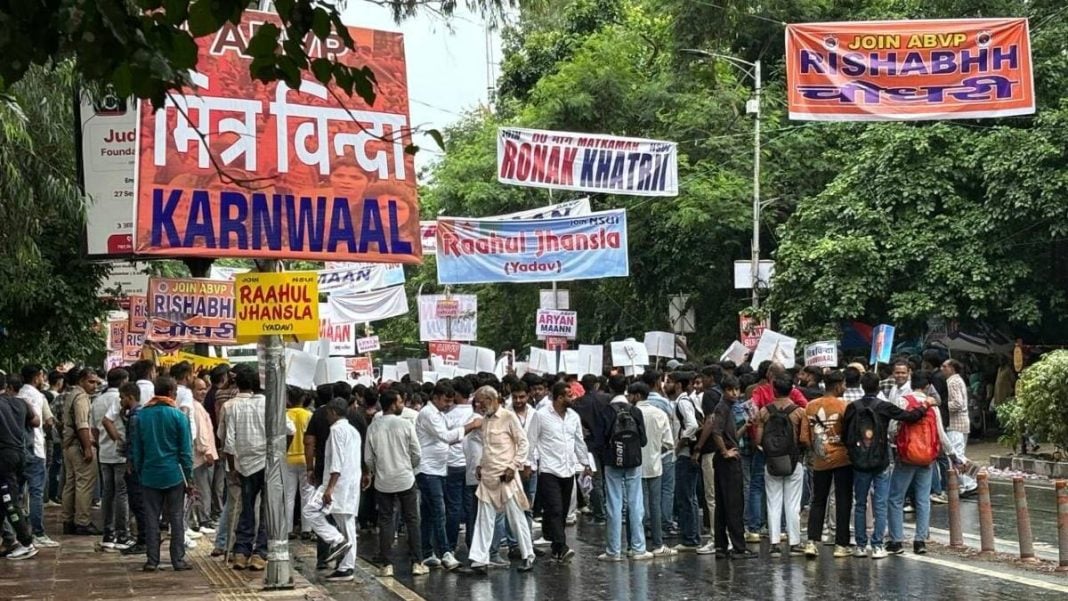


Delhi University elections are routinely described as one of India’s most important student political contests. Yet that democratic spectacle rests on a profoundly uneven architecture of participation.
The Delhi High Court in 2024 recorded that only six of Delhi University’s 43 colleges were women’s colleges affiliated with DUSU, even though women students in the remaining colleges constituted almost half of the University’s total strength.
Over the years, DUSU has acquired a particular conception of what politics looks like with the campaign built around visibility, crowds, SUVs, add-on of regionalist sentiments, and, at regular intervals, confrontation and intimidation. The spectacle sits easily giving no due regard to the Lyngdoh Committee recommendation pertaining to curb the influence of money and muscle power in campus politics.
When political credibility is repeatedly produced through such territorial control and networks, with an estimate of Rs 40-50 lakh being spent by the candidates, politics simply becomes a yearly spectacle rather than a struggle for students.
In this hyper-masculine model of politics, which is notoriously violent, safety reasons for excluding women’s colleges given the ugly turn that political rivalries might take during elections—institutions like Lady Shri Ram, Gargi, Jesus and Mary being anything but apolitical, are outside the electorate for the university’s central students’ union. While their exclusion has been allowed to acquire the appearance of an administrative decision, in the coming elections, most women’s colleges won’t be represented as they are not a part of DUSU.
Earlier this year, LSR students protested after their principal appeared on BJP’s political party social media platform, despite the college’s well established claim to be ‘apolitical’. But perhaps if the culture of student elections is built around men, money and muscle, their opting out can look like an assertion of political autonomy rather than apathy. Perhaps when women’s colleges are routinely described as safer; as spaces that have simply chosen not to participate in the rough world of DUSU, their distance is a mere choice—as though the environment that produced that choice has nothing to do with it.
Feminist politics begins, in part, precisely by asking who gets to be political or to say, who has been excluded from being political from the very beginning. If students have concluded that DUSU is too violent, too partisan, too expensive or too disconnected from their concerns, the question cannot be simply why they do not participate, but it has to be: who designed this political arena in the first place, and why have we accepted its rules to appear natural.
If DUSU is exclusionary, withdrawal can look like resistance. But it can also make exclusion invisible.
If Miranda House—one of the few women’s colleges still part of DUSU, were to withdraw from the election tomorrow, would it trigger a crisis of democratic legitimacy, or would it simply be registered as merely another institutional choice?
The question matters because it exposes how accustomed we have become to women’s political absence. Or perhaps, that is the danger of exclusion being seen as a mere choice. Because it no longer looks like exclusion. It looks like safety. Choice.
The way forward cannot be just another appeal to women to participate more. The institution must also revisit whether the current electoral system gives students an equal opportunity to elect, let alone contest.
And then if ever another women’s only college also chooses to opt out, perhaps the first response would be to ask what made staying no longer worth it.
Arpita Jain is a student of Faculty of Law, University of Delhi. Views are personal.
Also read: What lies ahead for Cockroach Janata Party