







Bloomberg: A battle for the future of artificial intelligence is being waged from the banks of the Huangpu river in Shanghai.
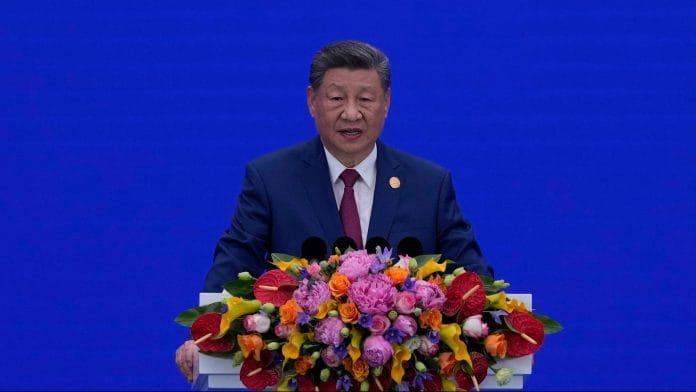
For the first time in its nine-year existence, President Xi Jinping kicked off China’s flagship AI summit, as overt a sign as any that this tech competition is as much about securing geopolitical influence as it is about coding efficiencies. Addressing industry chiefs and a growing cohort of global leaders now in attendance, Xi laid out China’s vision: Beijing is not content just being a player in the next industrial revolution — it wants to lead it.
Xi reiterated his calls for AI to be inclusive, extended open arms to Global South nations eager not to be left behind, and urged attendees to keep the technology under human control. He also reaffirmed China’s commitment to open development: “We should seize this rare historic opportunity to encourage open-source, openness, and collaboration.”
It’s a rare moment indeed. The remarks take a clear side in the crusade for the future of AI: whether its evolution will progress in the hands of a few elite labs or the people. American firms have bet on the former, which makes good business sense. China is urging the rest of the world to join in the latter.
The push to develop AI that can be freely shared has faced valid pushback over safety, with some in the industry arguing that making the digital equivalent of a nuclear bomb probably shouldn’t be available to all. Whether Beijing can contend with AI risks as part of its governance strategy, and genuinely leverage the open community to harden guardrails rather than break them, will be a major test.
Yet Xi’s attendance at the World AI Conference comes at a time when Chinese companies are upending the global tech race with this strategy. On the eve of the summit, Beijing-based Moonshot released Kimi K3, a massive open-weight model that early benchmarkers say is on-par with top-of-the-line offerings from Silicon Valley.
It dropped just weeks after fellow “Little Dragon” Zhipu, listed as Knowledge Atlas Technology JSC, released GLM 5.2, which influential investor Marc Andreessen called the first Chinese model to match and often beat US rivals “with no compromises.” The rapid pace of releases from both startups and Chinese Big Tech firms over the past year show that DeepSeek wasn’t a fluke. It gives significant backing to Xi’s ambition; China is the only country in the world competing neck-and-neck with Silicon Valley in the post-ChatGPT era.
The government’s pledge also contains a thinly veiled threat to its own companies that could make it all come undone. In recent months, cheap Chinese AI has garnered attention for undermining the business models of US titans. But the same commoditization pressures domestic firms as well. With so many companies now giving away their technology, it makes it hard to differentiate or find real revenue streams.
There’s a real danger that these companies go the way of electric vehicles: endlessly undercutting and competing with each other. The potential is especially apparent here in Shanghai, where over 1,000 firms are exhibiting. As more of these startups go public — with a high-profile DeepSeek IPO reportedly in the works — it’s something more difficult for investors to overlook.
But it’s a much bigger warning shot to American model makers like Anthropic PBC and OpenAI. Just-as-good Chinese alternatives are punching holes in their moats and challenging astronomical valuations ahead of their mega-IPOs.
Ultimately, it’s hard not to contrast Xi’s speech on global cooperation with events unfolding in Washington almost simultaneously. In a prime-time address, President Donald Trump accused China of interfering with the 2020 elections, claims that haven’t been backed by the US intelligence community. The spiel threatens to strain already fraught ties just as more people around the world view China more favorably than the US for the first time in nearly two decades.
Notably, Xi also revealed that he views AI as the next general purpose technology when he equated it to the steam engine and electricity. Historically, geopolitical power has been won not by who invented a breakthrough first, but who was able to spread its capabilities most widely throughout the economy. Xi recognizes that the real metric of the AI race is diffusion. He’s playing the long game. Can the same be said for Washington?
If history is being written in Shanghai this weekend, and China’s vision for the AI future plays out, the consequences will be more profound than market share. The openness could just as easily be pulled back once it’s no longer needed to undermine US dominance. And by then, Chinese models will have already become the default.
This report is auto generated from the Bloomberg opinion service. ThePrint holds no responsibility for its content.