





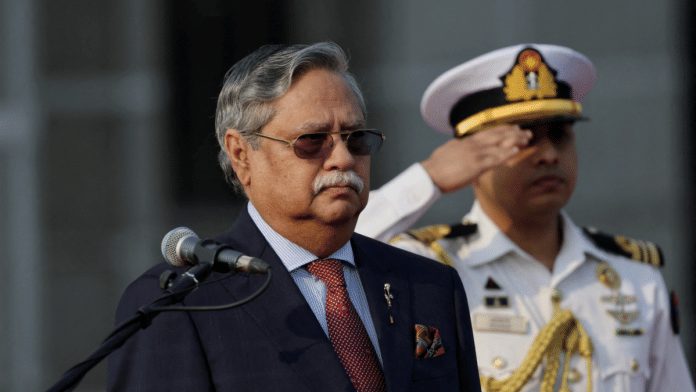


New Delhi: Bangladesh President Mohammed Shahabuddin resigned Friday, ending a presidency that oversaw one of the country’s most turbulent political transitions.
Speaking to reporters Friday afternoon, Shahabuddin confirmed his decision to step down. “It is already public knowledge. What’s the point of hearing it from me? I am unwell, so I have resigned,” he said.
According to reports, political pressure over his alleged ties to former prime minister Sheikh Hasina led to his resignation. His departure comes as Hasina announced a return to Bangladesh after nearly two years in exile in India, despite having been sentenced to death in absentia.
Since then, Shahabuddin had come under increasing pressure from leaders of the ruling BNP to step down, according to sources cited by BBC Bangla.
Shahabuddin, who had served as president since April 2023, remained in office through the ouster of Sheikh Hasina as prime minister in August 2024 amid protests led by youth, and the installation of a caretaker government days later.
Prothom Alo first reported the resignation Thursday, which was later confirmed by officials. Constitutionally, a new president is to be elected within 90 days.
Speaker of Parliament, Hafiz Uddin Ahmad, will assume the responsibilities of acting president in accordance with the Constitution until a new president is elected and sworn in.
Ahmad returned to Dhaka from Bangkok on Friday, where he had traveled on 19 July for medical treatment. Although he had originally been scheduled to return Sunday, he cut short his visit and arrived two days earlier.
The ruling Bangladesh Nationalist Party (BNP), which holds a two-thirds majority in Parliament, is widely expected to secure the election of its nominee. Senior BNP leaders have been meeting over the past several days to discuss potential successors to Shahabuddin, Prothom Alo noted.
Shahabuddin became Bangladesh’s 22nd president on April 24, 2023, during the tenure of the Awami League government. His constitutionally mandated five-year term was due to expire in April 2028, but he resigned nearly two years before its scheduled end.
His continuation in office became the subject of sustained political debate after the collapse of Sheikh Hasina’s government during the July-August 2024 mass uprising. The discussion intensified after the Bangladesh Nationalist Party returned to power following the 13th Jatiya Sangsad election.
The resignation also follows months of increasingly public criticism by Shahabuddin of the country’s interim administration led by Muhammad Yunus.
In February, just days after Bangladesh’s new government was sworn in, Shahabuddin gave an interview to the Bengali newspaper Kaler Kantho, accusing Yunus and leaders of the student-led uprising of conspiring to remove him through unconstitutional means during the country’s 18-month political transition and attempting to sideline the constitutionally elected president.
He then added that he had virtually no communication with Yunus during the interim government’s tenure and accused the former chief adviser of marginalising the presidency.
The remarks echoed comments the former president made in an interview with Reuters in December 2025, when he said he intended to leave office before completing his term, citing what he described as “humiliation” and marginalisation under the interim government.
Although the presidency in Bangladesh is largely ceremonial, with executive authority vested in the prime minister and cabinet, the office assumed unusual importance after Sheikh Hasina fled to New Delhi in August 2024 amid a student-led uprising that dissolved Parliament, leaving Shahabuddin as the country’s sole remaining constitutional authority.
Home Minister Salahuddin Ahmed said Thursday that the government had not asked the president to resign, adding that the Constitution permits the president to leave office if he chooses.
(Edited by Ajeet Tiwari)
Also Read: 2 yrs after the student uprising, Bangladesh faces a question: What did the bloodshed achieve?