






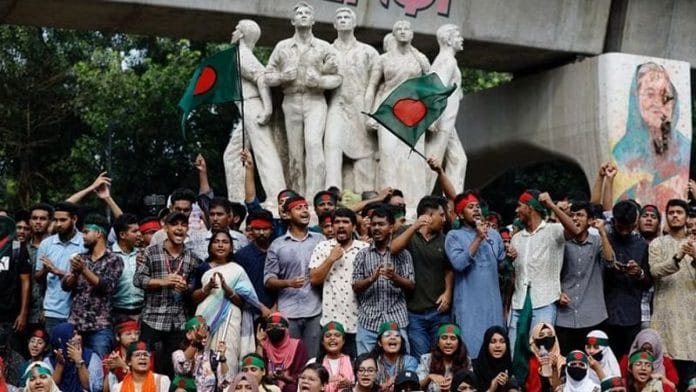


July is a busy month for Bangladesh. It is also the nation’s month of reckoning. In 2024, the students’ uprising that spread across the country like wildfire in July brought down the regime of then-prime minister Sheikh Hasina by early August.
The two Julys since then have been marked by national days of remembrance, state homage by highest-ranking government officials, and rallies at landmark locations like Saheed Minar by parties such as the National Citizen Party (NCP), the new student-led party that came out of the 2024 uprising.
But something has changed this July. The word itself has become a prefix for the divisive, cuss phrase ‘July CDI’. While the NCP and Bangladesh Jamaat-e-Islami, the country’s largest Islamist party, are now firmly in bed, Bangladesh is grappling not just with the Hasina question, but a more existential query: what was the point of so much bloodshed in July 2024?
‘July CDI’ and the Hasina hangover
On 1 July this year, popular Bangladeshi actress and director Meher Afroz Shaon made a controversial social media post referring to the 2024 uprising as “July CDI”. The abbreviation “CDI” is a common Bengali cuss word, used in both Bangladesh and West Bengal. On 4 July, The Daily Star reported that a general diary has been lodged with the Shahbagh Police Station against three women, actresses Meher Afroz Shaon and Mahiya Mahi and Shanta Farjana, for “allegedly mocking the July uprising and disrespecting its memorial on social media”.
“According to the complaint, Shanta Farjana threw a shoe at the July memorial. Meanwhile, Shaon allegedly portrayed the July uprising as a ‘staged event’, while Mahi allegedly mocked individuals and organisations that participated in the movement,” the Daily Star report said.
Since then, Bangladeshi social media has been filled with users referring to the students’ uprising as ‘July CDI’. In a viral Facebook post, user Joyturja Chowdhury is seen showing the middle finger to supporters of the “unholy” July uprising as he repeats the words ‘July CDI’ while speaking out against those who disregard Bangladesh’s 1971 war of independence, the leaders and supporters of the Jamaat-e-Islami, and other fundamentalist forces.
From the other side, the term ‘Mujib CDI’ has been coined to attack those who are putting up posts deriding the students’ uprising. Popular YouTuber Elias Hossain put up a post telling his viewers that to answer those who are shouting ‘July CDI’, the words ‘Mujib CDI’ and ‘Hasina CDI’ would be used from now on.
For retired Bangladeshi diplomat Mohammad Harun Al Rashid, the social media disenchantment with the July uprising and the coinage of slangs around it have to do with the realisation that under the garb of a students’ revolt, Islamists have been empowered in Bangladesh.
“First, Muhammad Yunus gave a free run to the Jamaat-e-Islami and other radical forces, and now Tarique Rahman is carrying on with the same policy of pandering to Islamists. Naturally, a large chunk of the citizenry is agitated with the direction Bangladesh is taking,” Rashid told ThePrint over the phone.
For Bangladeshi political journalist Sahidul Hasan Khokon, even on the second anniversary of the July uprising, the Hasina question still haunts Bangladesh. “Hasina’s declaration that she would return to Bangladesh this December has the country divided. The Tarique Rahman government is rattled. A court has given Hasina the death verdict yet there is considerable social media and ground support for her in Bangladesh,” Khokon told ThePrint, adding that the popularity of the phrase ‘July CDI’ goes on to show how a sizeable section of the population has turned away from those who thought overthrowing Hasina would change Bangladesh for the better.
“Despite government crackdown there are now open processions across Bangladesh in support of Hasina. This, even as the Tarique Rahman government has effectively cut off legal avenues for the Awami League to return to electoral politics,” Khokon said.
Also read: Bangladesh Army turns religious. Fidel Castro had warned Sheikh Mujib
What became of the revolution?
One of the big reasons why the July uprising has not been able to bring Bangladesh together is the persistent doubt over who led it and why. Every revolution needs a face, for the July uprising of 2024, it was the face of then-23-year-old Abu Sayed. On 16 July, Sayed was among the angry protesters who took on Hasina’s police in front of Rangpur’s Begum Rokeya University.
Sayed stood ahead of other protesters, directly in the line of fire of the policeman in front of him. Videos of what happened next, captured by multiple media outlets, would show police officers firing rubber bullets at Sayed, injuring him. He fell to the ground. Fellow protesters rushed him to the Rangpur Medical College Hospital. Doctors declared him dead on arrival.
The killing of Sayed gave the July uprising the impetus it needed. His picture, arms outstretched, daring the police to shoot him, would fire the students’ movement against Hasina’s hard power, and cross borders to find resonance among students, artistes, and celebrities in Kolkata. But who was Abu Sayed?
A month after Sayed’s death, I was invited to a closed-door meet at one of Delhi’s premier think-tanks to discuss the events unfolding in Bangladesh. The Hasina government had fallen by then, and so had her father Sheikh Mujib’s statues, pulled down by violent mobs that went around smashing and burning anything that reminded them of Awami League and what it stood for.
Sworn to Chatham House Rule, the events in Bangladesh were discussed by two former Indian Ambassadors to Bangladesh, two retired lieutenant generals of the Indian Army, and a top intelligence official, now retired, who said India should be worried about the growing cult of Abu Sayed.
“Abu Sayed’s Facebook posts showed a deep sense of mission. He drew strength from Islamic history, jihad, and martyrdom. He was a fan of Jamaat-e-Islami’s preacher-leader Moulana Delwar Hossain Sayeedi, a convicted war criminal in 1971. Do you guys know that in 2013, the International Crimes Tribunal in Bangladesh found Sayeedi guilty on eight out of twenty counts, which included murder, rape, and religious persecution?” the retired official said.
But why was he keeping a tab on Abu Sayed’s Facebook account? “The intelligence community in India was keeping tabs on all the leaders of this so-called students’ revolt against Hasina. Abu Sayed suddenly became this Che Guevara figure. We had to dig deeper about him. He was part of Bangladesh Islami Chhatrashibir, the de facto male student wing of Bangladesh Jamaat-e-Islami. And Sayed was not the only one. The movement was backed by the Jamaat from the start. The agitation against quota was just an excuse to overthrow Hasina and hand the country back to her radical detractors,” he said. “Hasina had been warned about this”.
And it was not just about Abu Sayed. For my book on the July uprising and its aftermath, Inshallah Bangladesh: The Story of an Unfinished Revolution, I had spoken to Bangladeshi independent filmmaker and writer FM Shahin. He had said that the uprising ended up creating a whole generation of ‘Digital Razakars’ or young radicals who use social media to spread their message.
“The Digital Razakars are everywhere. In college campuses, in coffee shops, freshly recruited in private and government jobs, in media and NGOs. There is no escaping them. They come out to bring down the house of Mujib or gather to call for the ban on Awami League and then they go back to their daily lives, to their social media feeds and their WhatsApp groups to talk about Islamist supremacy. It’s a scary new world,” said Sahin.
Interestingly, the political party that was birthed by the July uprising, the NCP, entered into an electoral alliance with Jamaat-e-Islami ahead of Bangladesh’s general election in February 2026. The alliance led to multiple resignations by top leaders of NCP, leading to an internal crisis in the party and deepening the doubt that the July uprising was always an Islamist plot to take over the reins of the country.
Finally, on the second anniversary of the July uprising, Bangladesh is faced with an existential question: what did all the bloodshed achieve?
“Citizens did not risk their lives on the streets of Dhaka merely to replace one predatory elite with another,” Shofiqul Islam wrote for Daily Waadaa.
“Their aspirations were structural, reflecting a long-deferred hope that the country could finally break free from its exhausted cycle of political vengeance and begin the tedious work of building a genuinely accountable state,” he said. Instead, he added, the July uprising merely removed a government, but the incentives of governance itself haven’t changed much.
For a bloody uprising that saw 1,400 fatalities and over 20,000 injuries, surely the gains should have been much more than this.
Deep Halder is an author and a contributing editor at ThePrint. He tweets @deepscribble. Views are personal.
(Edited by Aamaan Alam Khan)
It achieved headlines in the West and a myopic satisfaction in the heads of so called revolutionaries. They will realise their folly when they find nothing would have changed in a decade and then it would be too late by then. Stupidity is easy to follow, putting the head down and toiling for nation building is the tougher ask.
It good rid of Ms Sheikh Hasina’s increasingly autocratic, kleptomaniac rule. The only free and fair general election was the one that returned her to power. The subsequent ones were rigged, did not enjoy international legitimacy. 2. On the morning when she fled Bangladesh, she still directed use of lethal force against the protestors. Only to be advised she had one hour to pack and leave, beyond that her own security could not be guaranteed.
Bloodshed led only to loss of lives. Even after the independence uprising of India and Bangladesh, both continue to remain as shithole socialist countries. Corruption and incompetence are deeply ingrained in the Indian subcontinent and nothing can change it.