




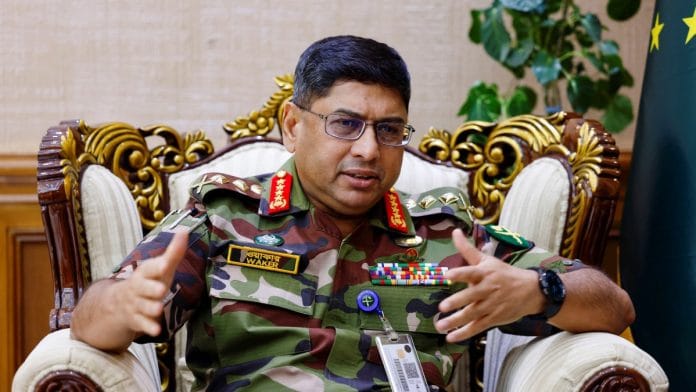

The spectre of Islamism that had cast a long shadow over Bangladesh’s politics, civil society, and academia has not spared the Bangladesh Army. Last month, during a formal address at the Bangladesh Military Academy, Army Chief General Waker-Uz-Zaman underscored the importance of religious values and adherence to moral principles in military life.
The Bangladesh Army has also raised a new unit with four companies named after the first four Islamic Caliphs — Umar, Abu Bakr, Ali, and Uthman. For an army that prided itself as being secular and apolitical, these changes have raised eyebrows both within the country’s borders and outside it. This religious turn though is not a new development.
As long ago as 1973, Fidel Castro had both predicted and warned against such an eventuality.
Religion first?
Last year, on 16 August, Waker-Uz-Zaman had reaffirmed the secular foundations of Bangladesh on the occasion of Janmashtami, saying that Bangladeshis would follow the ideals of Lord Krishna and live together in harmony. It was a time of communal unrest and the country was under the rule of an unelected interim government headed by Muhammad Yunus.
“This country belongs to everyone,” Waker had said. “There will be no division based on religion, ethnicity, or community. You will live in this country without fear. We will always stand by your side”.
The army chief had pledged to defend Bangladesh’s secular identity. “Hindus, Muslims, Buddhists, Christians, hill people, and Bengalis, we have all lived together in peace for centuries,” he said, adding that “whatever support and assistance you seek from us, Insha’Allah, we will provide it.”
In a marked shift from this secular stance, this year, on 18 June, while addressing the President’s Parade marking the commissioning of officer cadets from the 90th Long Course at the Bangladesh Military Academy, Waker spoke about the importance of religious values and adherence to moral principles in military life.
Waker’s change in stance was noted beyond Bangladesh borders. “Interesting transformation in Bangladesh Army Chief General Waker-Uz-Zaman. Once clean-shaven, he’s now sporting a full beard and in his last 2 speeches, he’s urged the military to embrace Islamic values,” Pakistani journalist and security expert Ali K Chisti wrote on X.
The change in stance, it seems, is not limited to the chief, given the naming of the four infantry companies after the first four Caliphs of Islam by the Army for the first time.
“Traditionally, army units in Bangladesh have been designated by geographical, numerical, or administrative terms, making this shift toward religious nomenclature notable. The battalion was formally raised on June 18 at the Bangladesh Military Academy Bhatiyari by Army Chief General Wakar-uz-Zaman, shortly after his Haj pilgrimage,” a report said.
Warning Indian security forces to remain vigilant against the growing radicalisation of the Bangladesh Army, Indian Army veteran Lt Gen MK Das, in an article in Organiser, wrote that this has a lot to do with the resumption of relations between the Bangladesh and Pakistani armies. Das said the battle cry of these new battalions in the Bangladesh Army has been changed from Joy Bangla (Victory to Bangladesh) to Islamic Allahu Akbar.
“There were reports of rise in radicalisation and Islamist influence in the Bangladesh Army in the past. The attempts at radicalisation were low key under PM Sheikh Hasina regime. But after her ouster from power in August 2024, the Bangladesh Army exhibited more eagerness to embrace Islamist traditions and similar recruitment narratives,” Gen Das said, adding that Pakistan’s ISI always had a deep footprint inside Bangladesh through the radical Jamaat-e-Islami which is now the main opposition party in the country.
And it is this Islamist footprint exported from Pakistan that former Cuban president Fidel Castro had warned Bangabandhu Sheikh Mujibur Rahman against in 1973.
Also read: Stop selective prosecution of Awami League. Bangladesh’s credibility depends on it
Castro’s warning
During a historic meeting in September 1973 at the Non-Aligned Movement Summit in Algiers, Algeria, Castro had famously praised Mujib’s towering presence and said he had not seen the Himalayas but had “seen Sheikh Mujib”. But the fiery revolutionary leader also had a grim warning for the founding father of Bangladesh: showing magnanimity to his political enemies would be considered a sign of inherent weakness in his character and not as a moral virtue.
Describing the meeting in his book Mujib’s Blunders: The Power and the Plot Behind His Killing, veteran journalist and Bangladesh expert Manash Ghosh wrote that Castro could see what Mujib couldn’t. While Mujib thought putting repatriates from Pakistan in key government positions would result in a change of heart, Castro had warned Mujib that it would set a dangerous precedent. “You are setting the country up for counter-revolution. When I threw Batista out of power in Cuba, I weeded out all his trusted men and replaced them with my own men,” Ghosh quoted Castro as telling Mujib.
Ghosh wrote that Mujib even made Pakistan’s intelligence chief his vigilance commissioner and the net result was that he was able to spy on him better and pass on crucial information to his former Pakistani masters. It was Mujib’s blunder that brought back pro-Pakistan, Islamist elements in Bangladesh’s administrative and military rank and file and eventually led to his assassination on 15 August 1975.
Decades later, on 19 January 2012, the BBC reported that the Bangladesh Army had foiled a coup by Islamist officers to overthrow then–Prime Minister Sheikh Hasina. “A band of fanatic officers had been trying to oust the politically established government. Their attempt has been foiled,” Brig Gen Razzaq was quoted as saying by the BBC. Razzaq had said “specific information has been unearthed” that some officers in military service were involved in the December conspiracy and a group of up to 16 hardline Islamist military officers, including at least two retired officers, were involved.
Fourteen years after that thwarted military coup, as Sheikh Hasina plans to return to Bangladesh, the Bangladesh Army has again taken a religious turn even as it tries to cosy up to Pakistan.
Deep Halder is an author and a contributing editor at ThePrint. He tweets @deepscribble. Views are personal.
(Edited by Aamaan Alam Khan)
For me, I shall pretend my entire world begins and ends with Bharat. I will sit comfortably like a frog-in-the-well, whispering to myself that whatever happens in West and East Pakistan cannot possibly touch us.
After all, the tragedies of Pahalgam were surely a figment of your imagination. The targeted violence against East Pakistan’s Hindus and the resulting waves of illegal immigration are merely illusions of your troubled mind.
Naturally, I will invoke ‘secularism’ and ‘professionalism’ to pat myself on the back, while safely avoiding shedding a tear for the soldiers who actually bleed at the borders to secure my right to be oblivious.
Because at the end of the day, I am compulsively compelled to say grand, inconsequential things… very frequently
For me, the world begins and ends with India. Pakistan and Bangladesh are different colours on the political map of South Asia. So, don’t think too much about what is happening in GHQ in Rawalpindi and its equivalent in Dacca. Our armed forces have a long, proud tradition of professionalism and secularism. Any dilution would impair the cutting edge calibre required to deal with a two front war.