



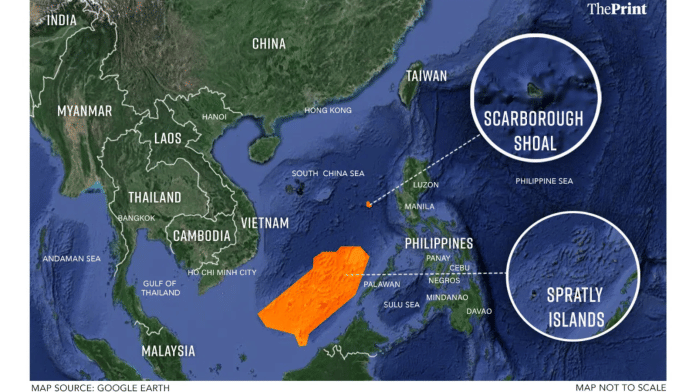
New Delhi: Nearly 10 years after the Philippines won a case against China at a Hague-based tribunal at the Permanent Court of Arbitration over sovereignty rights on Scarborough Shoal, tensions between the two Asian nations have escalated again.
China’s People’s Liberation Army (PLA) Monday announced that it has dispatched vessels and aircraft to the South China Sea in response to a joint US-Philippines maritime drill in the waters near Scarborough Shoal over the weekend.
The statement came after Manila said four Chinese vessels monitored the maritime exercise near the shoal.
Manila is fearful that China is preparing to take permanent control of the South China Sea shoal, which is about 120 nautical miles (222 km) west of the Philippine island of Luzon and is considered part of the Philippines’ Exclusive Economic Zone (EEZ).
Gilbert Teodoro, Defence Secretary of the Philippines, told Financial Times in an interview that the threat of permanent Chinese control is “significantly higher” than before. In the interview, published on 21 June, Teodoro said China has been operating a maritime research vessel in the disputed area. He said it could be “something to prod us with on the 10th anniversary of the arbitration award”.
Beijing has previously used research vessels to map and conduct activities with the apparent aim of developing artificial islands in disputed waters.
In April 2026, based on satellite images, it was reported that China had created a 352-metre floating barrier at the entrance to the shoal. Tensions escalated in June when Manila took diplomatic action to protest against an “illegal structure” at the shoal. The country’s South China Sea task force claimed to have found a 6 by 6 metre, floating structure with an antenna. China removed the floating structure last week.
After years of patrolling along Beijing’s nine-dash line claim, the China Coast Guard (CCG) last year seems to have concentrated its efforts at Scarborough Shoal by maintaining an unprecedented level of presence.
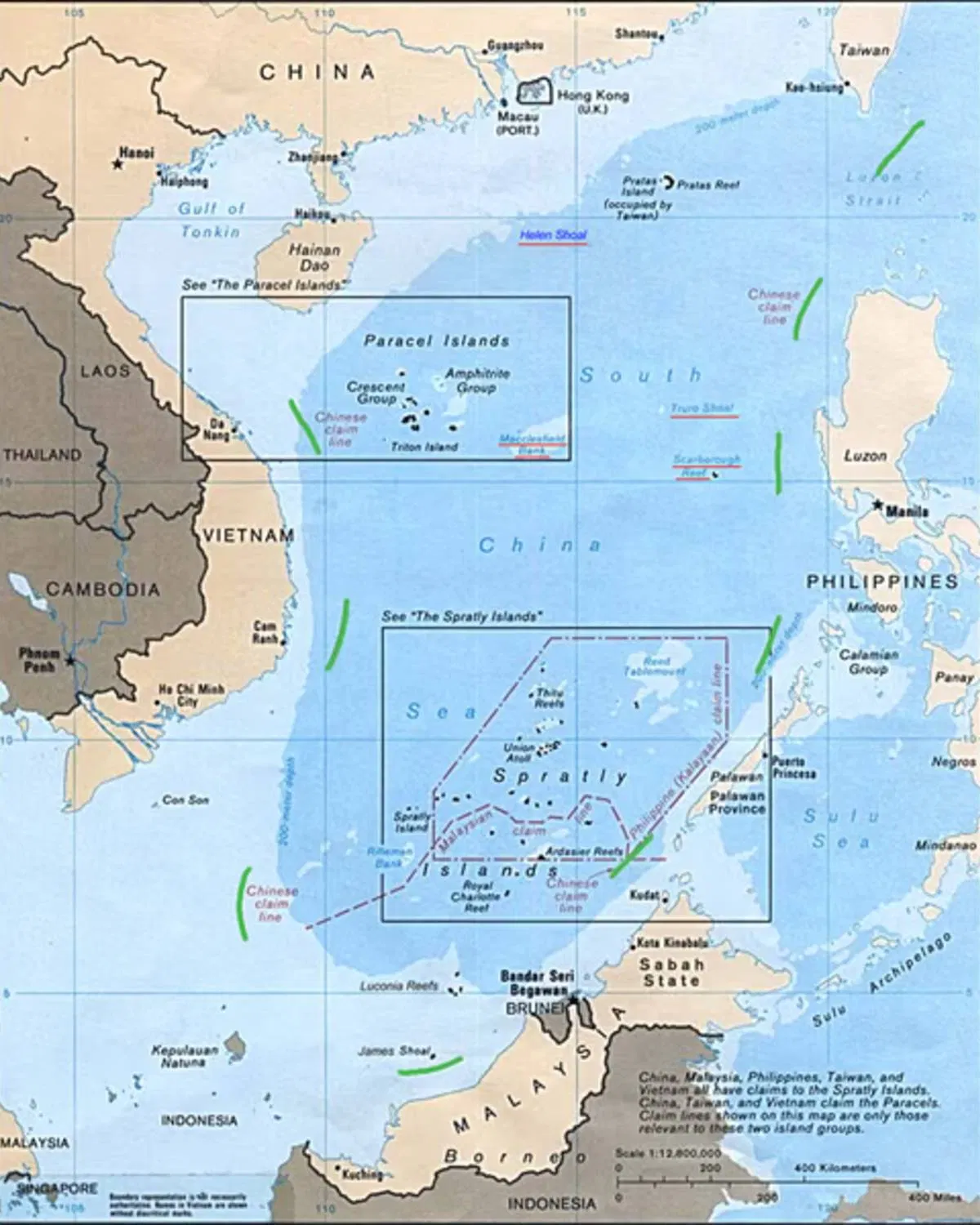
The nine-dash line is a set of line segments detailing China’s claims over various areas of the South China Sea, many of which are disputed territories.
2025 saw a widening gulf between China and the Philippines, with Manila accusing the Chinese navy and CCG of ramming ships and using water cannons against them. A series of combat readiness patrols and exercises, involving the navy and air force, were also conducted by China in May and August last year.
Then in September, China announced a plan to develop a nature preserve, covering the entire northeastern side of Scarborough Shoal, to conserve a 3,524-hectare (8,708-acre) coral reef ecosystem. The northeastern side was declared a “core zone” with an “experimental zone” flanking it.
The announcement drew strong criticism from Manila and US Secretary of State Marco Rubio.
Also Read: China is worried about US–Philippines military exercises. It’s too close for comfort
What is the shoal all about
Named after a British merchant vessel that got grounded there in 1748, the shoal is a triangular coral atoll having an inner lagoon and several rocks, located 200 km off the Philippines. The Chinese name for the shoal is Huangyan Dao or Minzhu Jiao, while the Filipinos call it Panatag Shoal or Bajo de Masinlok.
It is 874 km away from Hainan, the nearest Chinese territory in the South China Sea.
Located nearly in the middle of the South China Sea, inside the EEZ of the Philippines, Scarborough Shoal covers a total area of 150 square km. The shoal has a lagoon, with several rocks above the sea level forming a natural boundary around it.
It’s in close proximity to vital shipping lanes carrying an estimated $3 trillion worth of commerce annually, and can provide a natural safe haven to ships during storms.
The shoal also provides a strategic connection to the Bashi Channel, which links the South China Sea to the Pacific Ocean. It provides a crucial link for the Chinese Navy to move from Hainan island into the Pacific Ocean.
In a 2017 interview with ABS-CBN news channel, Antonio Carpio, then Senior Associate Justice in the Philippines’ Supreme Court, had said: “Scarborough Shoal guards the exit to the Pacific because the Chinese submarines are based in Hainan island, and if they fire their missiles in the South China Sea, those missiles will not reach the US because the range is only about 7,500 km.”
US Senator and Marine Corps veteran Dan Sullivan in 2016 claimed that control of Scarborough Shoal, combined with existing bases in the Paracel and Spratly archipelagos, could pave the way for Beijing to eventually control the entire South China Sea. It would give China a “strategic triangle” to monitor and police the entire region.
A legal victory
After a tense 2012 standoff between Chinese coast guard ships and a Philippine naval vessel that had stopped a Chinese fishing boat for inspection, Manila moved the Permanent Court of Arbitration in 2013, accusing Beijing of “excessive” maritime claims at Scarborough Shoal.
In July 2016, the Hague-based court, under the UN Convention on the Law of the Sea (UNCLOS), ruled that China had no legal basis to claim the shoal and that the shoal was under the EEZ of the Philippines.
China, a signatory and state party to UNCLOS, rejected the ruling and has continued to maintain a strong maritime and military presence in disputed areas.
External Affairs Minister S. Jaishankar had said in 2024 that India supported Philippines’ sovereignty.
Shubhanker Tripathi is an alum of ThePrint School of Journalism, currently interning with ThePrint.
Also Read: ‘Third parties have no right to interfere,’ says China on India backing Philippines