



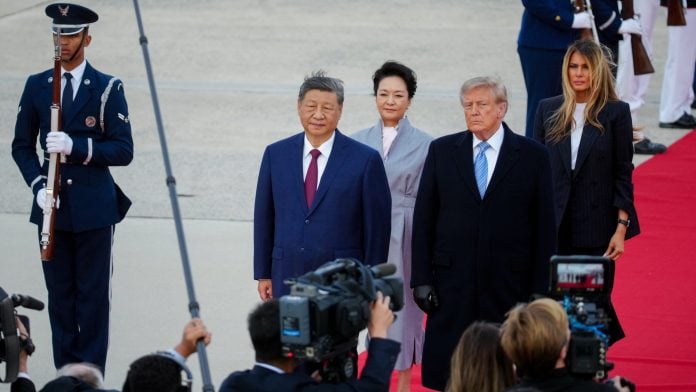
Treasury Secretary Scott Bessent announced the US and China have sealed a two-month extension to their trade truce, as Xi Jinping landed in America for his first state visit in eleven years.
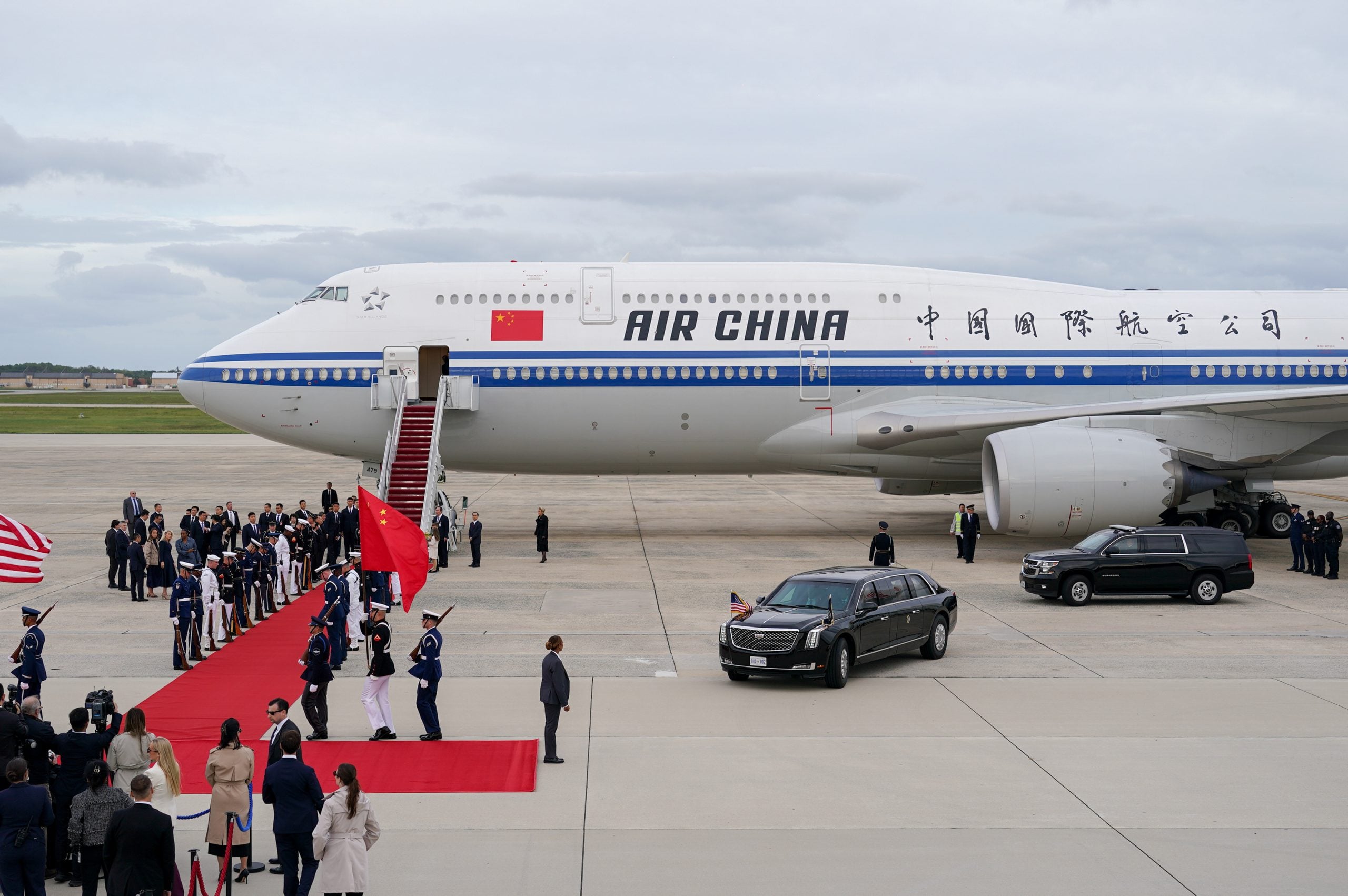
Xi and his wife Peng Liyuan, a celebrated soprano, touched down at Joint Base Andrews outside Washington shortly before 6 p.m. local time on Wednesday. Donald Trump shook hands with the couple, becoming the first US president in six decades to receive a foreign counterpart at that airport, excluding visits by the Pope.
Around the same time, Bessent unveiled a Jan. 10 deadline for the deal struck last year to keep down tariffs and some export controls between the world’s largest economies. The Chinese government has not confirmed that expiration date. “I don’t know whether a bigger deal can be done,” Bessent told Fox News.
Moments later, the Chinese Foreign Ministry released a statement from Xi declaring he is “confident” the trip would produce “fruitful results.”
Expectations for major breakthroughs have been low going into the summit. While the truce extension ensures stability until 2027, it fell short of the three-to-six month continuation some US officials had floated. The two-month addition, however, covers two world leader summits in Shenzhen and Miami later this year, where both men are expected to meet each other again.
“This sets a floor for the summit outcome, which markets can begin pricing in, while also leaving open the possibility that Trump and Xi will themselves strike a longer deal,” said Scott Kennedy of the Center for Strategic and International Studies. But the shorter time frame suggests the US is “yet to be satisfied with China’s offer on rare earths and possibly other issues,” he added.
With prospects for a longer-term extension still unclear, China’s benchmark CSI 300 Index fell 1.3% at Thursday’s midday break. MSCI’s gauge of Asian stocks dropped as much as 0.7% amid renewed pressure from elevated oil prices and US bond yields.
Shares of firms trying to provide an alternative to the China-dominated rare earths supply chain fell, as the truce extension allows more time for negotiations over the supply of the critical minerals needed for most modern technologies. In Tokyo, Toyo Engineering Corp., which makes technology to recover rare earths from the sea bed, slumped around 8%. Australian miner Lynas Rare Earths Ltd. slipped as much as 5%.
The truce between Beijing and Washington was unveiled last year at a summit between Trump and Xi in Busan, South Korea, and saw the suspension of high tariffs, rare-earth curbs and hefty fees for Chinese-built and -owned vessels calling at US ports.
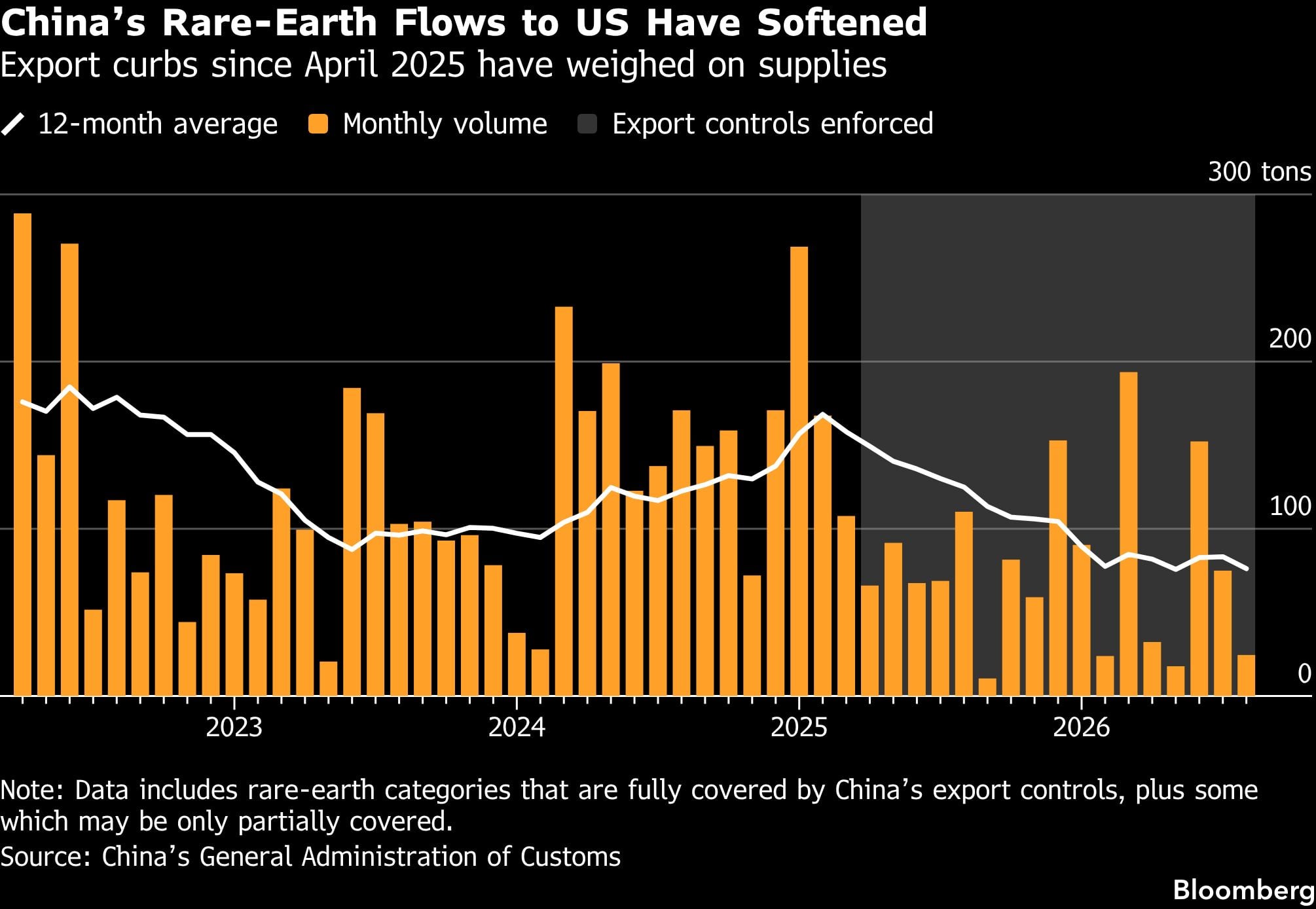
Bessent told Fox News on Wednesday that some deliverables “have not been perfect on the Chinese side.” China’s exports of rare-earth magnets, tiny but powerful components used broadly in modern manufacturing, have been running well below levels prior to the trade truce.
While Bessent’s announcement risked overshadowing the pageantry of Xi’s arrival, that moment had already been muted by reduced US coverage.
None of the five networks belonging to the White House television pool carried his welcome ceremony, after Trump banned three news outlets from the executive mansion. The president’s move, which he justified by criticizing the outlets’ coverage, strikes at the heart of US First Amendment protections for the news media. American viewers thus had to rely on social media or conservative video streams for live coverage.
By contrast, Chinese state media live-streamed Trump personally receiving Xi for audiences around the globe.
“It was a great greeting,” Trump told reporters on Wednesday evening upon returning to the White House. “We had some good meetings in terms of various things. We won’t go into the details, you’ll be reading about it pretty soon.”
Typically, presidents meet foreign counterparts at the White House for a formal arrival ceremony, with Trump being the first to greet a Chinese leader on the tarmac in recent memory. That break from protocol gives Beijing an opportunity to present China as an equal peer to the US for domestic audiences.
“It’s remarkable that Trump is going so out of his way to accord this kind of respect for America’s chief geopolitical rival,” said Jonathan Czin, who served as China director at the National Security Council during the Biden administration and is now with the Brookings Institution. “It is not clear what, if anything, Trump is getting from Xi in exchange for these many gestures.”
Trump will welcome the Chinese leader to the White House on Thursday morning with a state arrival ceremony, according to a US itinerary.
Xi is visiting Washington having used China’s stranglehold on rare earths to extract concessions from Trump during last year’s tariff war. The US president, meanwhile, is seeking to advance commitments on purchases of agricultural goods and aircraft, as well as establish a line of communication on artificial intelligence.
Deep divisions remain between the superpowers on issues including trade, Taiwan and their AI race. Xi is no longer expected to bring an entourage of Chinese executives, dimming prospects for the kind of major business deals favored by Trump.
As Xi landed in Washington, Bloomberg News reported the Chinese government had taken possession of potentially sensitive F-35 stealth aircraft parts that were inexplicably diverted to Hong Kong.
Airport Etiquette
The last time a US president welcomed a world leader besides the Pope at Joint Base Andrews was in 1962, when John F. Kennedy greeted then UK Prime Minister Harold Macmillan, whose country is a longstanding ally that fought alongside America in two world wars. A better parallel may be the reception given by Dwight D. Eisenhower to Soviet leader Nikita Khrushchev in 1959 during the Cold War.
When Trump visited Beijing in May, he was greeted at the airport by Chinese Vice President Han Zheng, as well as a military honor guard and hundreds of flag-waving children. The next day, Xi waited for him in the forecourt of the Great Hall of the People off Tiananmen Square.
“This to me seems like a clear case of the White House breaking past customs to get the summit started with a powerful gesture of respect to Xi Jinping to set the mood,” said Joseph Torigian, a China scholar at American University in Washington and author of a biography of Xi’s father. “It fits with President Trump’s belief that much of international politics is about personal relationships.”
Despite the pomp, significant barriers remain to striking a larger trade deal. The brief extension suggests the move is more about lowering tensions than resolving deeper complaints, said Bloomberg Economics’ Adam Farrar.
“The question now is whether more time can produce the substantive and predictable long-term deal markets are hoping for,” he added.
–With assistance from Yujing Liu, James Mayger, Colum Murphy, Jacob Gu, Hadriana Lowenkron, Martin Ritchie, Ryan Chua, Iris Ouyang and Fran Wang.
Disclaimer: This report is auto generated from the Bloomberg news service. ThePrint holds no responsibility for its content.
Also Read: What China’s state media is saying ahead of Xi-Trump Summit