





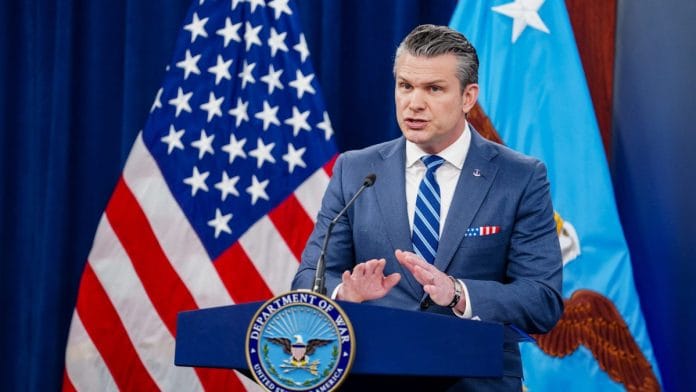


New Delhi: US Secretary of War Pete Hegseth Wednesday announced a new annual testosterone-screening programme for military personnel aged 30 and above.
The tests will be incorporated into the periodic health assessments of service members, while troops below 30 will be allowed to request them voluntarily. Those found to have low testosterone will have the choice to undergo testosterone replacement therapy. The treatment would not be compulsory, Hegseth said.
It remains unclear, however, whether hormone screening will be restricted to male service members or apply to female personnel as well.
In a video posted on X, Hegseth said that the policy was being implemented for US troops to make sure they “have the right testosterone levels” to operate at their “absolute best”.
“We owe our warriors the absolute best medical care in the world, and this programme delivers on that obligation,” he added.
The High-T Department of War. pic.twitter.com/hlAUq3j2cD
— Secretary of War Pete Hegseth (@SecWar) July 15, 2026
Calling the initiative part of a “High-T Department of War”, Hegseth said the military had a responsibility to ensure that troops remain “strong, resilient and capable” in face of the physical and psychological demands of the modern battlefield.
According to Hegseth, the initiative is “not about artificial enhancement”. “It’s about restoring the natural capabilities of our warriors so they can remain on the leading edge of lethality,” he said.
Testosterone levels, testing & treatment
Testosterone—produced primarily in the testicles in men, and in smaller quantities in women—plays an important role in muscle mass, bone density, sexual function, and mood. Levels generally decline with age, but medical guidelines do not ordinarily recommend testing every man after a particular birthday.
Doctors typically diagnose testosterone deficiency only when a patient displays symptoms and records low hormone levels in two separate morning blood tests. Levels can fluctuate considerably depending on the time of day, sleep, illness, and several other health factors.
The US Food and Drug Administration (FDA) has approved Testosterone Replacement Therapy (TRT) in the US for men with hypogonadism, a medical condition in which the body produces abnormally low levels of testosterone.
A series of studies among older men by US National Institutes of Health found that treatment improved erectile function, libido and other measures of sexual health, while producing a small improvement in mood. Other studies have indicated potential benefits for muscle mass, strength and bone density. However, evidence that it substantially improves fatigue, memory or overall well-being remains limited.
Also Read: Trump opens door for Ukraine to build Patriot missiles as Kyiv pushes to expand its own arsenal
Democrats allege hypocrisy
Hegseth’s announcement comes as Health Secretary Robert F. Kennedy Jr. and other figures in President Donald Trump’s administration have advocated easier access to testosterone treatment, as part of their “Make America Healthy Again” agenda. The FDA proposed easing restrictions on prescribing testosterone gels, pills, patches and injections last month.
The policy has also drawn accusations of hypocrisy from Democratic lawmakers, who contrasted it with Hegseth’s opposition to transgender military personnel receiving hormone therapy.
Senator Tammy Duckworth of Illinois, an Iraq War veteran and member of the Senate Armed Services Committee, remarked that the programme sounded “like gender-affirming care” to her.
Representative Chrissy Houlahan of Pennsylvania, an Air Force veteran, said it “proves that Secretary Hegseth takes direction from the far corners of the manosphere”.
Both called for hormone screenings to be offered equally to male and female troops.
Testosterone in the US military
The debate comes against a complicated history of testosterone use within the US military.
After the 2022 death of a Navy SEAL recruit during training exposed the presence of performance-enhancing substances within the programme, the Navy had introduced testing for testosterone and other muscle-building drugs the following year.
The Pentagon will now be simultaneously screening troops for the misuse of testosterone, while searching for personnel whom it believes may need more of it.