





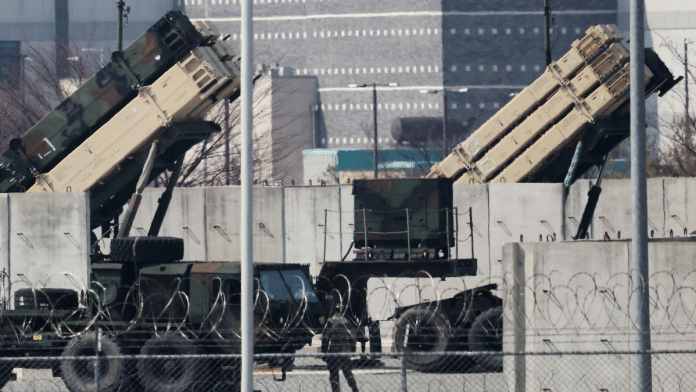

New Delhi: US President Donald Trump has said that his country would allow Ukraine to manufacture Patriot missile interceptors domestically, a move that could significantly strengthen Kyiv’s air defence capabilities as the war with Russia continues through its fourth year.
“We are gonna give you a licence to make Patriots,” Trump told Ukrainian President Volodymyr Zelensky during Wednesday’s North Atlantic Treaty Organisation (NATO) summit in Ankara, Turkey. “I think they can produce them very quickly once we explain it.”
The US President added that he had not yet informed defence manufacturers Lockheed Martin and Raytheon, “but that’ll work out alright.”
Trump also stated the US would give Ukraine the licence so that Kyiv could not “complain that we’re not giving them enough,” reflecting his long-held view that Europe and Ukraine should shoulder a greater share of the burden for the war.
NOW – Trump to grant Ukraine a license and teach them how to make Patriot Missiles. pic.twitter.com/FCWdwCus6p
— Disclose.tv (@disclosetv) July 8, 2026
The Patriot—‘Phased Array Tracking Radar for Intercept on Target’—is one of the world’s most advanced surface-to-air missile defence systems. Designed to intercept incoming ballistic and cruise missiles and aircraft, it has become central to Ukraine’s ability to defend itself from sustained Russian aerial attacks.
Patriot batteries are also among the most expensive air defence systems in the world, with a single battery and its missiles valued at around $1 billion.
Production of the missiles remains limited, with the US producing only about 600 Patriot interceptors annually, according to the Department of Defense.
Washington has become increasingly cautious about transferring additional interceptors after using more than half of its own stockpile during its conflict with Iran earlier this year, according to the think tank Center for Strategic and International Studies (CSIS).
“We have Patriots, but we don’t have that many. We need them for ourselves too,” Trump said at the NATO summit.
The Patriot announcement comes as Ukraine continues to endure some of the heaviest aerial bombardments this year. On Monday, a large-scale Russian missile and drone attack reportedly killed at least 27 people and injured more than 100 in Kyiv.
Just two days later, Russia launched another overnight missile attack on Kyiv, injuring at least two people and prompting air raid alerts across the capital.
Aerial war
Since Russia’s full-scale invasion in February 2022, missiles have played a defining role in the conflict. The Russians have relied heavily on long-range strikes, including cruise and ballistic missiles, to target Ukraine’s infrastructure, energy grid, and civilian centres. In response, Kyiv has depended on Western-supplied air defence systems to intercept incoming threats.
As the largest arms-importer in the world, Ukraine has also been among the largest recipients of American foreign aid and military assistance since the onset of the war in 2022. According to the Council on Foreign Relations (CFR), the US Congress has made $195 billion available in spending linked to the war on Ukraine, as of 31 March.
Washington’s commitment has appeared less certain under Trump’s second term, as he has repeatedly questioned the scale of American support for Kyiv.
Against this backdrop, Trump’s offer to allow Ukraine to manufacture Patriot interceptors represents a significant signal of continued US backing, particularly as Russia intensifies its aerial campaign.
This has pushed Ukraine to accelerate efforts to develop its own missile capabilities, both offensive and defensive.
Also Read: Why China’s ballistic missile test has rattled Indo-Pacific neighbours
Ukraine’s evolving missile arsenal
Ukraine has historically maintained a modest missile inventory, relying largely on Soviet-era systems. Since 2022, it has significantly expanded the domestic missile industry, out of necessity.
Kyiv has domestically developed and deployed longer-range strike systems such as the R-360 Neptune anti-ship cruise missiles, two of which were used to sink Russia’s Black Sea flagship Moskva guided missile cruiser in April 2022.
It has also invested heavily in longer-range missile and drone programmes capable of striking military targets deep into Russian territory.
Alongside offensive systems, Kyiv is accelerating efforts to develop its own air defence network. Ukrainian defence company Fire Point is leading development of a European ballistic missile defence project codenamed Freyja. It signed a Memorandum of Understanding (MoU) with German radar manufacturer Hensoldt in June, which will provide its TRML-4D radar for the system.
Discussions are underway with other European defence firms to supply advanced guidance technologies for the interceptor. Fire Point is aiming to have its first interceptor missiles ready by the end of this year, significantly ahead of its previous timeline, following the increased political backing from Ukraine and European governments.
These projects form part of Kyiv’s broader effort to establish a more self-sufficient missile industry, despite the pressures of wartime production.
Why licence matters
Trump’s proposed licensing decision could bridge crucial gaps, both short- and long-term. Allowing Ukraine to manufacture Patriot interceptors domestically would speed up supply and help Kyiv build technical expertise in advanced missile defence.
It would also help in insulating Kyiv from future political uncertainty surrounding foreign military aid. The move simultaneously raises questions about coordination with US defence contractors and the broader NATO supply chain.
Ukraine’s missile strategy reflects a dual-track approach of Kyiv building indigenous systems while also integrating advanced Western technology. The Patriot licence, if implemented, would mark a major step in that direction.
As the war approaches its fifth year, the battle for Ukraine’s skies has become just as critical as the fight on the ground.
Kyra Menon is an intern with ThePrint.
(Edited by Tony Rai)
Also Read: What Zelenskyy wrote to Putin in his open letter