







New Delhi: The US Central Command (CENTCOM) used one-way attack sea drones in combat for the first time Sunday, introducing an expendable maritime weapon into its ongoing campaign against Iran.
The weapon’s first operational use came as the US launched another wave of attacks against Iran Sunday evening, continuing days of renewed exchanges between the two countries. Iranian State media reported that one person was killed in southwestern Iran and four others injured.
Within hours, Iran’s Islamic Revolutionary Guard Corps (IRGC) said it had struck US military bases in Kuwait, Jordan, and Bahrain, further escalating the confrontation across West Asia.
The renewed hostilities followed the breakdown of an already fragile ceasefire agreed on 17 June. Speaking Wednesday at the North Atlantic Treaty Organization (NATO) summit in Turkey, US President Donald Trump stated that the truce was “over”.
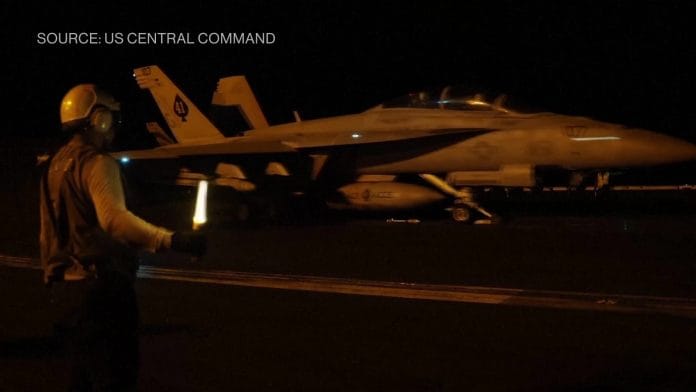
In a public release detailing Sunday’s operation and the weapons employed, the CENTCOM said, “U.S. Central Command (CENTCOM) completed a new wave of offensive strikes against Iran, July 12, hitting dozens of targets at multiple locations with precision munitions to degrade Iran’s ability to continue attacking international shipping flowing through the Strait of Hormuz.”
The targets included Iranian air-defence systems, coastal radar installations, missile and drone capabilities, and small boats.
According to CENTCOM, the operation combined “U.S. fighter aircraft, naval vessels, one-way attack aerial drones, and one-way attack sea drones for the first time.”
Although armed and surveillance-oriented uncrewed vessels have increasingly become part of naval warfare, the CENTCOM announcement marks the first publicly acknowledged American combat use of a maritime drone designed not to return from its mission.
What is a one-way attack sea drone?
A one-way attack sea drone is generally an uncrewed surface vessel, often resembling a small motorboat or speedboat, that carries explosives and is guided towards a target before detonating on impact or nearby.
Unlike reusable surveillance drones, these vessels are expendable weapons. Their function is comparable to that of a loitering munition in the air, in that they travel towards a designated target, carry their own explosive payload, and are destroyed during the attack.
Operators may control them remotely through satellite or radio connections, or programme them in advance to travel along a designated route. Cameras and other sensors can then help guide the vessel towards its target during the final stage of the attack.
Some systems can also navigate or identify obstacles with limited human direction. Depending on their design, they can be launched from shore, larger ships, or concealed positions along a coastline.
The CENTCOM has not disclosed which sea-drone system was employed on 12 July, how many were launched, or which specific targets they struck. It also has not released details about the vessels’ range, speed, warhead, guidance mechanism, or degree of independent operation.
The term “sea drone”, in this case, appears to refer to an uncrewed surface vessel, rather than an underwater drone. By operating directly on the water and presenting a relatively small visual, radar, and thermal signature, such a craft can be harder to detect than conventional warships or aircraft.
Sea drones do not have to sink a major warship in order to produce a significant military effect, as a strike on a vessel’s propulsion system, radar, weapons, or hull could remove it from operations and require extensive repairs.
Because these vessels are expendable, commanders can also send them into high-risk areas without placing sailors into direct danger. They may be produced and deployed in larger numbers and more quickly than crewed naval vessels can be, while launches from dispersed locations make it harder for an adversary to eliminate the threat at its source.
The technology, nevertheless, has its clear limitations. Rough weather, electronic jamming, communications failures, and physical barriers around ports can disrupt a sea-drone attack. Machine guns, helicopters, patrol craft and electronic-warfare systems may also intercept the drones before they are able to reach their targets.
Why combine sea and aerial drones
The significance of the operation lies also in the sea drones’ integration with aircraft, naval vessels, and one-way aerial drones.
A coordinated attack from several domains can force defenders to track threats that are approaching at different speeds, altitudes, and directions. Air-defence radars may be tracking aircraft, missiles, and aerial drones at the same time that coastal sensors and naval weapons are attempting to detect small, fast-moving vessels. This tactic can burden command-and-control systems and divide the defender’s attention.
A sea drone could be used to attack a small boat, radar installation, harbour facility, or coastal missile position directly. It could also make a target activate its radar or defensive weapons, which would thereby expose its location to American aircraft and missiles.
Changing dynamics of naval warfare
For the CENTCOM, the first combat use indicates that one-way sea drones are moving from experimentation to operational deployment, alongside established American air and naval power.
The choice of using this weapon in the Strait of Hormuz is especially consequential. The narrow waterway connects the Gulf with the Arabian Sea and it remains crucial to international energy shipments, as roughly a fifth of the world’s seaborne oil passes through it. Its confined geography also creates conditions in which coastal missiles, small boats, mines, and drones can pose serious threats to larger vessels.
“The Strait of Hormuz is a vital maritime corridor for global trade. Iran does not control it,” the CENTCOM said.
The statement followed Tehran’s declaration late Saturday that it had closed the strait—a claim rejected by Washington, which maintained that the passage remained open.
“U.S. forces are postured and prepared to ensure that freedom of navigation remains available to commercial shipping despite Iran’s continued unwarranted aggression, harassment, threats, and arbitrary declarations,” it added.
The sea-drone deployment signals that future naval battles may increasingly involve mixed formations of crewed ships, aircraft, and expendable uncrewed systems. Militaries may consequently have to be prepared to defend against threats arriving simultaneously from the air, beneath the water, and directly across the surface of the sea.
(Edited by Ajeet Tiwari)
Also read: US strikes India-linked Chabahar port in Iran as West Asia conflict intensifies