



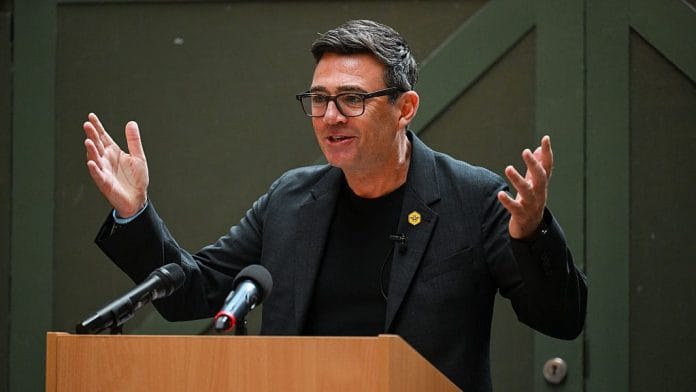

In his six weeks at No. 10 Downing Street, Andy Burnham has skilfully avoided making unpopular or divisive decisions. His predecessor as UK prime minister began his tenure by saying things were awful and kept reminding us that they might well get worse. Burnham has been as sunny as this year’s summer.
Too sunny, perhaps, just like the recent weather. The record-breaking heat has been a reminder that climate action is a vital problem he can’t postpone forever. But how he can answer complaints about sky-high energy prices while remaining virtuous on “net zero” emissions targets isn’t clear either.
A decision is overdue, for example, on whether to allow the development of two North Sea gas fields. This is something of a cause celebre for both sides of the green debate. One insists that it’s absurd to stop new fields when Britain will have to import expensive gas for the foreseeable future. The other argues that these North Sea sources have pretty much run dry anyway.
The tragedy for Burnham is that climate change, long depoliticized in Britain, has become just another front in a new culture war, an extension of US battles.
Naturally, Reform UK, a party that imports its talking points from the American far right, is taking the lead. Its politicians have scrapped green policies when taking office in local authorities, going to absurd lengths to do so. Its officials in Kent and Norfolk took only £50,000 ($67,400) of the £667,000 and £312,000 those counties were allotted for electric-vehicle charging stations. In Durham, some Reform councilors tried to shut down solar-panel projects, with the party’s deputy leader there claiming that pigeons were burrowing under them.
The mainstream right isn’t doing much better. Under Kemi Badenoch, the Conservatives have gone all-in on attacking the climate policies that they themselves put into place during 14 years in government — which had begun with PM David Cameron promising to run the “greenest government ever.”
Cameron did this to make himself electable by appealing to moderates. Badenoch, unfortunately and maybe unwisely, has gone hard in the other direction. New Tory candidates are subjected to a purity test. They must denounce the UK’s net-zero target, made law by another Conservative prime minister, Theresa May, in 2019. Sensible party members are appalled.
Other than her need to counter Reform, the politics here don’t justify Badenoch’s approach. Policies that incentivize decarbonization remain popular in the UK, and most of those who voted Tory in the last election approve of climate action. Burnham will doubtless see a tempting opportunity to draw a green line between his Labour Party and both Reform and the Conservatives.
But he should tread carefully. While the UK has gone first and furthest toward greening its electricity supply, it is struggling with some of the world’s highest prices, particularly for industry. Blaming the renewables push for forcing up costs is dubious, to put it mildly. Regardless, cheaper energy is a must for a leader who has reindustrialization at the center of his agenda.
A big part of the problem is how Britain calculates electricity prices. This is based on whatever is the most expensive source of power required to meet current demand, and that’s usually costly natural gas. Even at times when wind and solar are providing the far greater share, some gas-fired generation is necessary — and that’s what sets the overall price.
As a result, many renewable-energy suppliers get paid the same as their costly gas-fired counterparts. That’s great for their earnings, though terrible for consumers, whose high bills are capturing little benefit from the UK’s impressive green advances. The government has at least raised the tax on these windfall profits for low-carbon producers to 55%, but breaking that damaging price link to expensive gas needs to be the priority.
Another problem is that cheap renewables don’t mean a cheap electricity grid. Billions will have to be spent to get wind-generated power connected to England from the Scottish Highlands, for example. Until then, some producers will have to be compensated for their excess supply that cannot enter the grid.
The Conservative’s energy spokesperson, Claire Coutinho, imagines that those billions of infrastructure spending can simply be wished away by abandoning Britain’s commitment to achieve net-zero emissions by 2050. Setting aside the fact that voters remain committed to the target, the Tories have made some fantastical claims about the £320 billion that could be saved this way.
A Trumpian energy policy would never work in the UK anyway. You can’t turn back time to carbon-intensive power. Even if Burnham reopened the coalmines in an attempt to reverse everything Margaret Thatcher ever did, only 68 million tons of British coal is “economically recoverable.” In 2012 alone, Britain’s coal-fired power plants — all now shuttered — used 55 million tons.
So Burnham faces difficult choices. He has to thread the needle between his commitment to reindustrialization and bringing down households’ costs, while remaining visibly committed to green power.
Fortunately, his opponents are doing part of his thinking for him. Buried in Coutinho’s anti-net-zero rhetoric is the seed of a decent policy consensus: Do whatever it takes to reduce the costs of electricity, particularly since electrification needs to spread in Britain if it’s ever to achieve its long-term emissions goals. More transport must be shifted. It should be easier to change houses around to heat and cool them using electricity. Decarbonization is successful when it’s made cheap for consumers.
That would also mean making power cheaper relative to the price of natural gas — by finishing the task of removing green levies from power bills, for one, and by extending fixed-price contracts to older renewable generators — so that households and businesses can benefit from the low running costs of wind, nuclear and solar rather than being tied to the marginal price of gas.
Will that spike the guns of the anti-net-zero forces? Not entirely. But Burnham can still win easily. Let them commit themselves completely to this battle, then outmaneuver them. This was the strategy adopted by another midterm replacement charged with restoring a center-left ruling party’s fortunes.
Canadian PM Mark Carney abandoned his predecessor’s carbon tax on consumers, depriving his opposition of their primary gripe, while maintaining longer-term targets. Burnham could delink the 2050 net-zero ambition from the nearer-term goal for green electricity. Instead of Clean Power 2030, promise Cheap Power 2030.
Disclaimer: This report is auto generated from the Bloomberg news service. ThePrint holds no responsibility for its content.