



Kayode Emmanuel was parked outside the biggest hotel in Nigeria’s capital, the Transcorp Hilton Abuja, waiting for ride requests on his Uber Technologies Inc. app.
When none came, he did what many Nigerians do when faced with patchy internet: he toggled his phone’s airplane mode off and back on.
Then his wife called. She’d seen an Instagram post saying the ride-hailing firm had ceased operations in the country with immediate effect.
“No notice, nothing — just like that, Uber just left,” said Emmanuel, who had been a driver using the app for six years. “It was a harsh exit.”
The world’s biggest ride-hailing company on Sept. 2 said it was shutting off services in Africa’s most populous country, as well as in Uganda. The abrupt withdrawals followed exits from Tanzania and Ivory Coast over the previous 12 months.
In Nigeria alone, at least 50,000 drivers used the app and the income from it to support their families and to pay off car loans, said Ayoade Ibrahim, the general secretary and co-founder of the Amalgamated Union of App-Based Transporters of Nigeria.
“It’s a very big disaster,’’ he said. “Every worker has many people eating from his job.’’
Uber’s retreat highlights a challenge confronting many multinational companies drawn to Africa by its high-growth economies and the youngest and fastest-growing population of any continent. Those attributes haven’t automatically translated into the large, affluent consumer class that many businesses need to thrive. In Uber’s case, despite Nigeria’s population of 238 million, the number of people who could actually afford its prices was too small to sustain the business.
Across much of the continent, low disposable incomes mean companies need to keep prices down even as they grapple with high operating costs, volatile currencies and difficult business environments.
“Affordability is important in African mobility markets,” said Deepesh Thomas, Uber’s general manager for sub-Saharan Africa and Morocco. “Rider affordability and driver economics are interconnected. A marketplace needs to work for both sides.”
That tension has been acute for Uber, which built its African business partly around a narrative of higher vehicle and safety standards even as it competed in markets where consumers are intensely price sensitive. Rivals offering cheaper fares and more flexible terms for drivers have challenged that model.
But the market is difficult even for home-grown operators: Moove, the Nigerian-founded mobility startup that started in 2020 and is valued at $2.1 billion, on Oct. 8 announced plans to exit the African country. The firm built much of its early success by supplying vehicles to drivers on Uber’s local platform.
After starting its African operations in Johannesburg in 2013, Uber entered Nigeria and Egypt the next year followed by Kenya and Morocco in 2015. Uganda, Ghana and Tanzania were next in 2016 and Ivory Coast in 2019. As it expanded, it promoted safety as one of the advantages of its service. Alon Lits, Uber’s general manager for sub-Saharan Africa in 2014, said at the time that the entry into Nigeria was the beginning of an expansion drive.
Those distinctions can be tough to monetize in markets where price is often the top consideration. In the world’s poorest continent, many riders opt for cheaper services, opening the door for competition from international rivals such as inDrive, Bolt Technology OU and Yango, as well as local competitors.
While prices charged by Uber and Bolt are set by algorithms that weigh demand, weather conditions and traffic, Bolt fees are generally cheaper. The cheapest fare offered by Uber for a 3.2-mile trip in Johannesburg at 7:45 p.m. on Oct 6 was 50 rand ($3) while on Bolt it was 39 rand. In Kenya, a similar-length trip in Nairobi in a small car the next day cost 273 shillings ($2.10) compared with 220 shillings on Bolt. In Nigeria, Uber has switched off its app so it was impossible to make a comparison. inDrive allows drivers and riders to negotiate the price between them.
Safety is the “big differentiator that Uber has,” said Justin Suttner, general manager for sub-Saharan Africa for AURA, a company that runs an emergency-response platform for Uber drivers in Kenya and South Africa, saying that the tracking and response services deployed by Uber are superior even as rivals spend more to catch up.
In a November 2025 survey of e-hailing drivers, the City of Johannesburg said Bolt drivers “are more prone to hijacking, unlike Uber, which has extra safety features.’’
Bolt said “safety is central’’ to how it operates and it’s spending €100 million ($113 million) globally on security measures between 2024 and 2027. It said it carries out driver verification, vehicle inspections and operates an emergency assist service. inDrive didn’t respond to queries.
In its time operating in Africa, Uber has had to deal with drivers negotiating higher fares off its platform and an overnight threefold increase in fuel prices in Nigeria following the removal of a subsidy in 2023. It has also at times struggled to repatriate profits.
“Uber’s market was eaten into by inDrive and Bolt,” which offered cheaper services and less rules for drivers, said Damilola Olokesusi, the co-founder of Nigerian shared ride-hailing company Shuttlers, adding that her firm expects to profit from Uber’s exit. “The market is very price-sensitive” as rentals and food costs increase, so people want to pay less, she said.
Now Talinn, Estonia-based Bolt, which brought its services to the continent in 2016, operates in eight African countries compared with Uber’s six. The more than a million African drivers and couriers on its platform represent a quarter of its global partner base. Uber, inDrive and Yango have not published the number of drivers they have on the continent.
“You need to consider payment behavior, vehicle access, consumer affordability,” said Simo Kalajdzic, the head of Bolt’s South African operation. “While the platform is global, the model has to be local.”
Africa-wide surveys of more than 19,000 people by Barcelona-based Sagaci Research in 2023 and 2024 showed that Bolt was already pulling ahead of Uber with consumers naming Bolt as a preferred ride-hailing app over Uber in five of the seven countries in the region in which they both operated at the time. Bolt led all rivals in five of the 10 biggest markets in Africa.
The survey also showed that those with higher incomes were more likely to use ride-hailing apps, meaning a bigger market for the services in the richer countries in which Uber still operates.
In many countries, there just aren’t enough people willing or able to pay to ensure their safety and for better maintained vehicles, said Charlie Robertson, chief economic adviser at Kenya’s Equity Group Holdings Plc.
“My guess is Uber’s addressable middle-class market starts at about $2,500 gross domestic product per capita and Nigeria and Uganda are below that,” he said.
South Africa has an estimated GDP per capita this year of $7,500, according to the International Monetary Fund, while Kenya, at $2,700, is now the lowest of the African countries in which the company operates.
Uber, like other multinational companies before it, may have confused rapidly expanding economies in Africa with increases in individual wealth, he said. High population growth keeps income levels modest.
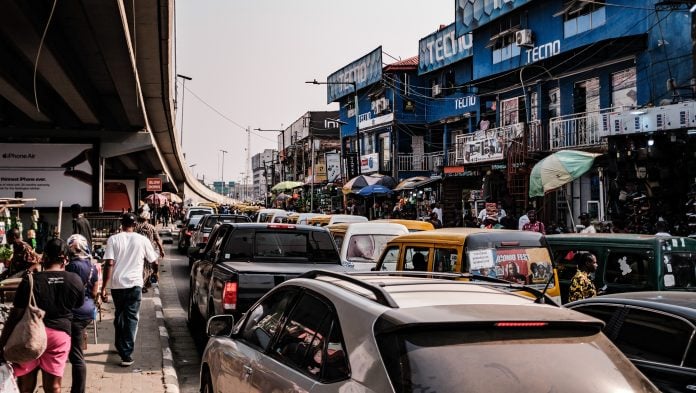
“Uber got very expensive, especially during the price spikes that are caused by Lagos traffic,” said Obong Scott, a 27-year-old digital marketer in Nigeria’s economic capital. “Me and my friends moved to Bolt and inDrive even though they had less comfortable cars than Uber. The Uber prices were not funny, especially when you have a budget.”
In markets where still operates such as South Africa, Uber is facing cut-price competition.
In Johannesburg, Bolt launched a low-cost service using the Bajaj Auto Ltd.’s Qute, a 9.9-kilowatt gasoline quadricycle. San Francisco-based Uber sought to counter that late last year with a 35-kilowatt Chinese electric car that costs more than twice as much.
Despite the challenges, India’s Mordor Intelligence estimates Africa’s ride-hailing market will expand almost 30% between 2025 and 2031 to $3.25 billion, driven by urbanization and rising smartphone adoption.
For drivers, the exit from Nigeria has been devastating, according to Ibrahim. Due to paperwork, many former Uber drivers are yet to transition to other apps. For those who have succeeded, their earnings have dropped.
“Nothing beats Uber,” said Abuja’s Emmanuel, who has now signed up to both Bolt and inDrive but has still seen his weekly income fall by a third. “These other apps have a long way to go.’’
The company’s sudden exit has provoked a backlash.
On Sept. 6, Nigeria’s Federal Competition & Consumer Protection Commission said it will probe the departure and Ibrahim’s union has approached the labor ministry and may take the issue to the country’s national industrial court that deals with labor issues. While Uber has retained a presence in Nigeria through a local unit of its Delivery Hero food-delivery business, its unclear whether any sanctions can be levied against the company.
Thomas maintains that despite leaving Nigeria, Uber is committed to Africa, pointing to the more than a billion trips undertaken in the region using the platform and a pledge to invest more than $300 million in South Africa.
But for many potential customers, there’s simply no choice.
“I only have Yango and Bolt — I don’t have Uber,” Joseph Appiah, a Ghanaian university researcher, said of the apps on his phone that he uses to summon drivers. “They charge the cheapest price.”
Disclaimer: This report is auto generated from the Bloomberg news service. ThePrint holds no responsibility for its content.