





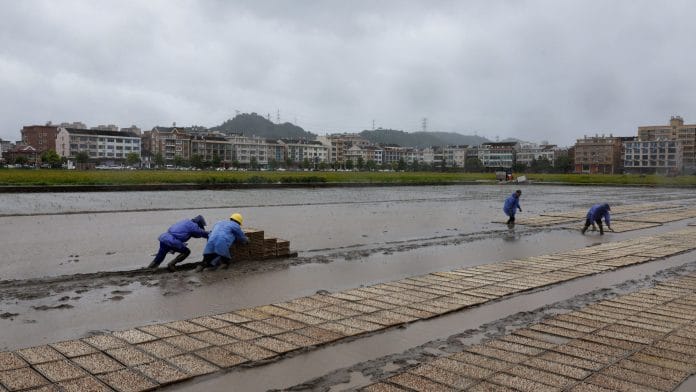


A large and powerful typhoon is moving toward China, bringing heavy rain and strong winds ahead of its expected landfall later Saturday and triggering an emergency response in the Zhejiang province.
Typhoon Bavi, the ninth typhoon of the year, was located about 489 kilometers off the coast of Wenzhou at 9 a.m. on July 11 with maximum sustained winds of Force 14, according to state broadcaster CCTV. Classified as a strong typhoon, Bavi is expected to make landfall between Cangnan and Sanmen in Zhejiang before midnight while moving northwest at 30-35 kilometers an hour.
According to Zhejiang provincial authorities, a Level I — the highest — typhoon emergency response will take effect at 11 a.m. on July 11 as the storm is forecast to bring severe winds, heavy rain, and high waves through July 12. Local governments have been authorized to suspend outdoor activities, work, classes, business operations, transport services and road traffic if necessary.
The typhoon is expected to bring heavy rain over much of Taiwan on Saturday, with the area around Taipei forecast to get 350 millimeters (13.8 inches) in 24 hours, according to the Central Weather Administration. Taiwan suspended trading on its stock exchange, offices in major cities were closed on Friday, and over 900 flights to and from the island were canceled for the weekend. More than 150,000 households across Taiwan experienced power outages, state-owned Taiwan Power Company said.
A large rain shield influenced by the typhoon and monsoon moisture is set to bring heavy downpours in east China as well as areas far from Bavi’s landfall, including Beijing over 1,000 kilometers to the north, said James Caron, director of meteorological operations for North America and Asia at Atmospheric G2.
The most rainfall may not happen in places directly in the typhoon’s path, he said. “They may occur where Bavi’s tropical moisture interacts with terrain, stalled boundaries or monsoon flow.”
China’s Fujian and Zhejiang provinces are expected to see very heavy rain on Saturday, with many places receiving as much as 250 millimeters in the 24 hours to Sunday morning, according to the China Meteorological Administration. Areas around Beijing and Tianjin are also set for intense downpours.
The typhoon has disrupted air travel in the region. Airlines operating at Hangzhou airport planned to cancel 198 inbound and outbound flights on July 11 as of 8:30 a.m., state broadcaster China Central Television reported.
On Sunday and Monday, rains are forecast to ease around coastal areas and Beijing, and move inland into Anhui province as well as parts of Henan and Hubei — which has already been soaked by severe storms.
At least 10 people were killed in a landslide triggered by a typhoon-enhanced monsoon that buried the homes of two families in Sarangani province in southern Philippines, according to a local official.
Disclaimer: This report is auto generated from the Bloomberg news service. ThePrint holds no responsibility for its content.