


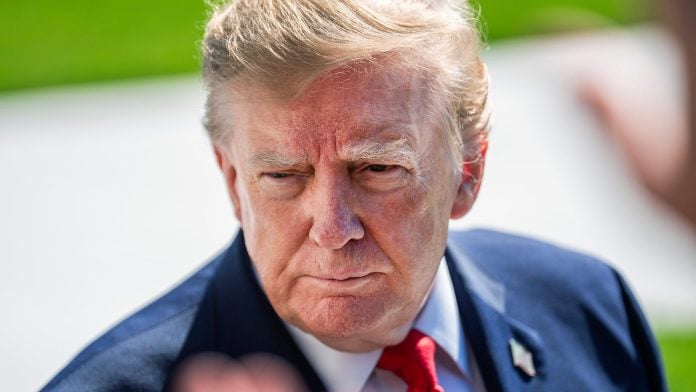
US President Donald Trump struck a more conciliatory tone about Iran over the weekend, saying it was “highly unlikely” he would order extensive strikes on the Islamic Republic.
Still, that depends on Iran signing “a very strong agreement,” he said on Sunday to CNN, underscoring how high tensions remain. His comments came shortly before the US launched limited attacks on an Iranian island in the Strait of Hormuz.
Marco Rubio, Trump’s secretary of state, played down the chances of rapid progress in negotiations, saying Tehran’s demands to date are unacceptable and in some cases “outrageous and ridiculous.”
Overnight, the US again struck Qeshm Island, state-run Islamic Republic of Iran Broadcasting reported, citing the deputy governor of Hormozgan province. There was no damage to essential infrastructure and the situation is under control, IRIB said.
Those followed similar strikes last week the US described as defensive operations. Since a truce in April, the warring sides have skirmished regularly but managed to avoid an escalation.
Any resumption of all-out war between Washington and Tehran would likely push up oil and energy prices, and see American allies in Middle East targeted by Iranian drones and missiles, further weakening their economies.
Trump is set to meet the prime minister of Qatar on Monday, as the Gulf Arab state leads diplomatic efforts to prevent escalation. He is scheduled to have talks with Sheikh Mohammed bin Abdulrahman Al Thani at the White House at midday.
Late last week, the US and Iran were closer to breakthrough after Tehran showed willingness to discuss issues related to its nuclear program that were previously off the table, according to a diplomat with knowledge of the talks.
Sheikh Mohammed, the Qatari prime minister, separately said the US and Iran needed to accept a deal, even if it was flawed.
“We will never have a perfect peace deal but you can’t wait for that perfect moment,” he said in a speech on Friday in the UK.
Gulf Arab states such as Qatar, the UAE and Saudi Arabia have urged the US against more mass strikes on Iran. They have been targeted by thousands of Iranian drones and missiles since the conflict erupted in late February with the US and Israel bombing the Islamic Republic.
A senior adviser to UAE President Sheikh Mohamed bin Zayed said that, while diplomacy must continue, the region needed to be patient.
“We should prepare for a long period of uncertainty in which neither a decisive resolution nor a stable regional order can be taken for granted,” the adviser, Anwar Gargash, said at a conference in Abu Dhabi on Monday.
This report is auto generated from the Bloomberg news service. ThePrint holds no responsibility for its content.