



President Donald Trump’s deal to purchase diesel fuel from Russia is a moral outrage: It rewards an aggressor that is terrorizing Ukrainian cities with drones and missiles, while punishing the victim for fighting back. Its economic benefits for America will be modest at best. Above all, the deal is sadly indicative of a deeper failing in Trump’s Ukraine policy. The president genuinely desires peace in that country. But his strategic blinders and indiscipline keep making that task harder.
The details of the deal are dispiriting. The US has agreed to temporarily lift sanctions so Russia can bring around two million barrels of diesel to market immediately (with around 13 million barrels committed in total), in hopes of driving down prices at the pump in the US before the midterm elections next month. The deal follows growing US frustration with Ukraine’s drone and missile strikes on Russian energy infrastructure, which have added to stress on global markets. It isn’t clear that the agreement will ease that pressure, given that the volumes involved are relatively small and the real problem in global energy markets is the president’s war with Iran.
But the deal will have a strategic impact, by weakening the push to cut Western purchases of Russian energy. It threatens to undo a year’s worth of European efforts to convince Trump that Russia, not Ukraine, is the primary obstacle to peace. And it creates a perverse scenario in which Trump fills the coffers of a neo-fascist autocracy while penalizing Ukraine for targeting Putin’s war economy in self-defense.
A bipartisan group of senators has already condemned the deal. Trump has defended it and announced an “energy ceasefire” between Ukraine and Russia — a breakthrough more imagined than real.
Whatever comes of this episode, it illustrates how election-year incentives and economic blowback from the Iran War are affecting US foreign policy in theaters far beyond the Middle East. It’s also a window into the frustrations of Trump’s bid to end the war in Ukraine.
Trump seems genuinely appalled by the killing. He has strong strategic incentives to seek a peace deal, amid a potential forever-war in the Persian Gulf and a rising Chinese threat in the Pacific. But his approach to peacemaking has done more harm than good.
To be fair, a realistic strategy would have included some of Trump’s initiatives, such as pushing the Europeans to take primary responsibility for aiding Ukraine. It would also involve quietly urging President Volodymyr Zelenskyy’s government to accept that it won’t recapture all the territory it has lost to Russia or become a member of the North Atlantic Treaty Organization.
Yet the other half of this strategy would have involved a concerted effort to ratchet up sanctions pressure on Russia, consistent support for Ukraine’s punishing deep-strike campaign, and strong measures to convince Putin that he can’t simply outlast US support for Ukraine or wait for the Western coalition to fracture. Here, the record is bleak.
Since his Oval Office showdown with Zelenskyy in February 2025, Trump has repeatedly feuded with the Ukrainian leader in public and threatened to withdraw US intelligence and military support. He has brawled with European allies not just in good causes (burden-sharing) but also in bad ones (acquiring Greenland). His administration has sometimes taken Russia’s side in seeking to influence European elections; it may withdraw significant US forces from the continent just as Moscow’s hybrid warfare campaign intensifies. Trump and his aides also convey the strong impression that they want to get back to business with Moscow, once the pesky war in Ukraine is cleared away.
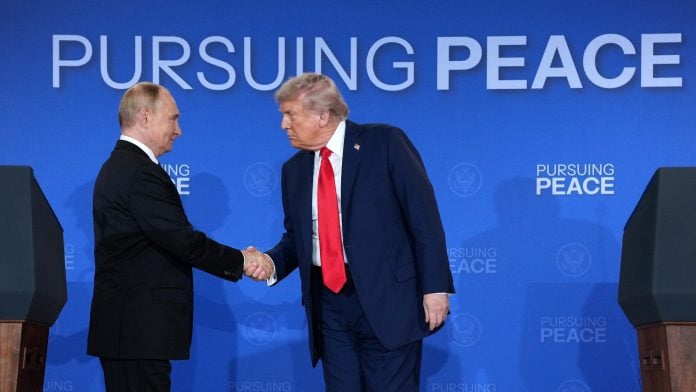
All this has surely encouraged Putin to think he can divide the US from Ukraine and from Europe if he shows enough bloody-minded patience. It gives him confidence he can win the war in Washington even if he can’t win it on the battlefield in Donetsk. Even when the administration seeks peace by offering up major Ukrainian concessions — as Trump did at his summit with Putin in Alaska last year — these efforts can’t satiate Moscow’s sweeping demands.
Trump’s Ukraine peacemaking has been a self-defeating experience that reflects two of his worst strategic flaws.
First, he has consistently misdiagnosed the source of the deadlock. He often seems more frustrated with Ukraine’s insistence on surviving as an independent nation than with Russia’s obsessive drive to snuff that independence out. He insists, against all evidence to the contrary, that Putin wants peace more than Zelenskyy.
That view may reflect Trump’s spheres-of-influence mentality, which holds that smaller powers must accommodate larger powers. But it blinds Trump to the fact that Putin seeks Ukrainian surrender as part of his larger geopolitical assault on the West. The Russian leader will only quit when the price of persistence becomes too high.
Second, a president who prioritizes quick fixes fails at the hard work of strategy. Peacemaking in Ukraine was never going to be easy. It demands deftly mixing pressure and diplomacy with Moscow; it requires sustaining Western solidarity while moving toward unsatisfying compromises.
But Trump lacks the patience for careful, coordinated statecraft; he disdains consultation with allies. So he has repeatedly launched ill-considered peace initiatives that panic Kyiv and Europe but fail to move Putin.
Now, Trump has struck a diesel deal that will have scant economic benefits and serious strategic costs. He is, reportedly, threatening to abandon Ukraine unless it drops its deep-strike campaign against Russian energy targets — that is, its best tool for making the price of Putin’s war prohibitive.
In the process, Trump is depleting American leverage, by encouraging Putin to continue his onslaught, and squandering US influence in Kyiv. Peace in Ukraine is a worthy destination. Alas, Trump has no idea how to get there.
Brands is also a senior fellow at the American Enterprise Institute, the author of The Landscape of Power: Geography and the Rise and Fall of Nations, and a senior adviser to Macro Advisory Partners.
Disclaimer: This report is auto generated from the Bloomberg news service. ThePrint holds no responsibility for its content.
Also Read: Trump strikes deal with Russia to buy diesel, undercutting US sanctions since 2022