





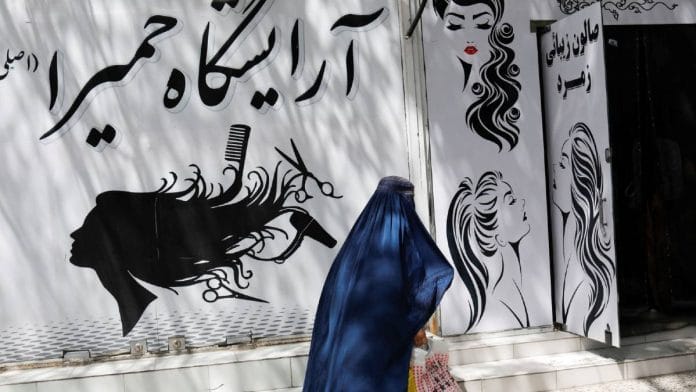


New Delhi: An unprecedented protest in Afghanistan’s Herat saw women take to the streets in large numbers Tuesday, following which the Taliban unleashed a brutal crackdown.
At least two persons including a child were reportedly killed and several others injured as the Taliban police opened fire. Local reports said around 35 women were detained by the morality police over dress code violations in several parts of the city Saturday. These actions led to women organising one of the largest public demonstrations seen in Herat since 2021, when the Taliban seized power in Afghanistan.
At least 150 men reportedly also took to the streets in solidarity.
The earlier crackdown intensified enforcement of regulations requiring women to fully cover their faces in public. The Ministry for the Promotion of Virtue and Prevention of Vice, responsible for enforcing the Taliban’s social regulations, then carried out a series of arrests.
The protest began Tuesday in Jebrail, a predominantly Hazara neighbourhood in Herat, where residents gathered to demand the release of the detained women. Hazaras make up one of Afghanistan’s largest ethnic minorities. Demonstrators chanted slogans including “education, work, freedom”, Amu TV reported.
Kabul Now said the forces then “opened fire” to disperse the crowd.
The Taliban authorities have not publicly confirmed any deaths, injuries or arrests. Reports said that those detained were later released after male relatives were summoned and warned.
The protests followed a decision by Herat’s governor, Noor Ahmad Islamjar, a senior Taliban official known for his conservative views, to intensify enforcement of dress regulations for women. Herat has long been regarded as one of Afghanistan’s more socially and culturally diverse urban centres.
Amnesty International condemned the action against protesters, describing accounts of Taliban forces firing on demonstrators as “deeply alarming”.
Former Afghan officials too took to social media to condemn the move.
“The barbarism and savagery of our country’s rulers have turned our land into a realm of terror, oppression, hunger, and utter backwardness. The recent events in Herat are a stark example of this,” Dr Rangin Dadfar Spanta, former foreign minister of Afghanistan, wrote in a post on X Tuesday.
بربریت و توحش حاکم کشور ما را به سرزمین وحشت، ظلم گرسنگی و عقبماندگی مطلق تبدیل کرده است. نمونهٔ اخیر آن، وقایع هرات است. همبستگی با زنان و مردان هراتی و تماشابیننبودن وجیبهٔ ملی و وطنپرستانه است. به این ظلم و حاکمیت تاریخزده باید خود مردم پایان دهند.
آزادی گرفتنی است!
— Dr. Rangin Dadfar Spanta- دکتور رنگین دادفر سپنتا (@DrDadfarSpanta) June 9, 2026
Since coming back to power in August 2021, the Taliban have imposed sweeping restrictions on women and girls, barring most secondary and university education, limiting employment opportunities, and enforcing increasingly stringent rules governing dress and movement.
The ministry had existed during the Taliban’s previous rule from 1996 to 2001 as well, and was expanded during that period. It oversaw deployment of the so-called morality police, who enforced the Taliban’s strict interpretation of Islamic Sharia law.
It was then reported to punish women deemed to be dressed “immodestly” or those who appeared in public without a male guardian. Girls were also barred from continuing their education beyond primary school, a restriction that the Taliban reinstated on returning to power.
The ministry also enforced broad social and cultural restrictions. Music, dancing and various forms of entertainment were prohibited, while activities such as chess and kite flying were banned. Prayer attendance was closely monitored, men were required to grow beards, and western-style haircuts were discouraged. Violations of these rules often resulted in severe punishments.
The latest unrest also comes amid broader concerns about security and civil liberties in Herat. Earlier, in April, hundreds gathered to protest a deadly attack on civilians in Injil district, where unidentified gunmen killed more than a dozen people near a shrine. Local leaders were later reported as saying that Taliban authorities pressured community elders to scale back planned demonstrations and funeral processions.
(Edited by Nida Fatima Siddiqui)
Also Read: The story of India’s forgotten Afghans — horse-traders, mercenaries, kings