



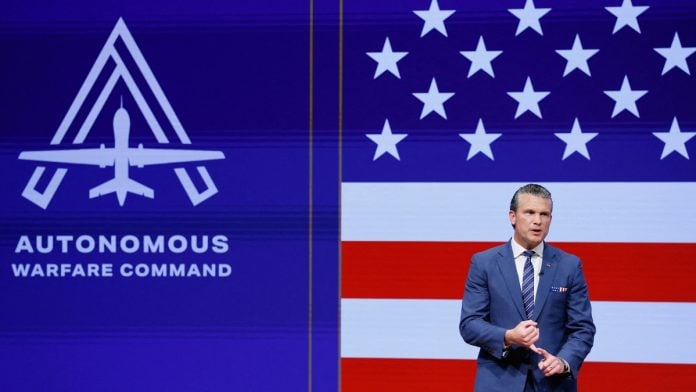
New Delhi: US Secretary of War Pete Hegseth on Wednesday announced plans to establish a new military command to accelerate the development and deployment of autonomous and robotic systems across the US military. The command will be called the ‘Autonomous Warfare Command’ (AutoWarCom), Hegseth said during his ‘State of the Force’ address at Marine Corps Base Quantico, Virginia.
AutoWarCom is expected to become operational by October 2027 and will be led by a four-star officer. Until a permanent commander is appointed, Defense Innovation Unit (DIU) Director Owen West and Navy SEAL Senior Chief Max Strasiser will lead the transition.
The new command underscores the US push to move away from costly conventional weapons platforms towards cheaper, AI-driven unmanned systems that have proved decisive in recent conflicts such as the Russia-Ukraine war.
In the conflict, high-cost assets such as main battle tanks, armoured vehicles and naval vessels have repeatedly been disabled or destroyed by commercial-grade first-person-view (FPV) drones and unmanned surface vessels (USVs) costing a fraction of their targets. Hegseth said drones now account for roughly 70 percent of Russian casualties, arguing that reliance on expensive legacy platforms can leave militaries vulnerable to mass attacks by low-cost autonomous systems.
He advocated supplementing expensive weapons with cheaper autonomous systems, backed by a Pentagon-proposed $74 billion budget for drone and counter-drone technology announced in April 2026.
AutoWarCom will integrate drone technology, AI and command-and-control systems. It will also have “service-like authorities”—special powers normally granted to individual military service branches—allowing it to rapidly acquire, test and field emerging technologies without being constrained by conventional procurement timelines.
“The autonomous and robotic revolution has enormous implications for equipment, doctrine, organisation, and the assumptions that have governed warfare for decades,” Hegseth said. “Civilian leaders can provide direction and urgency, but lasting change must be anchored in military command structures and operationalised by leaders across our joint force.”
Project Agincourt
AutoWarCom will initially be established through Project Agincourt, an interim initiative intended to test what the Pentagon calls “warfighting acquisition”. The project will pair military operators with entrepreneurs and provide funding directly to frontline units, aiming to shorten the time between identifying a battlefield requirement and deploying a solution.
The approach is particularly relevant to the Russia-Ukraine war, where electronic warfare tactics and drone frequencies can change within weeks. Under conventional Western procurement processes, systems can take years to move from contract award to deployment, by which time the technology may have been overtaken by battlefield developments.
AutoWarCom, supported by Project Agincourt, is therefore intended to give military units greater acquisition authority and allow software updates, drone modifications and other battlefield adaptations to reach operators more quickly.
“Cheap compute, superintelligence, and advanced commercial manufacturing have enabled the proliferation of low-cost, high-precision strikes,” Hegseth said. “Drone warfare supercharged by SI-enabled targeting is the biggest battlefield revolution in generations.”
SI refers to “superintelligence”, a term used by US President Donald Trump.
US military’s push for autonomous warfare
The creation of AutoWarCom follows several US military initiatives in recent years aimed at incorporating AI and autonomous systems into military operations.
Palantir’s Maven Smart System was deployed in early 2024 for combat operations against Iran’s Islamic Revolutionary Guard Corps, Hezbollah and Houthi targets. The system uses AI to process satellite and drone imagery and combine multiple intelligence feeds into a single map-based interface for military targeting and logistics.
Anduril’s Roadrunner, revealed in December 2023, is an autonomous vertical-takeoff-and-landing (VTOL) interceptor drone guided by the company’s Lattice AI system. It can dynamically intercept threats and return to base if it does not engage a target.
Under Operation Fury—the US-Israeli military operation against Iran—the Pentagon deployed thousands of sub-$4,000 quadcopters under its ‘Replicator’ initiative. Equipped with edge-computing AI, the drones can operate without GPS or continuous human control, map interiors, navigate tunnels and coordinate with each other.
The US and UK navies also test-fired an Mk 48 heavyweight torpedo from an autonomous unmanned underwater vehicle (UUV) in Scotland on 13 September. The test came a day after what was described as the first drone-versus-drone sea battle, in which a Ukrainian USV destroyed a Russian USV.
The US military’s use of commercial AI has also generated controversy. On 13 February, The Wall Street Journal reported that the US military had deployed Anthropic’s Claude AI through Palantir in Venezuela. Anthropic’s restrictions on fully autonomous weapons became a point of dispute, after which the Department of Defense designated the company a supply-chain risk, cancelled its $200 million contract and blacklisted it, while expanding contracts with Google, OpenAI, Amazon, Microsoft and Nvidia.
As part of his address, Hegseth also outlined plans to cut positions reserved for generals and admirals by 20 percent and introduced ‘Project Meridian’, a 120-day initiative co-led by SpaceX CEO Elon Musk, Anduril Industries cofounder Palmer Luckey, and former US House Speaker Newt Gingrich to develop technologies and concepts for future warfare.
(Edited by Chingkheinganbi Mayengbam)
Also Read: Why China will not slow down its AI pace