





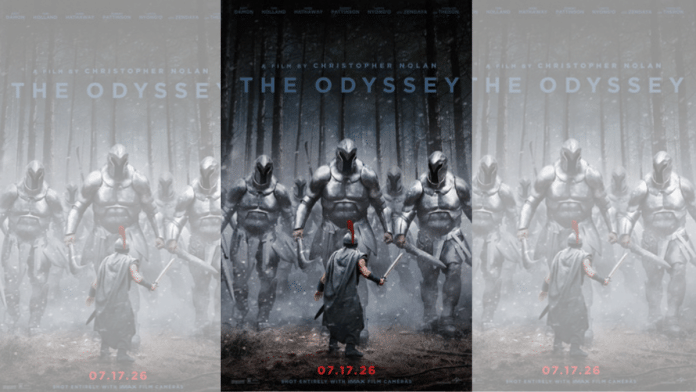


It is hard to think of a recent film that has excited as much interest. “The Odyssey” made $264.1 million in its opening weekend and an ancient Greek hero replaced Trump as the most talked-about person on social media. London’s Waterloo Imax, where I was lucky enough to see it, is booked until the middle of September. It is even harder to think of a film that has done as much to boost the cause of education. The British have bought more than 40,000 copies of Homer’s text since shortly before the opening. Homer, as they say, is hot.
Interest in classical civilization has been growing for some time. In Britain, the best universities have done an admirable job of keeping the Olympian flame burning: Some 600 people study “Greats” (Greek, Latin and Ancient History) at Oxford at any one time, an amazing achievement at a time when enrollment in modern languages is declining. The best classicists have done an equally admirable job in popularizing a demanding subject: Thanks to “classics for all,” an initiative by classics scholars, some 100,000 schoolchildren have studied classical language in British schools. Cambridge University’s Mary Beard is a Vesuvius of popular books and podcasts on classical subjects. It is perhaps an example of the power of the Ancient Gods that Bridget Phillipson, who terminated funding for the Latin Excellence Programme in state schools, lost her job as Secretary of State for Education this week.
The revival is even more remarkable in the United States. In 2024, the US boasted more than 1,500 classical schools, which emphasize canonical texts, including ancient ones, in their curricula, teaching 680,000 students. Southern states are leading a movement to revive humanist education in universities, focusing on the great texts and civic education. Ralston, a new college in Savannah whose provost is David Butterfield, a British classicist, requires its students to start their education living in Greece and learning ancient and modern Greek.
The US revival of interest in the classics has largely been driven by the right, for good reasons (despair over the dumbing down of mainstream education) but also questionable ones (worship of power and dominion). Nolan’s supposedly woke film, with its black Helen of Troy (Lupita Nyong’o), transgender soldier (Elliot Page) and rapping bard (Travis Scott), liberated the classical revival from any particular political agenda and sold the poem to a millennial generation that has been bought up on a combination of Game of Thrones and gender fluidity.
The case for seizing the Nolan moment and accelerating the revival of the classics starts with a simple proposition: The classics are supremely entertaining. Nolan does a fine job of capturing the pure excitement of Homer’s story: The bard thumping his stick and beginning his rhythmic tale; the wooden horse, half buried in the sand, dragged into the walled city of Troy; Circe molding Odysseus’s greedy soldiers into pigs; Odysseus communing with the underworld… (I leave aside the action hero finale when Odysseus slaughters his wife’s suitors, which was the weakest part of the film). This reminds us of how many other thrilling stories there are in the classical library, from great epics (Homer’s Iliad and Virgil’s Aeneid) to the Greek plays (can even a modern audience deal with the bloodletting?) to weird fables (Ovid’s Metamorphoses).
Armand D’Angour, a leading classicist at Oxford University (and a stern critic of Nolan’s film), prefers two other “e” words to “entertain”: enthrall and engage. The myths and the epics have an extraordinary ability to grip the imagination, particularly the youthful imagination, with their tales of Cyclops, giants, fortune tellers and sea creatures. (The only modern equivalents are fantasies such as J.R.R. Tolkien’s The Lord of the Rings and George R.R. Martin’s Game of Thrones). All ancient literature is characterized by an arresting strangeness that cannot fail to fascinate. The best of it is as good as anything written since — and often provided both a model and an inspiration for later works.
The argument for studying the ancient philosophers is as strong as the argument for studying the ancient poets. Here our three “E’s” continue to apply. Plato is a rare philosopher who writes as engagingly as any storyteller: Consider the fable of the cave, where we waste our lives watching manipulated images, or of Gyges’ invisibility ring, which illustrates the idea that we only behave ourselves because we are frightened of being found out. The Republic is both an intellectually demanding meditation on the nature of justice and a fantasy about an ideal society ruled by a philosophical elite.
Ancient political theory also provides the best available guide to coping with the most pressing problems facing us today: how to prevent democracies from destroying themselves through immoderation and decadence. The Ancients put equal emphasis on two axes of politics: the education of individuals and the reshaping of institutions. They believed that it’s impossible to have good government without educating people for self-control. A man who cannot rule himself cannot be allowed to rule a country without disaster. They also argued that power needs to be limited not just by political arrangements but also by social organization. Aristotle warned that political stability requires both a large middle class and a mixed regime that combines elements of aristocracy, monarchy and democracy.
The third part of the Oxford Greats School — the study of history as well as literature and philosophy — provides both entertainment and instruction. The rise and fall of the Roman Empire are arguably the greatest story ever told not just because of the empire’s outsized characters but also because of the universal principles that it embodied. Empires thrive so long as they embrace the rule of law, the dignity of public service and the virtue of soft power. They collapse if they empower narcissistic rulers, disdain soft power, engage in self-indulgent factional fighting or overstretch their empires. Surely these lessons should be at the heart of US education?
My starting argument about entertainment might strike many as itself an example of “decadence”: The inquisitive Socrates or the stern Cato the Elder would hardly have approved. But entertainment needs to be balanced against difficulty — indeed entertainment is the bait that first tempts us to endure the difficulty of mastering classical texts. The difficulty of the classics is a good in itself: It teaches us that the greatest rewards in intellectual life, as in athletic life, are purchased with the sweat of our brow. But it is also an antidote to one of the greatest evils of modern civilization. We live in an age of fragmentation: The multiplication of screens and the proliferation of quick fixes are reducing our intelligence and damaging our mental health. There is no better way of addressing these evils than concentrating for a prolonged period on studying a single great text.
The rapid advance of AI can only strengthen the case for a revival of classical studies. The Ancients grappled with the problem of how to design an education system when most of the grunt work was done by enslaved people (or what Aristotle called “human machines”): the answer was to focus on cultivating distinctively human qualities such as participating in and advancing high culture. We are beginning to confront the same problem today as smart machines do for knowledge work what regular machines did for regular work.
The Ancients were also obsessed with the vice of hubris: No matter how rich and clever you are, they tell us at every opportunity, the gods and fates will conspire to bring you down. What better way is there to think about the current AI race than to read the legend of Icarus, who flew so close to the sun that the wax holding his wings together melted and he fell to his death? Calling Christopher Nolan….
Disclaimer: This report is auto generated from the Bloomberg news service. ThePrint holds no responsibility for its content.