





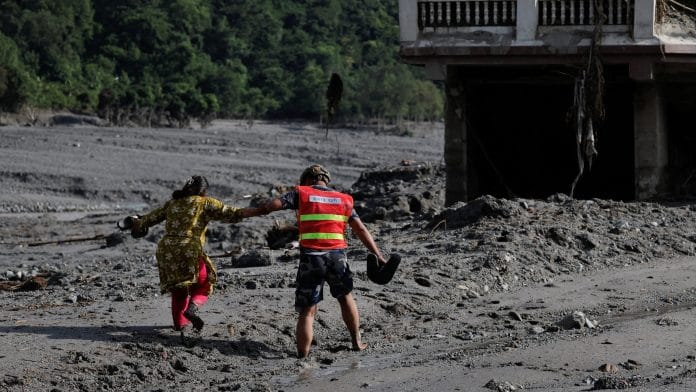

Nepal issued a fresh warning as water levels in a key river rose, threatening to disrupt rescue efforts after catastrophic flooding killed hundreds and left thousands still missing along its border with China.
Rescue personnel and those providing relief services in regions surrounding the Bhote Koshi river’s path were told to exercise “utmost caution,” the National Disaster Risk Reduction and Management Authority said in a post on X.
At least 690 people have been confirmed dead, while over 3,000 are still unaccounted for, according to figures provided by Nepal and China. The death toll is likely to rise as rescue workers speed up efforts to retrieve bodies.
The catastrophe was triggered on Wednesday by a glacial collapse that sent ice, mud, rocks and fast-moving water surging through a valley in Nepal, wiping out entire settlements in their path. Videos showed people attempting to flee as walls of water and debris swallowed buildings, tore down bridges and power lines, and washed away trees, boulders and vehicles.
“It was a horror to walk around. It looks like a bomb blew up, a bomb made of mud, there’s nothing left,” David Fisher, head of the Nepal delegation for the International Federation of Red Cross and Red Crescent Societies, told Bloomberg. “People have lost everything.”
Fisher on Saturday visited Nuwakot , an affected district still partially accessible by road. Thousands of people who have been displaced are taking shelter in any surviving buildings on higher ground, including houses of worship, hospitals and government buildings, he said.
Nepal has mobilized over 18,500 military and police personnel on challenging rescue missions, including in settlements steeped in sludge and at hydropower projects where workers have been trapped in tunnels. Tunnel experts from India and China have joined in rescue efforts as well.
China said on Saturday it had deployed nine tunnel experts to Nepal to help in rescue operations at a hydropower station, CCTV reported. India sent an 11-member medical and tunnel rescue team. A fourth flight from India reached capital Kathmandu with essential supplies and “technical capabilities” to support rescue and relief operations in Nepal, India’s Foreign Minister S. Jaishankar said on X.
One of Asia’s poorest economies, Nepal faces a daunting reconstruction effort at a time when it’s also being squeezed by higher fuel costs due to the Iran war, as well as weaker tourism and slowing growth. The disaster has compounded the challenges facing the Himalayan nation’s 36-year-old Prime Minister Balendra Shah, who rose to power earlier this year on a wave of Gen Z disaffection.
Rescuing Nepalis and foreign nationals is the government’s top priority, Foreign Minister Shisir Khanal said on Saturday.
Efforts to do so in the remote region have been hampered by tough terrain, heavy rains, and the risk of further flooding as rivers clogged with mud and debris formed new, unstable lakes upstream. Experts were closely monitoring such lakes, some of which were quickly filling with water that could breach the banks in an uncontrolled manner.
The affected areas reachable only by helicopter, and Nepal is seeking heavy-lift drones to provide supplies to those parts, Khanal said. Hundreds of bodies have been found downstream and the government had requested freezers to stave off decomposition and give families more time to identify loved ones.
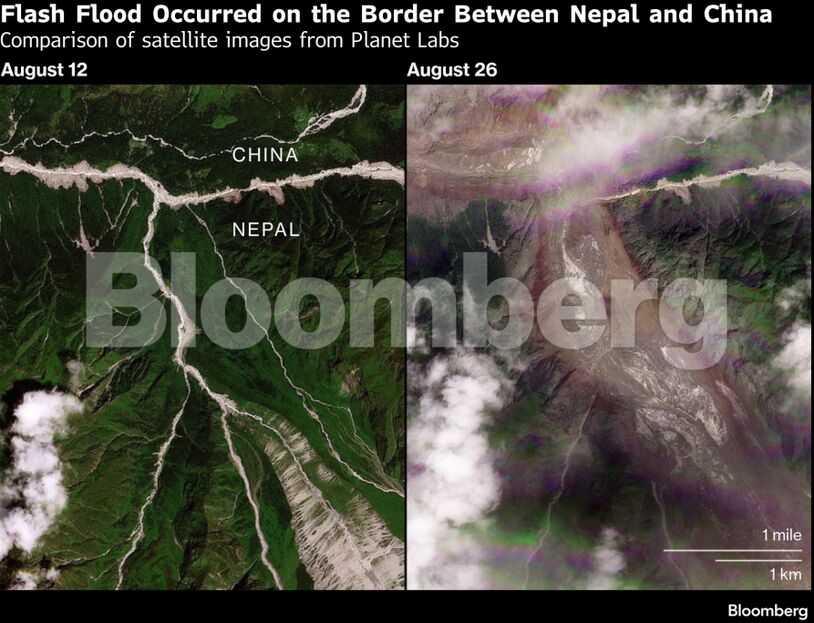
“The scale of devastation is quite significant and we anticipate international assistance for rehabilitation and reconstruction,” he said at a briefing in Kathmandu. “Our capabilities are low so we have been asking for foreign government support” in providing freezers, forensic capabilities and other specialized aid, he said.
Dozens of survivors were being treated at Tribhuvan University Teaching Hospital in Kathmandu. During a visit on Saturday, walls were papered with photographs of the dead and missing, while dozens gathered in hopes of news about their loved ones, registering individual details with police officials camped nearby.
While the hilly country is no stranger to recurrent landslides and floods, the magnitude of this disaster is almost exceptionally large.
“What’s unusual and frustrating is to be several days in and not be able to provide assistance to the bulk of people who’ve been affected,” IFRC’s Fisher said.
Disclaimer: This report is auto generated from the Reuters news service. ThePrint holds no responsibility for its content.