


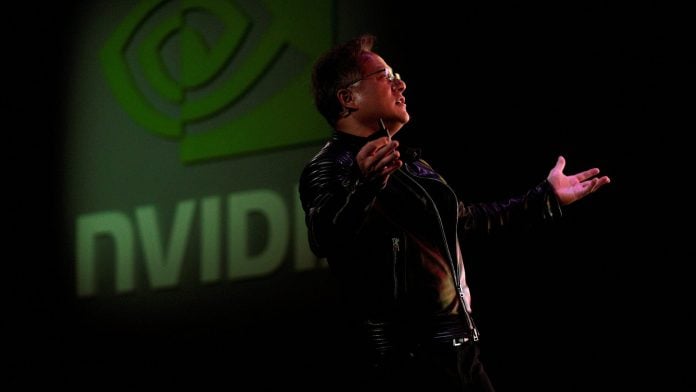
Relief about Jensen Huang’s return as the boss of Nvidia Corp. is already fading. Markets are back to worrying about the gigantic costs of funding the artificial intelligence race and what happens if the data center buildout slows down.
For Nvidia one dilemma hasn’t gone away with its leather-jacketed co-founder back at the helm: To what extent can it keep using its strong balance sheet to prop up the AI ecosystem and demand for its computing chips? Investors have grown wary of the “Bank of Nvidia’s” financial engineering. But reining it in would have drawbacks too. Getting the balance right won’t be easy.
In the short-term some moderation of its equity investments and financial backstops — where it funds firms that buy its chips or offers other kinds of payment support — might please Nvidia shareholders. It would mean fewer problems if these customers can’t pay their bills. Most are AI startups or neoclouds (which rent out computing capacity), so there’s a risk of at least a few hitting trouble.
For now demand for Nvidia’s processing units (GPUs) remains ravenous. With revenue expected to increase by 75% next year, the company could switch to repurchasing more of its own shares. At the end of October, it had a whopping $227 billion of remaining capacity to do just this.
Nonetheless, even with Donald Trump deciding he wants Huang to stay in charge, investors are cautious. Nvidia’s roughly $3.6 trillion market capitalization remains far below its peak and a mere 10 times the earnings analysts expect it to generate in the fiscal year ending January 2028. That’s surprisingly low for a tech firm growing at breakneck pace, no matter how huge its market value.
This reflects a cornucopia of worries, not least the Congressional and government probes that have followed news of Huang’s affair, and a separate accounting investigation. Then there are the tighter export controls and curbs on Chinese companies remotely accessing advanced AI chips overseas, and the political pushback against building data centers.
But the low profit multiple for Nvidia’s shares may also point to doubts about how long it can keep its astonishing pricing power and status as the top dog of AI computing. Alphabet Inc., Advanced Micro Devices Inc. and others are advancing alternative chips.
Even before revelations about his philandering forced Huang to step down briefly, Nvidia had become more circumspect about financing the AI boom. The cost to insure the company’s debts against default had begun to rise. This important gauge of credit risk remains elevated today.
Before his exit, he was already pressing neoclouds to get their own clients to pay more upfront, lessening the need for Nvidia to provide financial support. There were signs of a shift as well in how it treats its large AI lab customers: A proposed backstop for OpenAI’s lease obligations at one campus was reportedly trimmed, though it’s still a $105 billion potential liability. “We do not expect Mr. Huang’s return to bring a quick reversion to broader customer financing,” reckons Stifel analyst Ruben Roy.
And yet financing the AI industry has diversified Nvidia’s client base. Curtailing it would be a blow to the neoclouds who’ve been so profitable for Huang.
More than 40% of Nvidia’s data center revenue relates to “non-hyperscale” customers, taking in business clients as well as neoclouds. If the latter is weakened and their debt costs keep rising, purchases of Nvidia GPUs might end up more concentrated among the hyperscalers, the traditional giants of Big Tech — some of whom have ambitions to displace Huang’s firm.
Nvidia “would like to provide less credit support but there are limits to how low they can go,” Jay Goldberg, an analyst at Seaport Research Partners, told me ahead of Huang’s reinstatement.
If only its clients were all like SpaceX. Elon Musk’s rockets and AI firm is cashed up following a blockbuster initial public offering. It has vowed to use only Nvidia processors and Musk’s engineers are adept at building data centers quickly. Thanks to its profitable broadband unit, SpaceX has an investment-grade credit rating. Hence it’s been able to snag tens of billions of off-balance sheet financing without Nvidia’s involvement, although that is expensive.
Many Nvidia customers aren’t as rich as SpaceX, nor as loyal. Anthropic PBC’s IPO and private placement did swell its coffers to more than $200 billion. Yet that probably won’t be enough to secure an investment-grade rating right away, given its volatile cash flows and massive spending.
The major AI labs, including market leaders Anthropic and OpenAI, are on track to account for about 15% of Nvidia’s data center revenue. But those two customers are both developing chips and they want to diversify their processor purchases. OpenAI boss Sam Altman isn’t fond of paying $70 billion or so for a gigawatt of AI capacity, and he’s on a mission to compress supplier profits that inflate data center costs. Nvidia’s gross margins exceed 70%.
Anthropic is also laser-focused on costs. A multi-chip strategy knitted together by its software is well advanced — its smorgasbord includes Alphabet’s Tensor Processing Units, Amazon.com Inc.’s Trainium and AMD’s GPUs.
And while the hyperscalers are still buying heaps of Nvidia processors, investments in their own much cheaper custom silicon should eventually help them shift more of that spending away from Huang’s creations. Oracle Corp. will begin begin offering Alphabet’s AI chips in its cloud business next year. “Hyperscalers still have incentives to diversify accelerator supply,” notes Mandeep Singh of Bloomberg Intelligence.
Notably, Nvidia’s rivals are also using their balance sheets to gain market share. Chip designer Broadcom Inc. has been busy backstopping Anthropic’s computing commitments, for example.
In contrast, the $500 billion in potential Wall Street funding that Huang announced in August to let less wealthy companies buy its chips, remains untapped. Although talks with bankers are ongoing, Nvidia is under pressure to shoulder more of the burden if customers can’t pay.
Perhaps jitters in the debt markets will force rivals such as Broadcom to dial back their customer financing activities, too. But if the enormous financing that draws customers into Nvidia’s orbit starts weakening, so could its stranglehold on the AI computing market.
Disclaimer: This report is auto generated from the Bloomberg news service. ThePrint holds no responsibility for its content.