




Japan is close to notching its longest economic growth streak since WWII, as the nation weathers higher oil prices from the war in Iran and the central bank’s ongoing quest to normalize interest rates.
The government kept its view that the economy is “recovering moderately,” signaling the expansion still has room to run, according to its monthly economic report released Tuesday. That’s fueling speculation that the Cabinet Office’s leading index — a composite of key economic indicators designed to predict the direction of the economy — will continue on its expansionary trend.
The index for May, due July 7, is expected to show that the economy was on a growing trend for a 72nd month, or six years. If the June and July readings also point to continued growth, the current expansion would surpass the previous record of 73 months.
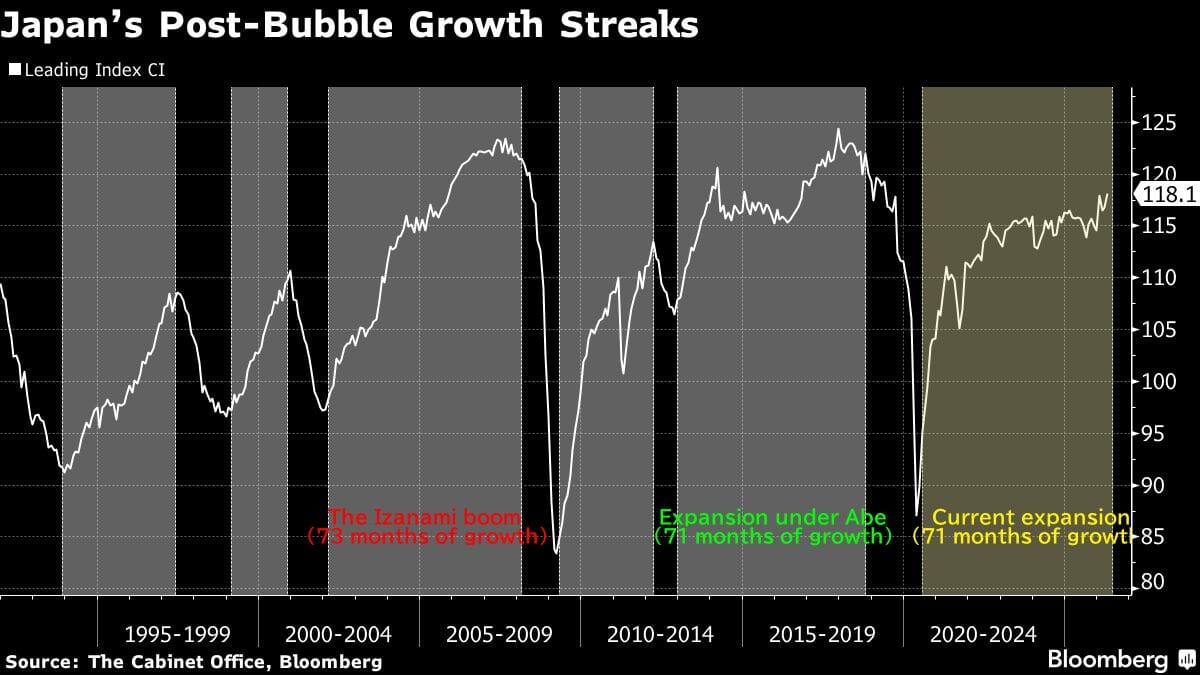
After bottoming out in May 2020 during the pandemic, Japan has broken from decades of deflation as price growth returned and wage gains strengthened.
Japan’s economy grew at a decent pace at the start of the year on the back of solid consumer spending and trade, with demand for artificial intelligence-related products providing a key boost for exports. However, the trend for households is uncertain as inflation — partly driven by a historic slump in the yen — squeezes purchasing power.
Even though growth in wages has outpaced prices in recent months, consumer confidence is still below pre-pandemic levels. And recent spending has been propped up in part by temporary subsidies from Prime Minister Sanae Takaichi, calling to question how durable the trend is.
“The current expansion is highly fragile,” said Taro Saito, head of economic research at NLI Research Institute. “While nominal GDP has continued to expand, people aren’t actually becoming wealthier.”
The BOJ raised interest rates earlier this month to 1%, the highest since 1995. Yet even after the hikes, Japan’s borrowing costs remain well below those in other major economies. Accommodative financial conditions and fiscal support have helped fuel a rally in domestic equities, with the Nikkei 225 climbing above 70,000 for the first time in June, more than triple its level at the end of May 2020.
The longest postwar expansion so far is the so-called “Izanami boom,” which lasted from February 2002 to February 2008 during Junichiro Koizumi’s administration. The next longest began in December 2012 under then-Prime Minister Shinzo Abe’s second administration.
Toshihiro Nagahama, chief economist at Dai-ichi Life Research Institute who also serves as a private-sector member of Takaichi’s government’s economic and fiscal panel, is more optimistic about the trend going forward.
“Supported by the generative AI investment boom and resilient production activity, the economy is unlikely to falter in the near term,” Nagahama said.
This report is auto generated from the Bloomberg news service. ThePrint holds no responsibility for its content.