



New Delhi: A ban on the burqa and niqab is among the three steps towards civic integration, security, and gender equality outlined on Sunday by Italian Prime Minister Giorgia Meloni. The other two are a cap on enrolment of foreign students and mandatory Italian lessons for immigrants.
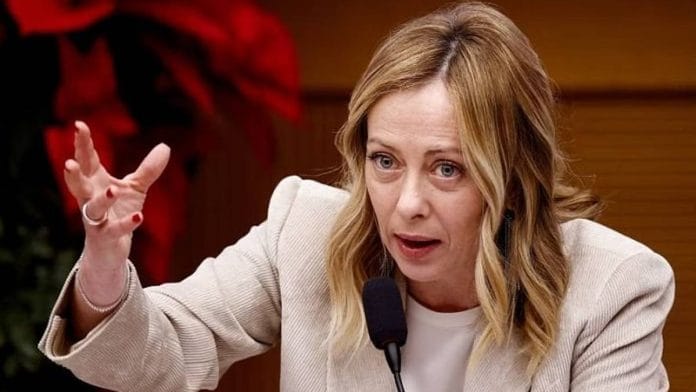
Meloni was speaking to the youth chapter of the Brothers of Italy party at the Laghetto dell’EUR in Rome on Sunday when she unveiled this radical new vision, contained in a proposed legislative package to be presented to the Italian Council of Ministers.
Meloni’s move comes ahead of an election cycle as her administration faces pressure from rival right-wing parties to maintain a strict stance on migration, secular civic identity, and cultural integration.
The most notable feature of the speech was the proposed ban on face-covering garments in schools and colleges, arguing that tradition cannot override women’s choices. “You must go to school with your face uncovered, and in Italy no one, in the name of a real or supposed tradition, can decide that a young woman must hide herself,” Meloni said.
The hijab is excluded from the ban because it does not cover the face.
Italy’s face-covering laws date back to May 1975 under Article 5 of Law No. 152, or the ‘Reale Law’, named after former justice minister Oronzo Reale. Introduced as an anti-terrorism measure during the ‘Years of Lead’, the law prohibits helmets and face coverings that obscure identification without good reason. A 2008 ruling by the Italian Council of State established a precedent exempting religious, cultural, and sports settings from this restriction, provided identity has been verified.
The proposed measure aims to remove these exemptions within education, treating open-face attendance as non-negotiable. These promises echo wider bills proposed by coalition allies, such as Matteo Salvini’s Lega, which seek to penalise face veils in public spaces with administrative fines.
Meloni also proposed a legal cap on foreign national enrolment per class. While a 30 per cent limit on foreign admissions already exists, no specifics were given on how it would change. Currently, foreign students make up 12 percent of total enrolment in Italian education.
Additionally, she proposed Italian language lessons for parents, arguing that assimilation cannot rely solely on schools when language barriers hinder communication with educators.
Such a ban would align Italy with European nations like France, Belgium, and Austria, which restrict full-face veils in public spaces or educational institutions.
Opposition parties pushed back sharply. Irene Manzi, school affairs representative for the Democratic Party (Partito Democratico), pointed out that most students labeled “foreign” were born and raised in Italy. Critics accused Meloni of politicising classrooms, calling measures like the 30 per cent cap redundant.
The executive branch must approve the draft text within the Council of Ministers. If introduced as a temporary ‘law-decree’, it takes effect immediately but requires Parliament to vote on and ratify it within 60 days, or the decree expires.
Ashwin Shekhar is a TPSJ alum, currently interning for ThePrint.
(Edited by Nardeep Singh Dahiya)
Also Read: Giorgia Meloni on why working with Donald Trump has been difficult