



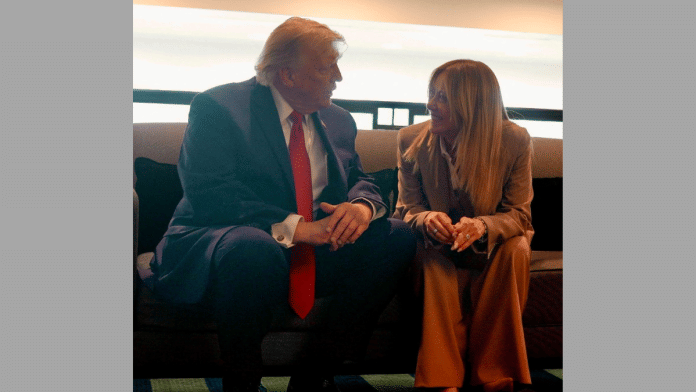
New Delhi: In an interview with The New York Times, Italian Prime Minister Giorgia Meloni acknowledges that working with Donald Trump has been difficult, particularly as disagreements have become personal.
Remarks directed at Italy and the Catholic Church eventually crossed a line.
“It’s evident that with Donald Trump, I believed things would be easier, given our convergence on immigration and woke culture. Things have turned out otherwise,” she said in the interview.
Meloni’s comments came after a series of public disagreements with the US president. She criticised Trump’s attack on Pope Leo, objected to his comments about Italy’s contribution to the war in Afghanistan and rejected his claim that she had “begged” him for a photograph at the Group of 7 summit in France.
Her comments highlight the limits of the supposed alliance between Europe’s nationalist right and Trump’s movement in the US. Shared ideology does not necessarily mean shared interests. Nor does it erase differences over national pride, foreign policy or how allies treat one another.
In the interview, Meloni made clear that Italy’s foreign policy cannot depend on whether she personally gets along with Trump.
“I continue to believe that the unity of the West is something very important. I don’t decide Italian strategy based on my personal relations,” she said.
Trump’s criticism, Meloni’s pushback
Meloni was the only leader of a European Union government invited to Trump’s inauguration. She also shared his positions on migration and progressive cultural issues and hoped to act as a link between the United States and Europe.
According to The New York Times, Trump criticised the EU, questioned the contribution of European NATO members ansd spoke favourably of US control of Greenland.
In Italy, one of the sharpest disputes followed Trump’s criticism of Pope Leo. Trump described the pope as “weak on crime, and terrible for Foreign Policy”. Meloni called the remarks “unacceptable”.
“She is the one who is unacceptable, because she does not care whether Iran has a nuclear weapon and would blow Italy up in two minutes if it had the chance,” Trump responded to Meloni’s condemnation of his earlier comment on Pope Leo.”
Fabio Rampelli, a vice-president of Italy’s lower house and a longtime associate of Meloni, described Trump’s remarks about Italy’s military contribution as deeply offensive.
“Insulting Italy when we had paid a tribute in blood in Afghanistan was a brutal affront,” he said.
The dispute intensified in June after Trump told an Italian journalist that Meloni had “begged” him for a photograph at the Group of 7 summit in France. Meloni rejected the account publicly. “Italy and I never beg,” she said.
In the New York Times interview, she continued to describe Western unity as important and said her foreign-policy approach was not based on whether she had good personal relations with another leader.
Meloni has presented Italy as both a Western ally and an independent national power. She has supported Ukraine against Russia and remained committed to NATO, while continuing to share some political positions with Trump.
Her broader ambition is to increase Italy’s influence in Europe. She has argued that Italy should no longer act as “the spare wheel to France and Germany”. Instead, she wants it to be “seated at the table of those who set the direction”.
(Edited by Prashant Dixit)