



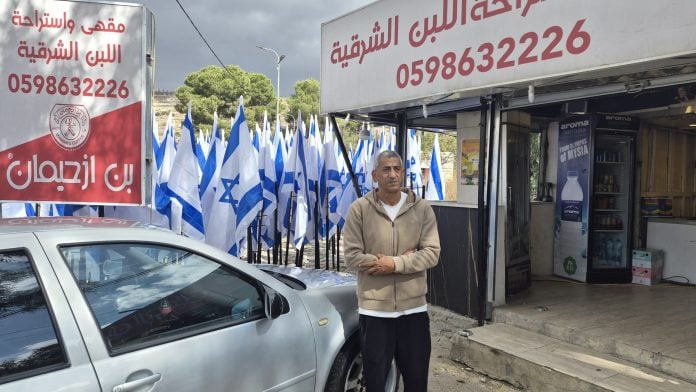
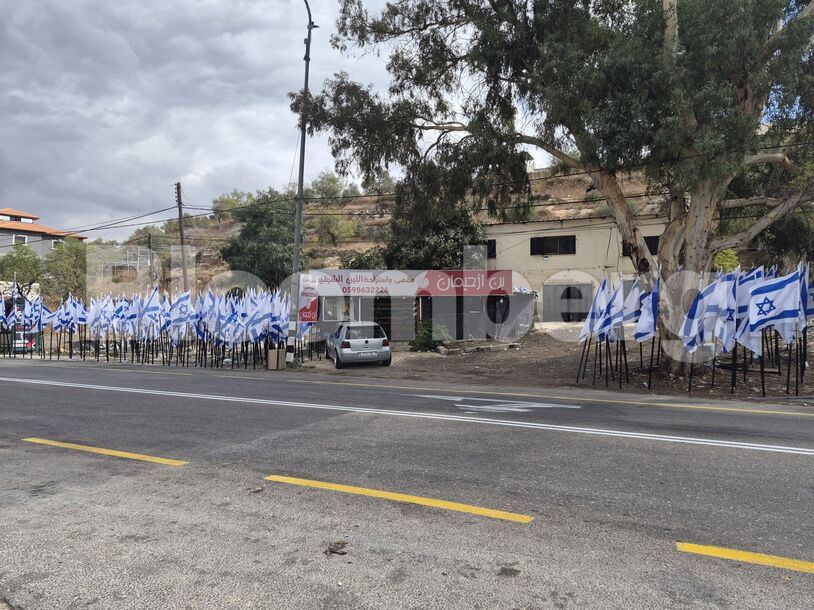
On Route 60 in the West Bank, sandwiched between the Palestinian village of Al Lubban Ash Sharqiya and the Jewish settlement of Eli, Muayyad Hussein feels under siege in the roadside kiosk he’s run for some 30 years. First, settlers set the unit on fire. Then they robbed his stock. Then, this month, on Oct. 7 of all days, they hammered a thicket of Israeli flags six-to-ten deep across his shop front and to either side as police looked on.
“What really worries me is that I have four sons, and one day they might be here when the settlers come,” said the 50-year-old, turning away as he teared up. “They won’t be able to watch their father humiliated and stay quiet.”
Hussein is not a Hamas jihadist and neither are his sons, one of whom was stacking products as we spoke. Nor is the campaign to plant forests of blue and white Israeli flags all over the West Bank the worst in the current wave of settler — let alone state — violence. But if Israelis elect a different government tomorrow, one of the first things it should do is remove the flags. These are not symbols of patriotism. They are symbols of erasure and hate.
Israel’s is a society traumatized by the savagery of Hamas’s Oct. 7, 2023, assault, which reached deep into the population’s DNA and will shape this vote and the years ahead. Demographic change and frustration with the drawn-out failure of the 1993 Oslo Accords already had led to a profound rightward shift in Israeli political opinion that began decades ago.
The researcher Beth Oppenheim recently traced this journey toward religious nationalism in an extensive project for the European Council on Foreign Relations. She concludes that it leaves limited room for change on matters of foreign policy or the Palestinian question, even in the unlikely event that an opposition coalition should win by a clear majority. Europe, she says, must recognize it is dealing with “a new Israel,” and shape its responses accordingly.
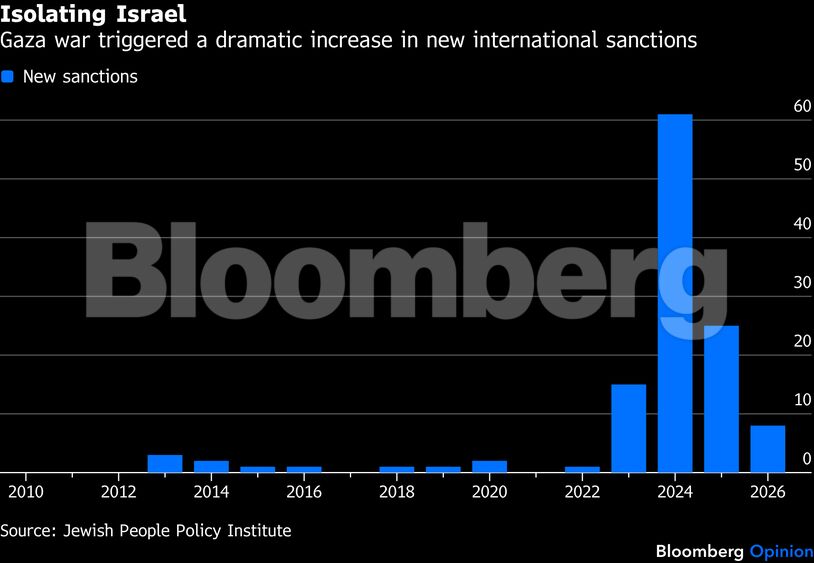
That is undoubtedly true, but unless steps are taken to start reversing the cycles of hate and violence that the last few years have sent into hyperdrive, this will not — as I wrote recently — be a sustainable Israel. The country is hurtling toward further conflict and international isolation, in a situation reminiscent of apartheid South Africa, said Yuli Novak, the outspoken executive director of B’Tselem, the Israeli Information Center For Human Rights in the Occupied Territories.
On Friday, two Palestinians attacked a West Bank checkpoint near Hebron, killing two Israeli soldiers. Police sealed off the West Bank’s largest city and Prime Minister Benjamin Netanyahu quickly pledged to “destroy” the neighborhood the gunmen — who also died in the gunfight — were from. By Saturday, swathes of houses had been bulldozed and hundreds of families evicted. Netanyahu and his coalition partners clearly believe this collective punishment will prove a vote winner — and they may be right.
At the Shiloh winery, a five-minute drive from Muayyad’s kiosk, I asked head winemaker Amichai Lourie how the recent UK-led boycott of exports from the West Bank in protest against settler violence would affect his business, an elegant spot that wouldn’t feel out of place in California’s Napa Valley. “There’s nothing new here,” he said, angered by the question. “People have boycotted, hated, persecuted and slaughtered Jews for thousands of years.”
Were I to dress to blend in and walk unnoticed about the local Palestinians, he added, I would soon understand that “they want to kill us all,” he said.
Some clearly do. The Hamas fighters who boasted of their atrocities against Israeli women and children three years ago did not stop by choice. But most Palestinians, the roughly 2 million who live in Israel as its citizens and the 5.5 million in the West Bank and Gaza, are neither gunmen nor murderers. They, too, are traumatized by what has unfolded since October 2023, tapping into their own history of loss and abuse.
There is no quick solution, no short cut to two-state — or one-state — harmony. Donning body armor to oversee Saturday’s pre-election destruction in Hebron, Netanyahu’s far-right Finance Minister Bezalel Smotrich called for a Gaza-scale military operation in the West Bank. And yet for all the dark fantasies about pushing each other into the sea, neither of these two communities are going anywhere. This fact must be recognized by Israel’s next leaders and, step by step, addressed.
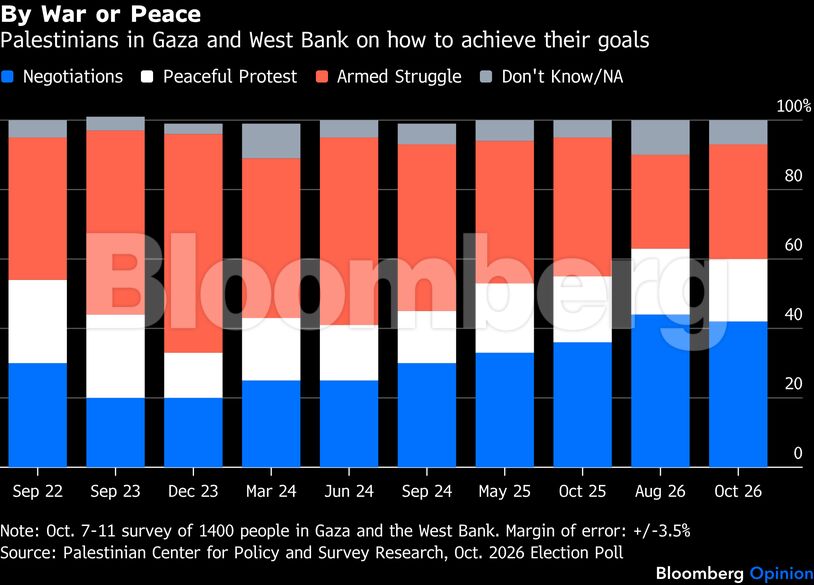
It helps to visit the West Bank to understand the intransigence of the two sides. What weighs on Israelis in part is the sheer proximity of the territory’s Palestinians, who as recently as this time last year said in a regular poll that they still supported Hamas and what it did on Oct. 7, and favored armed conflict over negotiation. Since then, a poll from this month shows, support for Hamas has collapsed (to 13% in the West Bank), together with the appetite for armed conflict. That shows attitudes can change, but trust will be much harder to build.
From the West Bank to the beaches of central Tel Aviv is about the same distance as from downtown Manhattan to John F. Kennedy International Airport. To Jerusalem, a city of more than 1 million people, there’s no distance at all — the territories Israel wrested from Jordanian control in 1967 begin within the city. With the Hamas attack from Gaza on hang gliders and motorbikes still front of mind, even many liberal Israelis are unwilling to countenance creating a Palestinian state that could again elect Hamas and, in the age of drones, would have their bedrooms in range.
For Palestinians, geography is just as compelling an issue. Settlements such as Eli are now fully developed towns, but in the 1970s and ‘80s were the hilltop caravans of their day. Today there are more than half a million settlers in the West Bank (excluding East Jerusalem). Their political and economic importance is growing, even as roads and utilities are diverted to serve them while roadblocks and checkpoints atomize the Palestinians and choke their economy.
Stopping in the largest Palestinian refugee camp, Balata, outside Nablus, the contrast with Eli and Shiloh could not be more stark. The roads here are more pothole than surface. Piled high to either side are the carcasses of cars, written off by Israeli insurance companies and stripped here for parts, in what passes for an industry. With travel restrictions making it difficult to commute to Israel, and tax revenues withheld from the Palestinian Authority, an always-weak economy has been utterly crushed.
“We just want to live,” says 85-year-old Mirah Amir, who has been here since he fled Israel in 1949 and remembers eating with his Jewish neighbors before Israel’s creation. The younger men waiting with him for taxi fares that never seemed to come were less philosophical and more bitter.
So what to do? The answer cannot be heroic. It has to start small but unequivocally to begin to unwind the damage of the last few years. In Gaza, fundamental policy may not change, but a new government can unblock progress on Donald Trump’s peace plan and halt measures transparently aimed at making the territory uninhabitable.
In the West Bank, those flags the police allowed Hussein to remove only to the extent they blocked access to his shop must all go. The so-called Hilltop Boys, responsible for much of the high-profile violence in the West Bank, should be disarmed, their caravan settlements dismantled and the land returned to its displaced Palestinian owners. The police and security services must be reformed and go back to enforcing the law instead of enabling lawlessness.
Just as important is to start repairing relations with Israel’s own Arab communities, where neglect by police has in recent years allowed organized crime gangs to run free, more than doubling the murder rate from 2022 to 2023.
There is opportunity in this crisis. Whatever path Israel takes to deal with the West Bank and Gaza, it needs to start by integrating its own Arab population if it is to escape an endless cycle of terrorism, repression and international isolation. That won’t take much, because the bar for improvement could hardly be lower. Even the opposition says it won’t form a coalition with Arab parties, which represent a fifth of the population, despite the fact that this would bring them near-certain victory. The Election Committee, made up of legislators in proportion to their seats in parliament, tried to ban all the Arab parties from running, only to be overruled by the Supreme Court. The court decision was no surprise, but the exercise aimed to delegitimize Palestinian parties in the eyes of Jewish voters and demoralize Arab ones.
Palestinian Israeli politicians and activists I spoke with on my recent visit believe the tactic will backfire. “We are now facing the persecution that Jews faced in the past,” said Hassan Jabareen, founder and director of Haifa-based Adalah, the Legal Center for Arab Minority Rights in Israel. He litigated on behalf of the Arab parties in their court case and believes normally apathetic Arab voters will come out this time to eject what he called “a criminal, killer government” in favor of a merely discriminatory one.
Turnout will matter, because even if Arab legislators won’t join a Jewish coalition under the main opposition leader Gadi Eisenkot, they will support it with their votes.
Palestinian Israelis won’t be in government this time, Yahya Dahamsha, political director for the predominantly Arab Ra’am party, told me at his office in Nazareth. It’s all too raw for both sides, even though he said Ra’am itself is willing. But this could and should happen at the next election and in time it must if the country is to return to health. In one small, promising sign, Yoav Segalovitz, a Jewish former senior police officer, has joined the religious-conservative Ra’am to run on its Knesset list.
Having Arab ministers in positions of power, able to negotiate key demands for their community, is the only path toward some kind of reconciliation and trust. It happened before, when Ra’am joined a coalition government to oust Netanyahu the last time he briefly lost office, in 2021, and proved widely accepted. It should happen again. Both camps need to marginalize their racist extremes.
“If Eisenkot can just offer hope, instead of all this hate and incitement, he can change things,” said Dahamsha. For good or ill, he said, “it’s all about the leaders.” Tomorrow, Israelis will have to choose.
This report is auto generated from the Bloomberg news service. ThePrint holds no responsibility for its content.