



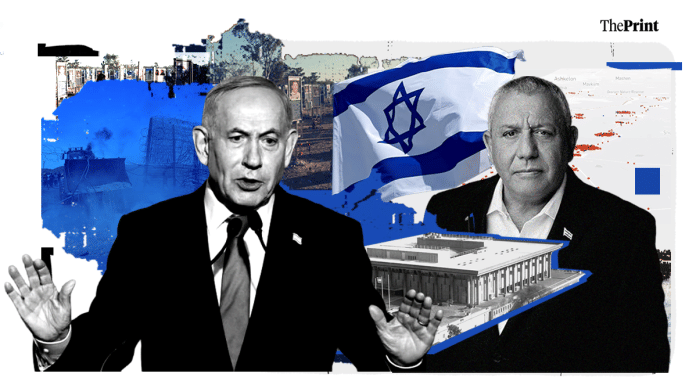
New Delhi: Israel heads to the polls on 27 October, its first since the 2023 Hamas attack in which roughly 1,200 people were killed and 251 taken hostage.
This was among the country’s worst security breaches under Prime Minister Benjamin Netanyahu, who has built his image as ‘Mr Security’ and heads the most right-wing, religious-nationalist government in Israel’s history. Netanyahu’s opponents have used his failure to foresee and prevent the attack, as the centerpiece of their electioneering, positioning themselves as better-suited for Israel’s national security.
Repeated reports that Netanyahu was warned of a possible attack before 7 October have weakened his position. This election is more about who gets to form the next government, with Iran and the Palestine question shaping the election race.
Netanyahu, 77, has been the longest-serving prime minister of Israel, having surpassed even Israel’s founding father and first leader, David Ben-Gurion. He first came to power in 1996, becoming Israel’s youngest supremo, returned to office in 2009 and served continuously until 2021.
He was voted back in late 2022, after five elections in under four years from 2019 to 2022 had left Israel with a string of short-lived governments. The upcoming election will mark one of the rare cases where a government completes a full term.
To attack Iran or to not
Netanyahu had said he does not favour a pre-emptive strike against Iran before the elections, but reports suggest that he and US President Donald Trump had discussed the possibility of launching a new major operation against Iran before Israel’s general elections and US midterms.
On Wednesday, The Financial Times reported that the Israel Defense Forces (IDF) was ready to carry out strikes on the weekend of 10 October to target Iran’s nuclear facilities, regime sites, and energy plants. Trump, however, did not give the green light to restart military operations before US midterms, scheduled for 3 November.
Still, the Israeli and U.S. militaries continue to be on alert and finalising preparations in case they decide to go ahead, albeit renewed military operations could carry grave political implications for both leaders. They jointly struck Iran in late February, killing Iran’s Supreme Leader Ali Khamenei, which kickstarted a conflict that has not only upended global energy markets and regional economies but also plunged West Asia into greater turmoil.
A poll by the Hebrew University of Jerusalem shows that a majority of Israelis feel that Iran had won over them or gained more from the conflict, and that Israel’s long-term security had been weakened.
The political damage to Netanyahu, who has sold himself as a wartime prime minister, shows in the numbers: support for his premiership plummeted from 40.5 percent in early March to 29.4 percent in June.
On Monday, US Secretary of War Pete Hegseth made an unannounced visit to Israel and held a secret meeting with Netanyahu in Ovda air base in southern Israel. Both reportedly discussed new strikes against Iran.
On Wednesday, The New York Times also reported that the two have made specific plans for renewed strikes against Iran after the American midterms, with potential targets including Iran’s nuclear facilities, energy infrastructure and drone and missile arsenal. To this end, both militaries have stepped up exercises, flying planes over Iraq to practice maneuvers.
With only two months remaining for the year to end, neither Israel nor the US have achieved their strategic objectives in Iran, with Tehran unwilling to concede.
Trump endorses Netanyahu
Trump has given a last-minute endorsement to Netanyahu. “Bibi Netanyahu has been a Great Warrior Prime Minister, and an even greater Partner for Peace in combatting the Islamic Republic of Iran,” he posted on Truth Social on 18 October.
Trump said the US would be alone in the war against Iran if Netanyahu were not re-elected, and he is “not inclined” to take on this job alone. “Please let this Letter serve to represent my Complete and Total Endorsement of Bibi Netanyahu in his upcoming Race for Re-Election as Prime Minister of Israel.”
Netanyahu thanked Trump on X for his tremendous support, saying the two would together “complete the mission and eliminate the Iranian nuclear program”. In a video of a phone call he also posted, Netanyahu told Trump he was by far the greatest friend Israel has ever had in the White House, and ever will.
It’s unclear how Trump’s endorsement will boost Netanyahu’s vote share. Trump’s relationship with Netanyahu has been close but also fractious at times, with the US president criticising his policies, both in public and private. When an Axios reporter asked Trump why he delayed his endorsement, he said: “I was always going to do that. I just didn’t want to do it too soon”.
In an interview with TIME magazine, published 1 October, Trump—responding to a question about whether Israeli people should give Netanyahu another term—said: “Well, I can only say that I’m not involved in politics anymore”. “Well, people have written off Bibi many, many times, just like they’ve written off me many, many times. I wouldn’t underestimate Bibi,” he added.
Netanyahu’s main contender
Bibi faces a formidable challenge from former IDF chief of staff Gadi Eisenkot. Eisenkot’s newly formed centrist Yashar (Hebrew for ‘straight’ or ‘honest’) Party has overtaken Bibi’s Likud Party in numerous polls. Eisenkot’s main allegation against Netanyahu is that he has not done enough to destroy Hamas’ capabilities. However, Eisenkot and Netanyahu hold similar positions on Gaza: they do not want Palestinian statehood and support Jewish settlement in the occupied West Bank.
Eisenkot comes from a modest working-class background who worked his way up through the ranks, with many Israelis seeing him as a soldier-turned-politician who’s straightforward and honest, something that his party name itself reflects. His credentials as a strong alternative to Netanyahu are bolstered by personal loss: his son and two nephews were killed in combat in Gaza following the 7 October attacks.
Eisenkot is credited with devising the infamous ‘Dahiya’ or ‘Dahiyeh Doctrine’, which recommends deliberate, disproportionate damage to civilian infrastructure to pressure a hostile government or an armed group. The doctrine derives its name from a Hezbollah stronghold in Beirut, bombed by Israel during its 2006 war on Lebanon.
While Yashar is emerging as the leading party, neither of the parties is projected to win an outright majority of 61 seats in Israel’s 120-seat national assembly, known as the Knesset.
In any case, governments in Israel are formed by a coalition of multiple parties, since it uses a proportional representation voting system. This means that small parties have a lot of sway over who will be appointed prime minister and how long they remain in office. If one party walks out, the government falls.
Netanyahu’s coalition comprises his own right-wing Likud, Finance Minister Bezalel Smotrich’s Religious Zionism; National Security Minister Itamar Ben-Gvir’s far-right Jewish Power (Otzma Yehudit); Shas and New Hope parties. The ultra-Orthodox Jewish party United Torah Judaism quit the coalition in 2025 over a long-running dispute over conscription or mandatory military service for seminary students, and this has emerged as a main issue during the campaigning. Even Ben-Gvir had quit in January 2025, opposing the ceasefire deal in Gaza, but rejoined the coalition a couple of months later.
Other players
Some other key opposition parties include: Yisrael Beiteinu led by Avigdor Lieberman; Yesh Atid by Yair Lapid; B’Yachad by Naftali Bennett, and Democrats by Yair Golan. It was Lapid and Bennet’s party that had stitched up a coalition to oust Bibi’s government in a 2021 election. Their government lasted for 18 months, following which Netanyahu stormed to power in the 2022 elections.
Of these parties, only Golan’s Democrats, a “liberal-democratic Zionist” party, has criticized Israel’s killing of Palestinians and annexation of the West Bank, while also backing the two-state solution. It is also the only opposition party to support the inclusion of Arab parties in a potential coalition.
Then there are the Arab parties—representing the Palestinian citizens of Israel who roughly account for one-fifth of the population—that can potentially play the role of a kingmaker. The two main Arab parties are the Joint Arab List, a coalition of Hadash, Balad and Taal, and the smaller United Arab List (Ra’am), an Islamist party headed by politician Mansour Abbas. Both parties condemn Israel’s conduct in Gaza and illegal settlements in the West Bank, but Ra’am has more moderate stances towards Israel.
Though Netanyahu and his rivals have vowed to not partner with an Arab-led party, this can change. There is past precedent, given the Lapid-Bennet coalition included the Ra’am party for the first time in Israel’s history.
The previous elections—before Netanyahu’s incumbent government was formed in 2022—were marred by deep polarisation, leading to fractured mandates. It was this polarised polity that aided Netanyahu’s return to power due to his choice of allying Likud with the far-right parties.
Now, given both the trauma of 7 October as well as the unprecedented conflicts Israel has tangled itself in since 2023, there remains significant uncertainty over how much such polarisation has increased or decreased, and the effect it may have on the upcoming elections and how a government will be formed. The coalition math required in Israel compounds this.
Two things, though, are established. One, Netanyahu is a consummate political survivor and has emerged victorious even in times when no one thought he would. Second and more important, irrespective of who comes to power, most parties now competing amongst themselves share a similar foreign policy slant with regard to a two-state solution and views on Iran.
(Edited by Tony Rai)
Also Read: Moscow Format has become a talk-shop. Afghanistan is receding from global agenda