



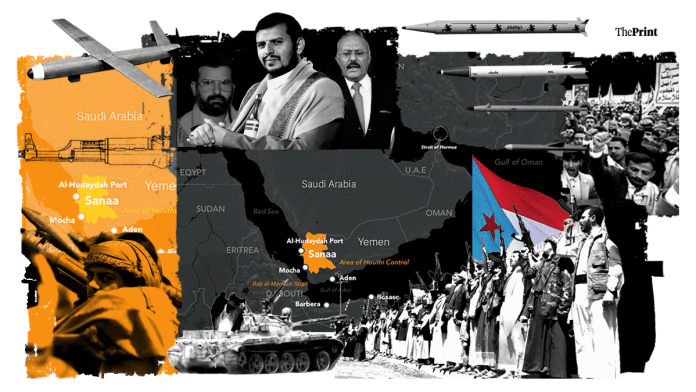
New Delhi: The Houthis in Yemen have reopened a front that had witnessed a lull for the past few years, in a region already grappling with one too many fronts.
After a truce, which had held since 2022, collapsed in July this year, the Iran-backed group has stepped up attacks on Saudi Arabia’s energy facilities—including the headquarters of Aramco, the world’s top oil producer and the kingdom’s economic mainstay—and struck Riyadh’s King Khalid International Airport twice, leaving many dead and injured.
This was preceded by a rapid advance last month, when they captured large swathes of territory along Yemen’s Red Sea coastline, including the port city of Mokha and the island of Perim. This means the Houthis have tightened their grip on the Bab el-Mandeb Strait, a vital maritime chokepoint, threatening to disrupt global energy supplies beyond the Gulf.
But how did the Iran-backed Houthis, once seen as little more than a ragtag militia, grow into a formidable fighting force, shaping the wider calculus in the Middle East, while also commanding global clout? And why are they attacking Saudi Arabia?
Who are the Houthis?
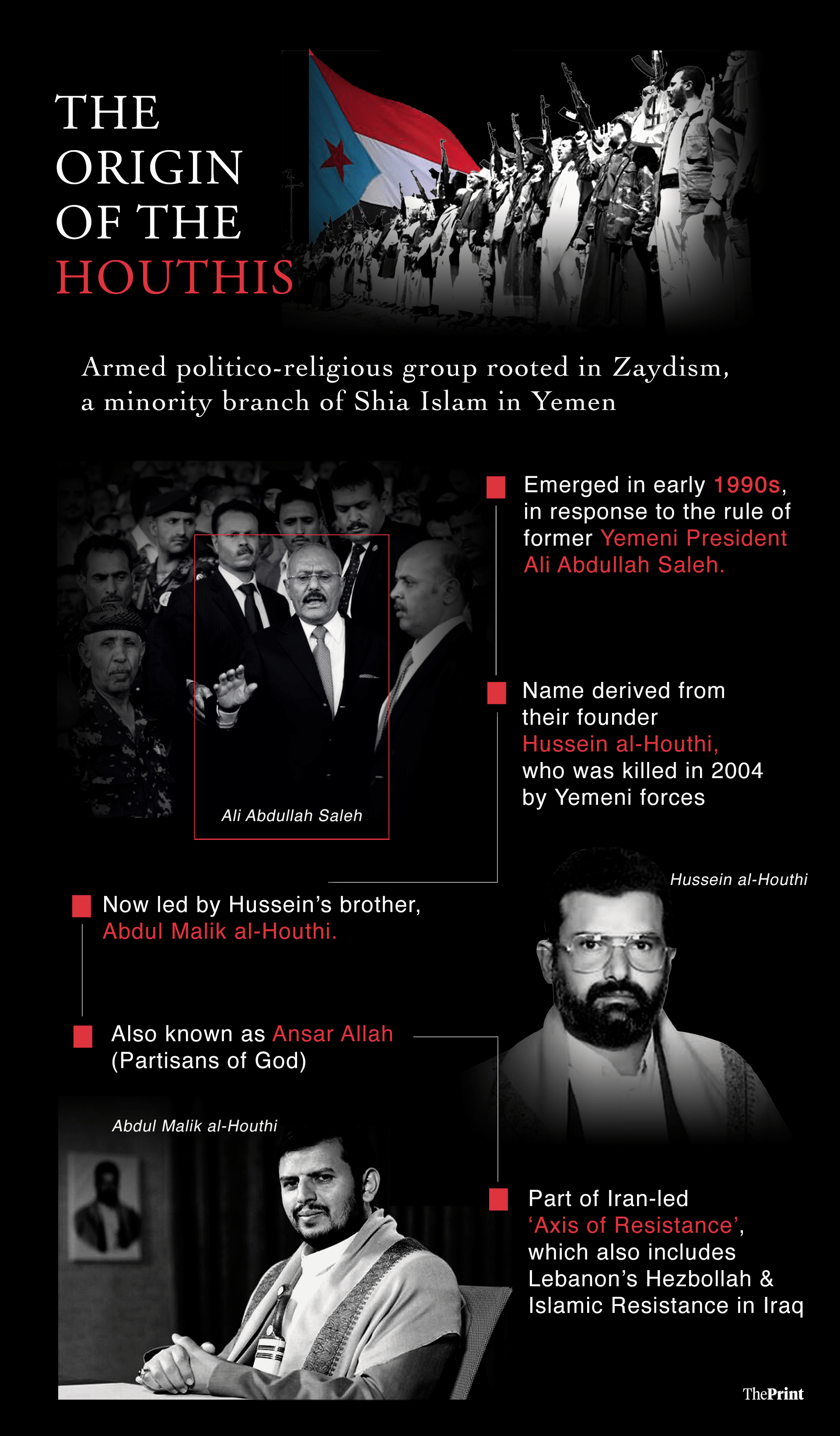
With a stronghold in northern Yemen, the Houthis are an armed politico-religious group rooted in Zaydism, a branch of Shia Islam almost exclusively found in Yemen. Zaidis and Shias are lesser in numbers, compared to the Sunnis in Yemen, and the Zaidis themselves are a minority within the larger Shia school of thought.
Zaydism or Zaydiyyah get their name from Zayd ibn Ali—the great grandson of Ali, Prophet Muhammad’s cousin and son-in-law, revered by all Shiites.
The Houthis emerged in the early 1990s, in response to the rule of former Yemeni President Ali Abdullah Saleh. They derive their name from the group’s founder Hussein al-Houthi, who was killed in 2004 by Yemeni forces. The group is now led by Hussein’s brother, Abdul Malik al-Houthi.
When the 2011 Arab Spring—a wave of pro-democracy uprisings across the Middle East and North Africa—came to Yemen, Saleh was forced to step down as president in 2012. He was replaced by his vice-president Abdrabbuh Mansour Hadi. Then, in a dramatic turn of events, Saleh and his loyalists joined hands with the Houthis against Hadi. By 2014, the Houthis had taken over Yemen’s capital Sanaa. But in December 2017, they killed Saleh for breaking his allegiance and offering an olive branch to the Saudis.
The Houthis are otherwise known as Ansar Allah (Partisans of God), and are a part of the Iran-led ‘Axis of Resistance’, which also includes Lebanon’s Hezbollah and the Islamic Resistance in Iraq.
Though they receive much of their supplies from Iran, assisted by Islamic Revolutionary Guard Corps (IRGC) commanders and Tehran’s military advisers, the Houthis retain a degree of independence.
Also Read: Asim Munir has plucked the last thorn from Pakistan’s democratic rose
The attacks on Saudi Arabia
The Houthis are attacking Saudi Arabia because the latter supports government forces in Yemen that they seek to overthrow. It is essentially a war among the Yemenis, in which the Saudis have chosen a side—and are paying the price.
When the Houthis seized Sanaa in 2014 and drove the internationally recognised government (IRG) south towards the port city of Aden, Saudi Arabia—fearful of growing Iranian influence in Yemen and along its borders—launched a military intervention against the group in 2015. The civil war that ensued made Yemen a site to one of the most severe humanitarian crises in the world.
In April 2022, a UN-brokered ceasefire between the Houthis and Saudi-backed IRG came into effect.
Though the Houthis targeted Israel and shipping through the Red Sea after the Israel-Hamas war in Gaza erupted in October 2023, the truce had held between them and the Saudi kingdom. In fact, when the United States launched Operation Prosperity Guardian in December 2023 to protect commercial vessels in the Red Sea from Houthi attacks, Saudi Arabia did not join this coalition.
Even when the US and Israel launched their war on Iran at the end of February this year, Riyadh initially appeared likely to escape the worst of it, as Tehran inflicted the heaviest damage on the United Arab Emirates, Qatar, Bahrain and Kuwait.
However, in July, the Houthis imposed a maritime embargo on Saudi Arabia. The group said this was in retaliation against the Saudi siege on Yemen, particularly Houthi-controlled areas, as well for its attack on Sanaa airport. They insisted that they pose no threat to international shipping, but only Saudi-flagged vessels.
The Houthis have since continued their escalatory campaign that has not shown signs of petering out. Analysts say these attacks are intended to raise financial, geopolitical and reputational costs for Saudis.
Saudi crown prince Mohammed Bin Salman Al Saud has been trying to extract the kingdom from the Yemen conflict as his Vision 2030 economic diversification plan depends on regional stability to attract Western capital.
Multiple airlines have now cancelled flights to the kingdom.
As recently as 15 October, the Houthis targeted the presidential palace complex in south Yemen, the Al-Maashiq palace, which is the seat of Yemen’s Saudi-backed IRG in Aden.
The Houthis’ weapons
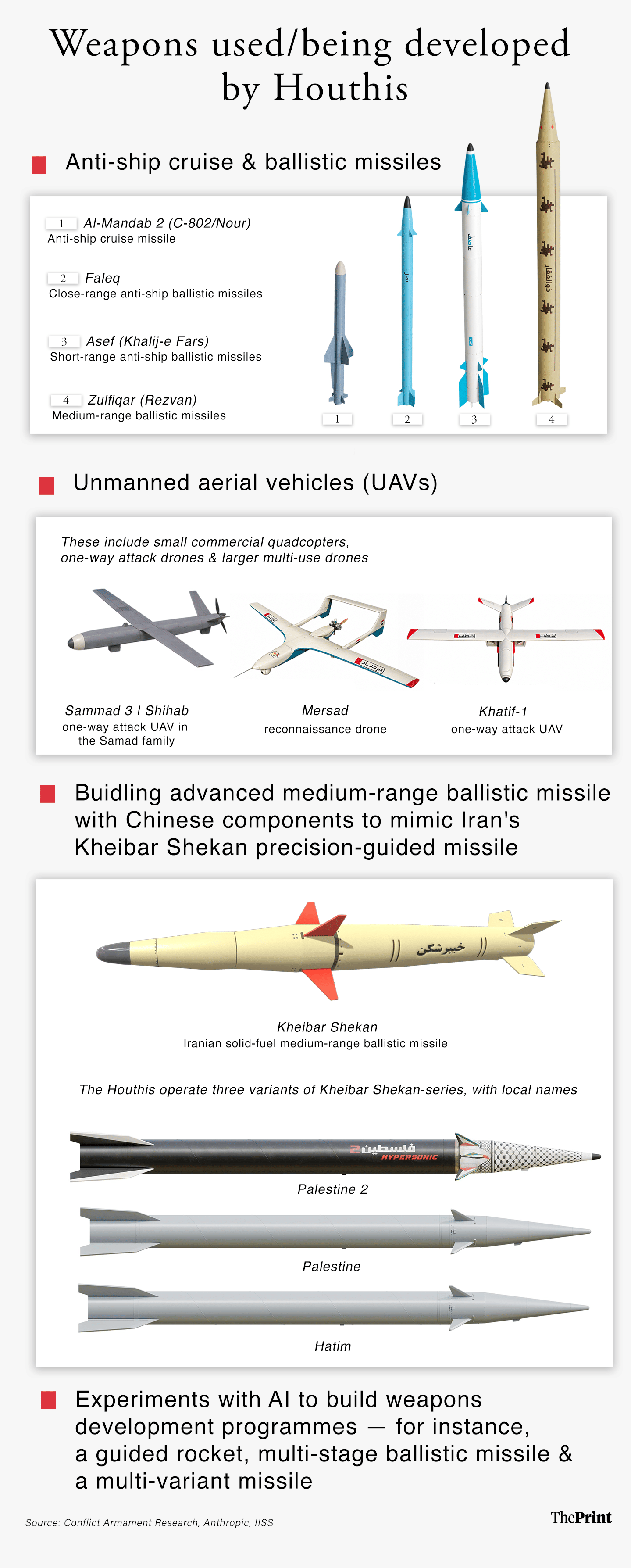
Since seizing Sanaa, the Houthis have built up a wide array of arsenal, including anti-ship cruise and ballistic missiles and drones.
According to a new Conflict Armament Research (CAR) report released this month, The Wall Street Journal reported, the group is attempting to build medium-range ballistic missiles. This, they are doing, by using Chinese-delivered components to mimic one of Iran’s most potent weapons—the Kheibar Shekan precision-guided missile. If successful, the Houthi missile would have a range up to about 1,200 miles, meaning all of Saudi Arabia and Israel would be within its reach.
The CAR report, also seen by ThePrint, says the Houthis operate all three variants of the Kheibar Shekan-series, with their own local labels. For instance, the first is called ‘Hatim’ by the Houthis, and the second one is ‘Palestine’. The third one, which Iran calls ‘Fattah-1’, is labelled as ‘Palestine-2’.
The Houthis are under a UN Security Council arms embargo, and CAR findings suggest its supply chains now extend beyond Iran-linked networks.
In another report of their Diversion Digest issue in July this year—reviewed by ThePrint—CAR categorised the evolution of unmanned aerial vehicles (UAVs) that the Houthis have into four phases, each stage reflecting the group’s changing complex objectives. In 2015, they were using small commercial quadcopters with a range of up to 10 km. In 2016, they had first-generation one-way attack UAVs of up to 200 km, and by 2018, this advanced to 1,500 km. By 2022, the group was using larger and multi-use UAVs with a range of up to 2,500 km.
The same report looked at Houthis’ attempt to use hydrogen fuel cells to extend the range of their UAVs, spotlighting the speed with which non-state armed groups are seeking to integrate commercial capabilities into locally produced or modified systems.
Now, the Houthis have also turned to artificial intelligence. In a September report titled ‘Detecting and countering misuse of AI’, Anthropic detailed how it disrupted attempts by multiple threat actors, that it calls Generative Threat Groups (GTG), using its model Claude for malicious activity.
Anthropic said that a cell designated as GTG-87001, based in northern Yemen—the Houthis’ stronghold—sought to use Claude to build three weapons development programmes. One was for a guided rocket, the second for a multi-stage ballistic missile with a stated range goal above 2,000 km, while the third was for a multi-variant missile (referred to as the “R2000” set) that included a hypersonic glide vehicle variant.
“The actors used Claude Code in place of human software engineers to develop the guidance, navigation, and control (GNC) software that steers and stabilises a flying vehicle”, added the report. Anthropic further said that it does not have evidence if they succeeded in fielding an operational device, but that they did unsuccessfully test-fire a guided rocket, after which the actors returned to Claude to work out why it failed.
Undefeated
Several States, over the years, have fought the Houthis, but more prominently, Saudi Arabia, the US and UK, and Israel. The Yemen Data Project, a not-for-profit that collects and disseminates data on the Yemen war, especially air strikes against Houthis, shows that none of the campaigns since 2015 have been able to defeat the group.
Between March 2015 and April 2022, roughly across seven years, 25,054 air raids were conducted on the Houthis by the Saudi-UAE-led coalition under Operation Decisive Storm and Operation Restoring Hope. This coalition was backed by several Gulf countries as well by the US and UK. Notably, two of Saudi’s allies refused to join this coalition: Oman and Pakistan.
After a lull of nearly two years, the next phase of strikes against the group came from the US on 12 January, 2024, in response to Houthi attacks on commercial vessels in the Red Sea and Gulf of Aden. The UK was the main partner of the US in this operation. Australia, Bahrain, Canada, Denmark, the Netherlands and New Zealand were named as additional supporting nations under the banner of Operation Poseidon Archer, which came to a close with the end of the Biden administration.
Then, in March 2025, almost two months into his second term, US President Donald Trump broke the de-facto ceasefire in Yemen, launching Operation Rough Rider, which ended in May that year with Trump announcing a ceasefire. The US carried out 339 strikes in 53 days—from 15 March to 6 May—surpassing the number of strikes in the year-long US-UK Operation Poseidon Archer under Biden.
Israel, on the other hand, had conducted its first air strikes on the group in July 2024, when the Israel Defence Forces (IDF) launched Operation Long Arm. Israeli air raids continued intermittently through 2025.
In the latest round of fighting, however, Saudi Arabia appears to be practically alone without direct Western military support, and aid from any of its partners under the Mecca Pact—Pakistan and Turkey. Earlier this month, the Mecca Pact members held an emergency meeting and decided to “activate collective deterrence measures” in response to Houthi attacks. Pakistan even confirmed it has troops deployed in Saudi Arabia, but none of these efforts have resulted in Turkey and Pakistan directly engaging with the Houthis on the Saudi kingdom’s behalf.
The kingdom’s air defences have shown gaps, with reports of its early warning systems going silent as attacks mounted. This is despite having one of the world’s most sophisticated arsenals, built mainly on American systems. Saudi Arabia is the world’s top purchaser of US weapons.
According to a report by The New York Times, Saudi defences were designed against potential threats from the east or northeast, that is from Iran or Iraq, but not from Yemen to the southwest. The asymmetric warfare waged by the Houthis compounds the problem.
(Edited by Mannat Chugh)
Also Read: Why the Pakistani province of Khyber Pakhtunkhwa has defiance baked into its politics