



New Delhi: Iran secretly acquired a Chinese-built satellite to monitor and eventually target US military bases and allied infrastructure in the Persian Gulf. According to a report by Financial Times, the IRGC Aerospace Force, which maintains and operates Iran’s arsenal of missiles and drones, received the Chinese-built satellite, TEE-01B, in late 2024.
It gave Iran access to high-resolution imagery, which it relied on to monitor and eventually strike US bases and allied infrastructure in Gulf Cooperation Council (GCC) member-states during the active conflict.
The revelation comes against the backdrop of Washington—though it did not name China—threatening to impose punitive sanctions against any country that supplies weapons to Iran. On Wednesday, US President Donald Trump said China had agreed not to sell any weapons to Iran and that Chinese President Xi Jinping would give him a ‘bit, fat hug’ when the two meet in Beijing next month.
Documents seen by FT further revealed that the satellite Iran acquired was built and launched by Earth Eye Co, a Chinese firm which offers “in-orbit delivery”. Under this model, spacecraft launched from China are transferred to overseas clients after reaching orbit.
Under the terms agreed upon by both parties, IRGC was granted access to commercial ground stations operated by Emposat, a Beijing-based satellite control and data service provider.
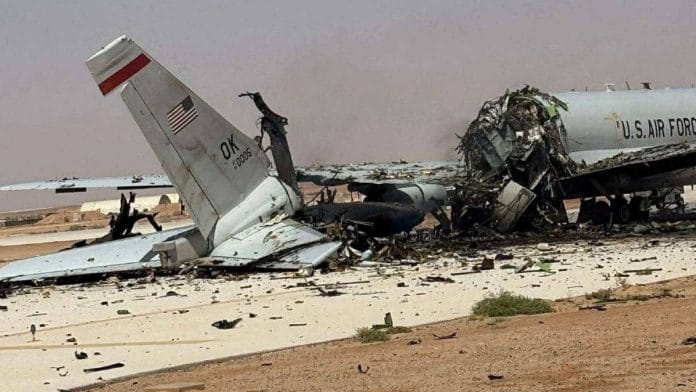
According to the FT report, Tehran used the satellite (TEE-01B) to track US-operated Prince Sultan Air Base in Saudi Arabia from 13-15 March, nearly a fortnight after US and Israel launched the first wave of strikes inside Iran on 28 February. On 14 March, Iranian missiles struck the Prince Sultan Air Base, damaging five US Air Force refueling planes.
The White House spokesperson, while side-stepping the question about Iran acquiring the Chinese-built satellite, pointed out that US President Donald Trump has warned China of “big problems” if it continues to provide air defense systems to Tehran.
For its part, when asked about the satellite, the Chinese embassy in Washington told FT: “We firmly oppose relevant parties spreading speculative and insinuating disinformation against China.” Liu Pengyu, the embassy spokesperson, said, “We uphold an objective and impartial stance, and have made efforts to promote peace talks. We never engage in actions that escalate conflicts.”
According to the report, IRGC also used the satellite to surveil the Muwaffaq Salti Air Base in Jordan, the US Fifth Fleet naval base in Bahrain, and Erbil International Airport in Iraq. All three facilities were targeted by Iran during the ongoing conflict.
Other sites that were surveilled include Camp Buehring and the Ali Al Salem Air Base in Kuwait, the US military base at Camp Lemonnier in Djibouti, and Duqm International Airport in Oman. Civilian sites surveilled include the Khor Fakkan container port, and Qidfa power and desalination plant in the UAE, and the Alba aluminum smelter in Bahrain.
The TEE-01B, which is capable of capturing imagery at “roughly half-metre resolution”, detailing specific aircraft, vehicle movements, and minute changes to infrastructure, is a leap for Tehran’s surveillance capacities. Previously, IRGC used the Noor-3 satellite, which offered a resolution of approximately 5 metres.
Nicole Grajewski, an Iranian expert at Sciences Po University, told FT, “This satellite (TEE-01B) is clearly being used for military purposes, as it is being run by the IRGC’s Aerospace Force and not Iran’s civilian space programme.”
While emphasising the agreement between the Chinese firm and IRGC, Jim Lamson, a former CIA analyst and senior research associate at the James Martin Center for Nonproliferation Studies, told the publication, “Iran’s satellite ground stations, which were hit in 2025 and 2026, can be hit very easily by missiles from a thousand miles away. You can’t just hit a Chinese ground station located in another country.”
The documents seen by FT show that the IRGC Aerospace Force paid 250 million Yuan, approximately $36.6 million, to Beijing in September 2024 as part of the deal. This covered the cost of the satellite, software, ground network, and ongoing technical support.
While Earth Eye Co and Emposat operate as commercial entities, both appear to have ties with the Chinese government. Richard Zhao, founder of Emposat, worked at the state-run China Academy of Space Technology for 15 years, according to FT. The report added that several executives of Earth Eye, too, have links with the Chinese armed forces.
Aidan Powers-Riggs, an expert at the CSIS think-tank, told FT, “It (Emposat) was founded by veterans of China’s state-run space programme and bankrolled by investment from national military-civil fusion funds.”
(Edited by Amrtansh Arora)
Also Read: US blockade to choke Iran’s economic lifelines—its ports. From Kharg to Chabahar