



By Andrea Shalal
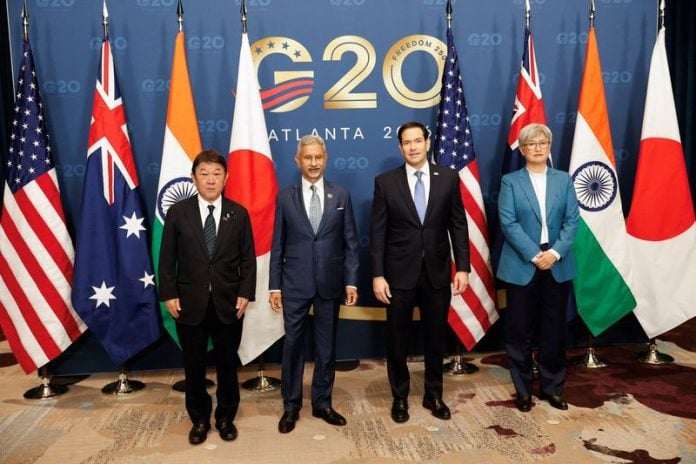
ATLANTA, Oct 31 (Reuters) – Foreign ministers from the US, Australia, India and Japan on Saturday pledged to work on building reliable global supply chains and expressed grave concerns about what they called “economic coercion” through export restrictions and non-market practices, but stopped short of calling out China.
The joint statement by the foreign ministers of the Indo-Pacific “Quad” came at a time when Japan has been extremely critical of Beijing over its restrictions on critical mineral exports, and the US has been assembling a coalition aimed at uniting G20 countries concerned about China’s dominance in rare earths and other critical minerals.
The meeting was held shortly before US Secretary of State Marco Rubio hosted the final session of a meeting in Atlanta of foreign ministers from the broader Group of 20 major economies, which includes China.
The Quad ministers reiterated their support for a free and open Indo-Pacific, underscoring the importance of economic security in maintaining global stability and prosperity, including through reliable and open global supply chains.
“They expressed grave concerns regarding economic coercion, including through arbitrary export restrictions, as well as non-market policies and practices that result in overcapacity to disrupt global supply chains in critical industries,” the joint statement said.
The ministers also emphasized the “absolute necessity to protect and preserve navigational rights and freedoms in the Strait of Hormuz, the Red Sea, and the Bab el-Mandeb Strait,” the statement said.
The group pledged more than $85 million in assistance to support trusted artificial intelligence technologies across the Indo-Pacific region and said it would launch a new effort to identify vulnerabilities in semiconductor and related supply chains before they cause disruptions.
It was the third meeting of the Quad foreign ministers this year, with plans taking shape for US President Donald Trump to attend his first formal meeting of the leaders of the four countries next month in Manila during a conference of the Association of Southeast Asian Nations.
Rubio told reporters that a Quad leaders meeting in Manila would “hopefully” be announced very soon, but gave no further details.
He said the Quad was not “an anti-China or anti-anybody coalition,” adding that the joint statement was raising concerns about behaviors and activities that he said were “coming repetitively from one country.”
He said the US had invested a lot of time in the Quad group and wanted to continue to build on its work on specific projects and initiatives, including a $20 million project in Palau aimed at improving its digital infrastructure.
Rubio said the four countries had already made substantial progress in ensuring they could pool resources in the event of a humanitarian crisis or national disaster, and also planned to set up a business forum so that businesses in all four nations could find new opportunities to work together.
(Reporting by Andrea Shalal; Editing by Tom Hogue, Paul Simao and Franklin Paul)
Disclaimer: This report is auto generated from the Reuters news service. ThePrint holds no responsibility for its content.