



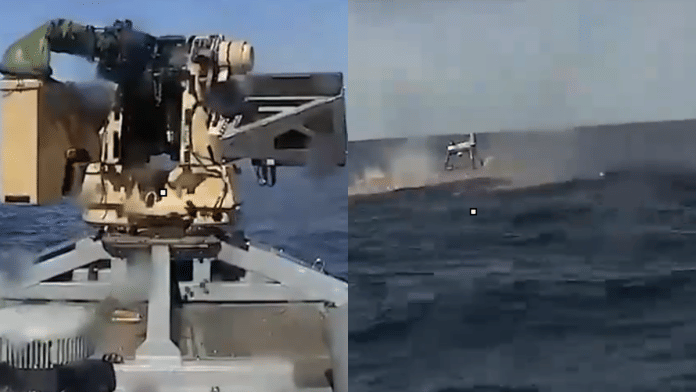

New Delhi: In what is being called the world’s first naval drone engagement, a Ukrainian uncrewed surface vessel (USV) destroyed a Russian uncrewed vessel in the Black Sea on Saturday.
The Ukrainian Navy described the encounter as “the first naval battle in history between uncrewed surface vessels”. The duel is believed to have taken place in the northwestern Black Sea, between Odessa and Crimea.
The Ukrainian vessel was a Sargan-3000 USV, also known as Seawolf, equipped with a remotely operated Protector weapon station carrying a 12.7 mm machine gun turret.
The system was developed by Ukrainian defence company Nordex, while the Protector turret is produced by Norwegian defence firm Kongsberg.
Ukraine identified the destroyed Russian vessel as an improved Orcan-type USV, also known as Zefir. The Russian government has not publicly commented on the incident yet.
Ukraine’s military intelligence service, the GUR (acronym for the Main Directorate of Intelligence of Ukraine’s Ministry of Defense.), said it detected the Russian vessel and then the Ukrainian USV was sent to engage it.
The Sargan-3000 had previously attracted attention in July after Ukraine said it was used to sink the Russian FSB patrol ship Izumrud near Novorossiysk. The vessel has a range of nearly 1,600 km, a payload capacity of up to 450 kg and a top speed of around 50 knots. Ukraine is also estimated to be capable of producing around 25 of the USVs a month.
According to Naval News, Russia has used USVs alongside long-range aerial drones equipped with cameras and communications systems to attack Ukrainian ports and naval targets like the thwarted attack on 23 June 2026.
The aerial drones can reportedly act as communication relays, extending the operating range of the USVs.These Russian USVs are being kept in Chornomors’ke (northwestern Crimea) and a special base on Lake Donuzlav built in February 2026, according to OSINT data.
As USVs on both sides become more capable of attacking conventional naval assets, they are also increasingly likely to become targets themselves. The loss of one Russian USV may be limited in material terms, but repeated drone-on-drone engagements could force both sides to rethink their maritime strategies, increase production and develop dedicated capabilities to detect and destroy enemy USVs.
Ashwin Shekhar is a TPSJ alum, currently interning with ThePrint.
(Edited by Ajeet Tiwari)
Also read: Putin ready to talk to Ukraine but rejects halting long-range strikes