





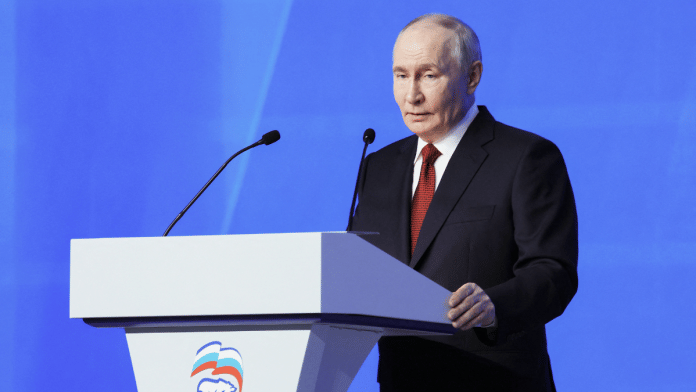


Russian President Vladimir Putin said he’s ready to continue talks with US envoys on ending the war in Ukraine, while rejecting a proposal to halt long-range strikes that have proven damaging for both sides.
The Kremlin expects US negotiators Steve Witkoff and Jared Kushner to travel to Moscow to continue talks on ending the war in Ukraine once Washington is less focused on the conflict with Iran, Putin said in an interview with state television shown late Sunday.
“We’re ready to continue negotiations and discussion of the details and modalities — if not agreements, then at least the topics discussed in Anchorage,” he said, referring to talks with US President Donald Trump last August in Alaska. Putin also said there were continued contacts between Kyiv and Moscow, without elaborating further, and that he declined proposals to mutually halt strikes deep inside Russia and Ukraine and to confine fighting to just the four occupied Ukrainian regions.
“Our retaliatory strikes deep into Ukrainian territory are much more powerful, sensitive and, frankly, destructive, leading to truly serious consequences” for Kyiv, Putin said, without naming the source of the proposals. The Russian leader said he rejected the idea to limit the geographic area of combat as it would let Ukrainian forces redeploy troops from other sections of the front.
Putin’s refusal to agree to even a limited halt to long-range strikes underscores that Moscow remains unwilling to trade away tools that keep pressure on Ukraine, even if such a deal would blunt Kyiv’s growing ability to impose costs inside Russia. The Russian leader’s stance also cast doubt on what renewed talks with the US envoys can accomplish, as the Kremlin continues to press maxamilist demands for ending the war, now well into its fifth year, that include Ukraine ceding territory Russian forces don’t control.
The White House didn’t respond to a request for comment. A representative of the Ukrainian presidential administration also didn’t immediately respond to questions.
Kyiv has stepped up attacks on Russian energy infrastructure and military targets this year, seeking to turn the tide against Russia’s invasion. Ukraine has since intensified strikes on refineries, slowing processing and causing fuel shortages in Moscow and other regions. Average gasoline prices in Russia rose 3% in the week from June 16-22, according to official data, the biggest jump increase in at least 20 years.
Ukraine on Saturday said it used Flamingo missiles to attack a military plant in the Russian city of Volgograd. The missiles are a recent addition to Ukraine’s arsenal, with a range of 3,000 kilometers (about 1,860 miles), making it an alternative to the drones Kyiv deploys for most long-range attacks on Russia. The city of Volgograd is located some 460 km from the border with Ukraine.
On Sunday, Ukrainian President Volodymyr Zelenskyy said his forces attacked oil refineries in Russia’s Krasnodar and Yaroslavl regions, while last week, an attack on an industrial plant in the Voronezh region killed five people and injured dozens. Kyiv’s strikes have also disrupted logistics and supply routes to the annexed Crimean peninsula, plunging the region into crisis and forcing officials to resort to emergency measures.
The costs from the strikes are increasingly impacting ordinary Russians, who face elevated borrowing costs and a worsening gasoline crunch. Central bank Governor Elvira Nabiullina cited the fuel-market issues as part of the reason she saw little room for more interest-rate cuts.
About 75% of Russia’s regions now have some form of fuel rationing or supply disruptions after authorities in several regions imposed restrictions on drivers.
Russia has also continued to hit Ukraine with drone and missile attacks on a near daily basis, often with deadly results.
Ukrainian strikes on Russian facilities do not affect the situation at the front, Putin said, pledging to produce more air defense to protect Russia’s energy infrastructure.
“We do have the necessary defense systems,” he said. “The question is how quickly we can increase production and deliver them to the troops or to protect critical infrastructure.”
This report is auto generated from the Bloomberg news service. ThePrint holds no responsibility for its content.