







Oman has been thrust to the forefront of global geopolitics by the Iran war and closure of the Strait of Hormuz.
The Arab sultanate — a sparsely populated desert country with substantial oil and natural gas reserves — borders the southern part of the narrow choke point, one of the world’s most important energy trade routes.
As the US and Iran try to negotiate a permanent peace deal, the future of the strait is a key sticking point. Oman, which has established a reputation for neutrality, has found itself under pressure from both sides: Iran wants it to agree to a system to jointly manage traffic and charge fees for certain maritime services, while the US, as well as many countries in Europe and Asia, insist that pre-war freedom of navigation must be restored and ships be allowed to pass without any mandatory charges.
What is Oman’s approach to foreign policy?
Oman, which borders Saudi Arabia, the United Arab Emirates and Yemen, has long practiced “active neutrality,” engaging with regional players while avoiding aligning with any camp.
The approach partly stems from Oman being the only nation where most of the population is Ibadi, a branch of Islam that’s neither Sunni nor Shia. Some analysts say this helps Oman maintain the trust of both Iran, a majority Shia country, and Sunni states such as Saudi Arabia and the UAE.
Oman has been dubbed the “Switzerland of the Middle East” for its neutrality and frequent mediation between warring countries. It’s one of the most experienced conflict mediators in the region, along with Qatar and the UAE.
It hosted secret talks between the US and Iran that set the stage for the 2015 nuclear deal — an accord that President Donald Trump pulled out of three years later during his first term in office. Oman was also the main interlocutor as the two countries renewed their dialogue in the weeks leading up to the current war.
Oman facilitated some rounds of discussions that led to a rapprochement between Iran and Saudi Arabia in 2023. And last year it helped broker a ceasefire between the Houthis in Yemen, who had been attacking ships in the Red Sea, and the US, which had engaged in a bombing campaign against the militant group.
What is Oman’s position on the Iran war?
Alongside the other five members of the Gulf Cooperation Council — Bahrain, Kuwait, Qatar, Saudi Arabia and the UAE — Oman urged the US not to start a conflict with Iran. They feared the consequences would reverberate across the region and were vindicated when the Islamic Republic retaliated against US and Israeli airstrikes by firing thousands of drones and missiles at its Arab neighbors.
Oman went a step further than the rest of the GCC by publicly criticizing Trump’s decision to go to war, calling the move “unlawful.” It said that the talks it was mediating — focused on getting Iran to curb its nuclear program for a decade or more — were making progress. Oman described Iran’s counterstrikes as “inevitable, if deeply regrettable and completely unacceptable.”
How has Oman fared during the war?
It suffered less from Iranian attacks than other GCC members. Unlike the rest of the Gulf Arab states, the US doesn’t have troops or bases permanently in Oman. The two countries do cooperate militarily — under defense agreements going back decades, American forces can access Omani facilities for some operations.
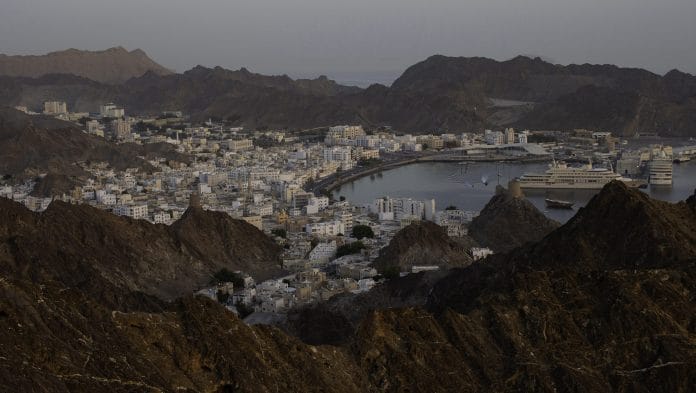
Oman’s capital Muscat, home to around 1.7 million of the sultanate’s 5.7 million people, was spared by Iranian strikes, although at least one ship was targeted off its coast. Ports elsewhere in the country, including Duqm and Salalah, were hit by projectiles.
Oman has been able to maintain its oil exports since the start of the conflict as it has ports outside the Strait of Hormuz. Its revenue from crude sales surged as the war drove up energy prices. Amid the relatively contained economic disruption, Oman’s stock market has been one of the world’s best performers this year, as of early July. Its gross domestic product is set to grow the fastest of any Gulf state in 2026, according to the International Monetary Fund.
How was Oman involved in the Strait of Hormuz before the war?
The Strait of Hormuz connects the Persian Gulf to the Arabian Sea and wider Indian Ocean. It’s around 100 miles (161 kilometers) long and just 24 miles wide at its narrowest point. Most of the strait lies in the territorial waters of Iran and Oman, whose exclave of Musandam touches the southern part of the waterway.
Prior to the war, neither state impeded transits through Hormuz or levied charges for passage, in line with the United Nations Convention on the Law of the Sea (UNCLOS) — an international treaty that both countries signed but Iran never ratified.
A traffic separation scheme was proposed by Iran and Oman and adopted by the UN’s International Maritime Organization in 1968. This designated two shipping lanes in the middle of the strait — one for entry and one for exit — to avoid collisions.
How does Oman fit into efforts to resolve the future of Hormuz?
The Iran war has led to the creation of two new routes through the waterway: one that hugs the Iranian coast and is controlled by Tehran, and another that veers closer to Oman and the US is helping to coordinate. As Iran asserts control over traffic, it has sporadically attacked ships in and around Hormuz, and more recently those transiting the Omani route. It’s also believed to have mined the traditional shipping lanes to encourage vessels to use its designated path.
Iran’s position is that the strait cannot return to the pre-war status quo. It established the Persian Gulf Strait Authority in May and said that vessels need permission from this body to cross the waterway and must use its northern corridor. A mandatory insurance policy is also required. While this is currently free, the PGSA has signaled that this could change in the future.
Iran wants to create a system to jointly manage Hormuz with Oman and, where necessary, charge ships. The messaging from Oman has been more mixed, although it has maintained that it will abide by international maritime law. Under UNCLOS, ships can’t be charged merely for passage through territorial waters, but they can be charged for “specific services rendered.”
A joint statement published by Iran and Oman on June 23 said the two countries would seek to reach an agreement on the future administration of navigation through Hormuz, including the costs associated with these services. But two days later, Oman signed a statement with the US and GCC that, according to Washington, “rejected any tolls, fees, or attempts to assert control over the Strait.”
For now, the US remains vehemently opposed to any kind of control of the strait by Iran or Oman. Treasury Secretary Scott Bessent said the US would punish any actor that facilitated tolls.
What type of Hormuz charges might Oman be considering?
In private, Omani officials have told European counterparts that transiting ships may have to pay some fees, perhaps in relation to de-mining or navigation assistance, according to people familiar with the matter. It’s unclear if Oman thinks those charges would be voluntary or mandatory.
Oman is studying the Strait of Malacca in Asia as a potential model, one of the people said — a sign that it’s trying to find a solution that appeases Iran and the rest of the world. The Malacca strait is loosely managed between Indonesia, Malaysia and Singapore. They receive voluntary financial contributions via a fund so that they can maintain navigation aids such as buoys, beacons and lighthouses. Details of these contributions aren’t regularly released but in 2017, Singapore disclosed that $22 million had been raised over a 10-year period, equating to roughly $2.2 million per year.
This report is auto generated from the Bloomberg news service. ThePrint holds no responsibility for its content.